Quality
Kanban: When Your Organization Stops Hiding Work in Progress and Starts
Making Quality Flow Visible
The Board Nobody Wanted to
Build
There’s a moment in every quality manager’s career when they realize
something uncomfortable: they have no idea how many quality problems are
actually in progress right now. Not how many were reported last month.
Not how many appear in the weekly KPI dashboard. But how many open CAPA
records, unresolved customer complaints, pending deviations, stalled
improvement projects, and half-completed audits are sitting in various
inboxes, shared drives, and email threads scattered across the
organization like landmines in a field nobody walks through anymore.
The quality system doesn’t lack data. It lacks visibility.
And then someone — usually a new hire from a lean manufacturing
background or a consultant who asks an unforgivable question like “Can
you show me all your open quality issues in one place?” — introduces
Kanban. Not the software development version with its swimlanes and WIP
limits and sprint ceremonies. The original version. The one that came
from a Toyota factory floor where a piece of cardboard and some Post-it
notes did what a million-dollar QMS database couldn’t: make the work
visible.
This is the story of what happens when an organization takes its
hidden quality work and puts it on a wall. And how that simple act of
visibility changes everything.
The Problem With Invisible
Work
Quality work has a peculiar characteristic that distinguishes it from
production work: you can’t see it accumulate.
When parts pile up at a workstation, everyone notices. The conveyor
backs up. The forklift has nowhere to put the pallet. The shift
supervisor starts pacing. The physical world provides its own signal
system, and that signal triggers action. But when quality issues pile
up, nothing visible happens. Customer complaints sit in an email folder.
CAPA investigations stall waiting for root cause data. Corrective
actions get assigned to people who already have full-time jobs doing
something else. Deviations get logged in a database that generates
reports nobody reads.
The work becomes invisible. And invisible work, as any lean
practitioner will tell you, is the most dangerous kind — because you
can’t manage what you can’t see.
I worked with a medical device manufacturer that had 347 open CAPAs
spread across three different electronic systems. The quality director
knew the number because she ran a report every Monday morning. What she
didn’t know was that 23 of those CAPAs had been open for over two years,
that 41 were waiting on the same engineering resource who had been
reassigned to a product launch, and that 12 had been effectively
abandoned by their owners without ever being formally closed. The
database said 347. The reality was chaos wearing a compliance hat.
The organization wasn’t incompetent. It was overwhelmed by work it
couldn’t see.
What Kanban Actually Does
to Quality
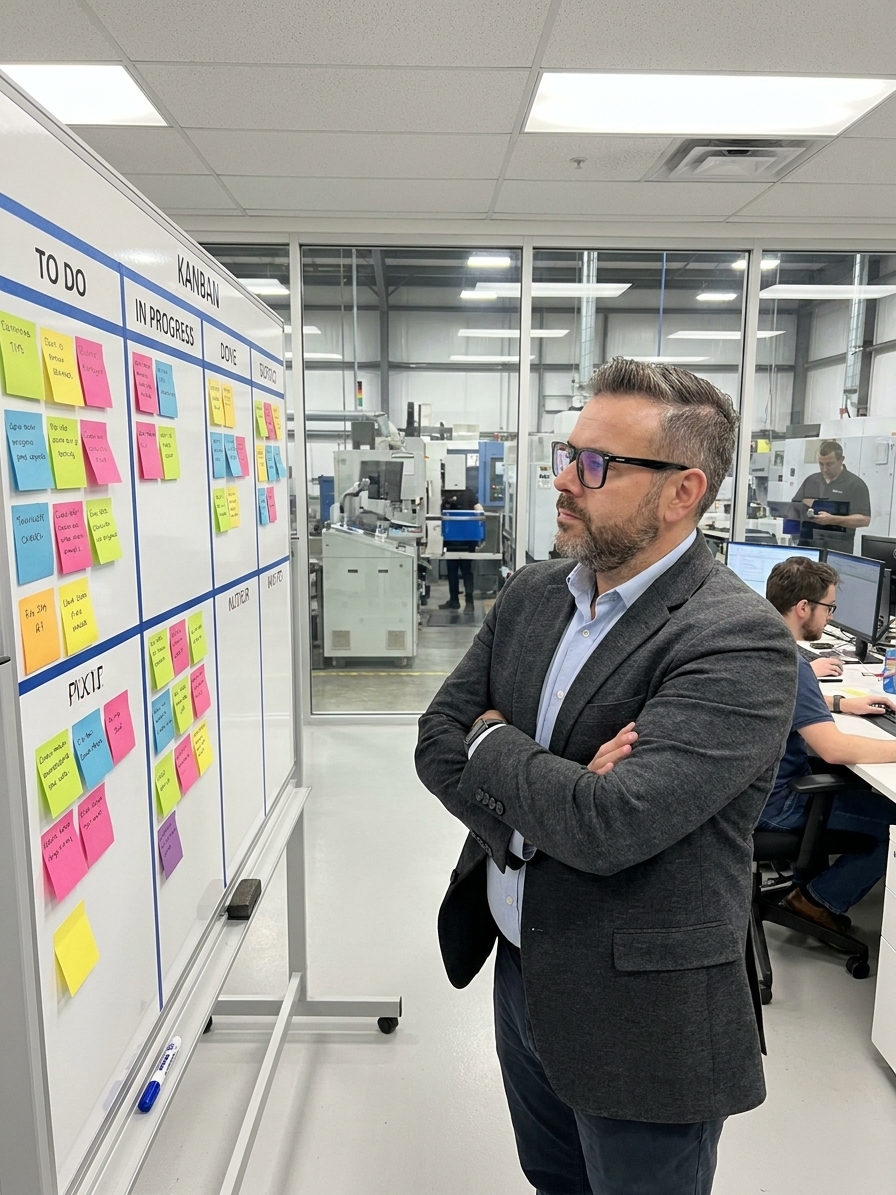
Kanban, in its simplest form, is a visual system for managing flow.
The word means “signal card” in Japanese, and its power lies not in
complexity but in the opposite. A Kanban board answers three questions
that every quality organization struggles with simultaneously:
What are we working on right now? Not what’s in the
database. Not what was reported in last week’s meeting. What are actual
human beings spending actual hours on today? When you force this
question into a physical space — a wall, a board, a screen that everyone
can see — the answers become uncomfortable fast. Because the board
doesn’t lie. If your team of five quality engineers has 23 cards in the
“In Progress” column, the math speaks for itself: either they’re not
sleeping, or most of that work isn’t actually in progress. It’s waiting.
Stalled. Abandoned in spirit if not in documentation.
What’s waiting to be worked on? The backlog. The
queue. The list of things that someone decided was important enough to
write down but not important enough to resource. In quality, the backlog
is where urgent goes to become chronic. The customer complaint that
arrived with heat and urgency three weeks ago sits behind 14 other
complaints that arrived with equal heat and urgency. The board makes
this accumulation visible, and visibility creates the pressure to
prioritize that invisibility never will.
What’s done? Not “what’s been closed in the system.”
What’s actually, demonstrably, verifiably complete? The “Done” column on
a quality Kanban board is one of the most powerful accountability tools
I’ve ever seen, because it separates the appearance of progress from the
reality of it. A CAPA that’s been “90% complete” for six months is not
done. A corrective action that’s been implemented but never verified is
not done. An audit finding that’s been addressed with a procedure update
but never audited for effectiveness is not done. The board demands
honesty.
The Column That
Changes Everything: Blocked
Here’s where quality Kanban diverges from production Kanban in a way
that catches people off guard. In production, the work is relatively
self-contained. A part moves from station to station, and the
constraints are physical — machine capacity, tooling availability,
material supply. In quality, the work is almost never self-contained.
Every investigation depends on data from somewhere else. Every
corrective action requires buy-in from someone in another department.
Every effectiveness check needs production time that production doesn’t
want to give.
This is why the most important column on a quality Kanban board isn’t
“In Progress.” It’s “Blocked.”
The Blocked column is where cards go when the person working on them
has done everything they can and is now waiting on something outside
their control. The engineering data that hasn’t arrived. The manager
approval that’s been sitting on someone’s desk for two weeks. The
production line time that’s been promised but never scheduled. The
training that needs to happen before the corrective action can be
implemented.
When you start moving cards to “Blocked,” patterns emerge that no
report will ever show you. You discover that 60% of your stalled CAPAs
are waiting on the same department. That three-quarters of your overdue
customer complaints are blocked by the same approval process. That the
bottleneck in your quality system isn’t the quality department at all —
it’s a management review process that was designed for a company a third
of your current size.
I saw this play out at an automotive Tier 1 supplier where the
Blocked column revealed that 78% of open corrective actions were waiting
for a single signature: the plant manager’s. Not because the plant
manager was negligent, but because the approval process required him to
review each one individually, and his calendar was booked solid with
production meetings. The quality team had been blaming themselves for
six months. The board showed them the real problem in six minutes.
WIP Limits: The Quality
Heresy
The most controversial moment in implementing Kanban for quality work
is always the same: when someone suggests a WIP limit.
Work In Progress limits are a core Kanban concept. The idea is simple
— you set a maximum number of items that can be in any column at any
time, and when the limit is reached, the team has to finish something
before starting something new. In production, this is intuitive. You
wouldn’t load 50 parts onto a machine designed for 10. In quality, it
feels like heresy.
“We can’t ignore customer complaints.” “We can’t stop logging
deviations.” “We can’t tell the auditor we decided not to work on a
CAPA.”
And they’re right. You can’t. But here’s what WIP limits actually do
in quality: they force you to confront the difference between
capturing an issue and resolving it.
Every quality system already has a mechanism for capturing issues.
Complaints get logged. Deviations get documented. CAPAs get opened. The
intake process works. What doesn’t work is the resolution process, and
the reason it doesn’t work is that quality teams try to resolve
everything simultaneously and end up resolving nothing effectively.
A WIP limit of, say, five active investigations doesn’t mean you stop
recording the sixth complaint. It means you acknowledge that if five
investigations are already consuming your team’s capacity, the sixth one
isn’t going to get meaningful attention anyway. It’s going to sit in
someone’s inbox, generating status update requests and overdue
notifications, consuming administrative overhead without producing
investigative progress. Better to capture it, triage it, and queue it
than to pretend you’re working on it when you’re not.
The psychological impact is immediate and profound. Quality engineers
who have been drowning in 30 open investigations suddenly have five.
They can think deeply about each one instead of superficially about all
of them. Root cause analysis improves because someone actually has time
to go to the gemba instead of writing status reports about why they
haven’t gone to the gemba yet. Corrective actions get implemented
instead of planned.
The organization doesn’t do less quality work. It does less quality
work badly and more quality work well.
The
Daily Stand-Up: Seven Minutes That Replace Seven Meetings
Kanban boards in quality create a natural rhythm that most quality
organizations have never had: the daily stand-up.
Not a meeting. Not a status review with slides and minutes and action
items that get filed and forgotten. A stand-up. Seven minutes, maximum.
Everyone standing around the board. Three questions per person:
- What did I move yesterday?
- What am I working on today?
- What’s blocking me?
That’s it. No presentations. No explanations. No defensive
justifications for why something isn’t done. Just movement and blockers,
movement and blockers, day after day after day.
What makes this powerful in quality is the cumulative effect. Most
quality organizations operate in weekly or monthly cycles. Weekly CAPA
review meetings. Monthly management reviews. Quarterly trend analyses.
These are important for governance, but they create a rhythm where
problems can hide for days or weeks between check-ins. A CAPA that
stalls on Wednesday doesn’t surface until the following Tuesday’s
review. A blocker that appears on Monday doesn’t get addressed until
someone runs a report the following week.
The daily stand-up compresses that cycle to 24 hours. Blockers appear
and get addressed the same day. Stalled work gets noticed before it
becomes overdue work. Dependencies get coordinated in real time instead
of through email chains that take three days to resolve. And perhaps
most importantly, the team develops a shared awareness of what everyone
is working on — which means they start helping each other instead of
working in parallel silos.
I watched a quality team at a pharmaceutical company reduce their
average CAPA cycle time from 94 days to 38 days with no additional
resources. They didn’t change their investigation methodology. They
didn’t buy new software. They didn’t restructure the department. They
put their work on a board, set WIP limits, and talked about it for seven
minutes every morning. The visibility did what visibility always does:
it made the inefficiency so obvious that it became impossible to
defend.
The Electronic Illusion
A word of warning: the moment you start talking about Kanban in
quality, someone will suggest implementing it electronically. A digital
board inside the QMS. A shared spreadsheet. A project management tool
with custom fields and automated notifications.
Resist this impulse. At least at first.
The power of a physical Kanban board is precisely its physicality. It
exists in a space that people walk past. It creates a visual landscape
that changes throughout the day. It makes accumulation tangible — you
can feel the weight of 40 cards in the backlog column in a way that a
database record labeled “40 open items” never communicates. The physical
board is a constant, ambient signal. The electronic board is information
you have to remember to look at.
Physical boards also create something that electronic systems
destroy: casual, spontaneous conversation. When a quality engineer walks
past the board and notices that a colleague’s card has been in “Blocked”
for three days, they ask about it. Not in a meeting. Not in an email. In
the hallway, on the way to get coffee, in the natural flow of human
interaction. These informal exchanges — “Hey, I saw you’re waiting on
the lab results — I know someone there, want me to nudge them?” — are
the invisible connective tissue of effective quality organizations.
Go electronic later, if you must. But earn the understanding
first.
From Board to Culture
Here’s what nobody tells you about implementing Kanban in quality:
the board is the beginning, not the end.
What the board does is make the current state visible. What happens
next is what separates organizations that use Kanban as a tool from
organizations that internalize it as a principle. The ones that truly
transform begin to ask different questions. Not “How many CAPAs are
open?” but “Why are CAPAs piling up in the first place?” Not “Who’s
behind schedule?” but “What systemic conditions are creating more work
than our team can handle?” Not “How do we close these faster?” but “How
do we prevent these from opening?”
The board becomes a mirror, and the mirror becomes a catalyst for
systemic thinking. Teams start noticing that certain types of problems
recur every month. That specific processes generate disproportionate
numbers of deviations. That the same equipment appears in investigation
after investigation. The visibility doesn’t just improve workflow — it
reveals the underlying patterns that traditional reporting obscures.
This is where Kanban transcends project management and enters the
territory of quality strategy. An organization that can see its quality
work clearly is an organization that can question the systems producing
that work. And an organization that questions its systems is an
organization that can change them.
The Arithmetic of Attention
There’s a mathematical reality underneath all of this that most
quality organizations refuse to acknowledge: attention is a finite
resource, and the equation doesn’t care about your compliance
requirements.
If your quality team has the capacity to thoroughly investigate ten
problems per month, and your organization generates thirty, then twenty
problems will receive inadequate attention. This isn’t a failure of
effort or commitment. It’s arithmetic. You can write it in policy that
all problems must be fully investigated. You can train your team in
advanced root cause analysis. You can buy better software. None of it
changes the fundamental constraint: ten units of capacity divided by
thirty units of demand equals three and a third, with rounding.
Kanban makes this arithmetic visible. And once it’s visible, the
organization faces a choice it has been avoiding: either increase
capacity, decrease demand, or accept that some problems will be
investigated more thoroughly than others. The first option costs money.
The second requires improving the processes that generate the problems.
The third requires a risk-based approach to prioritization.
Mature quality organizations choose all three. Immature ones pretend
the math doesn’t exist and wonder why their team is burning out and
their CAPAs are overdue.
What the Board
Reveals About Your Organization
After six months of running a quality Kanban board, most
organizations discover something unexpected: the board tells them more
about their organizational culture than any engagement survey ever
could.
If cards move quickly through the board, it means the organization is
responsive. Decisions get made. Resources get allocated. People
collaborate across departments. The quality system works because the
organization around it works.
If cards pile up in “Blocked,” it means the organization has
structural bottlenecks that no amount of quality training will address.
The problem isn’t the quality team. The problem is the organizational
architecture.
If cards accumulate in the backlog and never move, it means the
organization is generating more problems than it’s willing to address —
which usually means leadership has not made quality a genuine priority,
regardless of what the policy manual says.
And if the board is empty? That’s the most dangerous signal of all.
Either the organization has achieved perfection, or it has stopped
reporting problems. In twenty-five years, I’ve never seen the
former.
The Quiet Revolution
The most remarkable thing about Kanban in quality is how unremarkable
it looks. A board. Some cards. A daily conversation that lasts less than
ten minutes. No capital expenditure. No software implementation. No
organizational restructuring. No training program.
And yet, in organization after organization, I’ve watched this simple
system do what elaborate quality programs couldn’t: make the work
visible, surface the real constraints, force honest prioritization, and
create a rhythm of continuous attention that prevents problems from
hiding in the gaps between meetings.
Kanban doesn’t solve quality problems. It makes them impossible to
ignore. And in most organizations, that’s the only thing that was
missing.
The quality issues were always there. The capacity to address them
was always there. What was missing was the willingness to look at the
full picture — all of it, all at once, in a format that permits no
hiding. Kanban provides that format. What you do with the visibility it
gives you is, as always, a matter of leadership.
But you can’t lead what you can’t see. And now you can see it.
Peter Stasko is a Quality Architect with 25+ years
of experience transforming organizations across automotive, aerospace,
and pharmaceutical industries. He specializes in bridging the gap
between quality theory and shop floor reality — because the best quality
system in the world is worthless if the people doing the work can’t see
what they need to do next.