Quality
PDCA: When Your Organization Stops Treating Improvement Like a
Destination and Starts Treating It Like a Direction — and the Small
Cycle Nobody Respected Becomes the Engine That Drives Everything
The Quality Director
Who Declared Victory
Martin was a quality director at a German automotive supplier, and he
had just done something spectacular. His team had spent fourteen months
overhauling the焊接 process on a critical suspension component. Defects
dropped from 2,300 PPM to 180 PPM. The customer sent a congratulatory
letter. The CEO mentioned Martin by name at the quarterly all-hands. The
plant manager ordered champagne for the quality department.
Martin framed the customer letter, updated his résumé, and moved on
to the next crisis.
Nine months later, the defect rate was back to 1,800 PPM.
What happened wasn’t sabotage or equipment failure or supplier drift.
What happened was far more common and far more dangerous: Martin had
treated improvement like a destination. He arrived. He celebrated. He
left. And the process, left without the engine that had driven it
forward, slowly rolled backward downhill.
The Japanese have a word for what Martin forgot. Actually, they have
four words. Plan. Do. Check. Act. And the most important thing about
those four words is not any one of them — it is the fact that they form
a cycle. The arrow from Act does not point to a trophy case. It
points back to Plan. Every single time.
The Deming Wheel That Nobody
Spins
The PDCA cycle — sometimes called the Deming Wheel, though Deming
himself credited its origin to his mentor Walter Shewhart — is arguably
the most influential management concept of the twentieth century. It is
the operating system beneath Toyota’s entire production system. It is
the metabolism of every mature quality management system on earth. It is
baked into ISO 9001, IATF 16949, Six Sigma’s DMAIC, and every credible
problem-solving methodology you can name.
And it is almost universally misunderstood.
Not misunderstood in its individual steps. Everyone understands Plan
(figure out what to do), Do (try it), Check (see if it worked), Act
(standardize or adjust). The misunderstanding is more fundamental. Most
organizations treat PDCA as a four-step project. A sequence with a
beginning and an end. A tool you pull off the shelf when something
breaks and put back when it’s fixed.
But PDCA was never designed to be a tool. It was designed to be a
way of thinking. A perpetual motion machine for organizational
learning. The most powerful quality system on earth is not the one with
the most sophisticated tools or the most certified auditors. It is the
one where PDCA spins at every level, every day, without stopping.
Deming understood this viscerally. He spent decades watching American
companies adopt his methods as projects and then abandon them when the
project ended. His frustration was palpable. In his later years, he
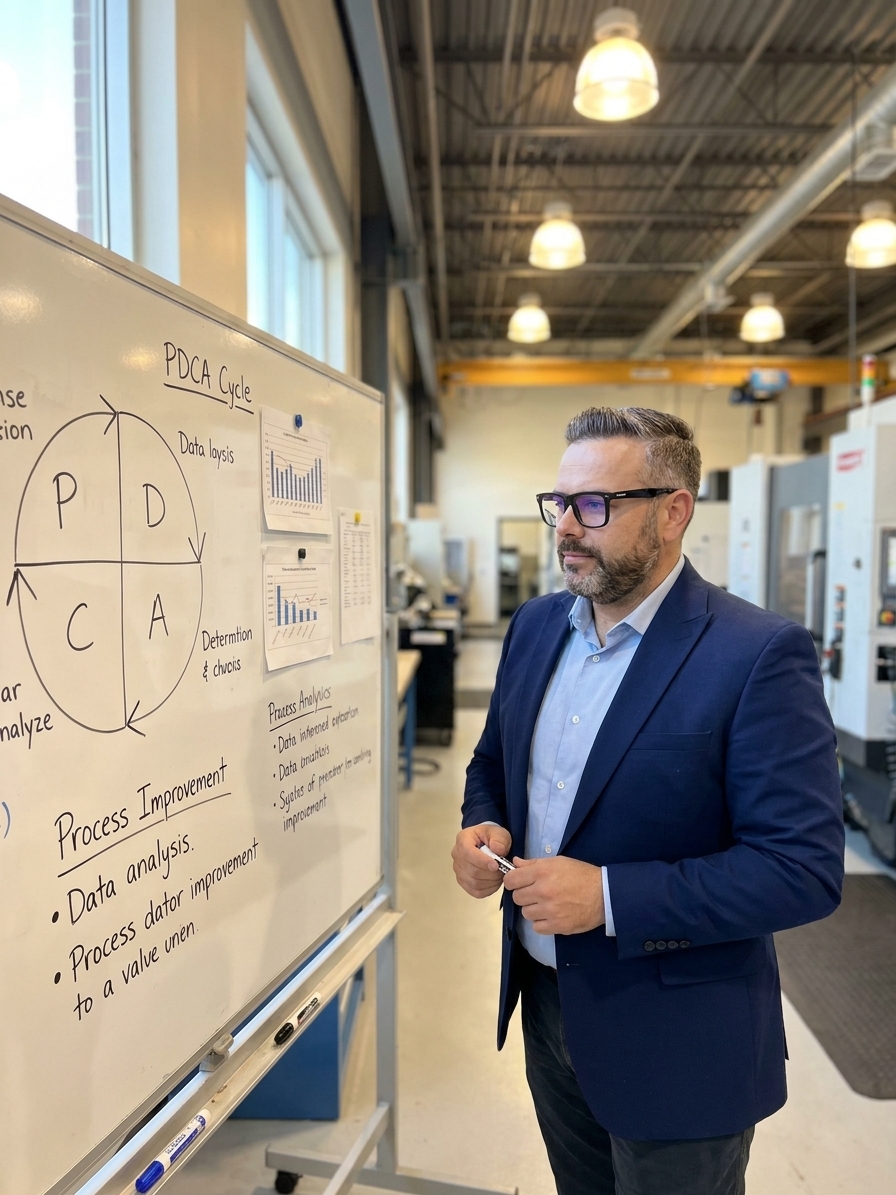
would sometimes draw the cycle on a whiteboard and then, with theatrical
slowness, draw an arrow from Act back to Plan and say: “This is the part
you keep forgetting.”
He was right. We keep forgetting it.
Plan: The Step Everyone
Rushes Through
Let’s walk through the cycle. Not because you don’t know the steps,
but because knowing the steps and understanding what they actually
demand are two very different things.
Plan is where improvement begins, and it is where
most improvement fails — not because people skip it, but because they
perform a parody of it.
Real planning in PDCA is not “let’s brainstorm some ideas and pick
the best one.” Real planning is:
- Grasping the current condition with data, not
opinions. What is actually happening, measured how, compared to
what standard, over what time period, with what variation? - Defining the gap between current condition and target
condition. Not a vague aspiration (“we need to get better”) but
a specific, measurable gap (“we are at 180 PPM and we need to reach 50
PPM by Q3”). - Analyzing root causes before proposing solutions.
Not jumping to “we need better training” or “we need new equipment” but
actually understanding why the gap exists. - Formulating a hypothesis. A plan in PDCA is not a
decree. It is a hypothesis: “If we change X, then Y will improve because
Z.” This is scientific thinking applied to operations.
I worked with a medical device manufacturer that spent three weeks in
the Plan phase for a single improvement cycle. Three weeks. Their VP of
Operations was apoplectic. “Just fix it!” he kept saying. But the team
held firm. They mapped the process. They collected baseline data. They
analyzed variation. They identified three root causes and designed a
countermeasure for each.
When they finally moved to Do, the improvement was immediate and
permanent. They hit their target in eleven days. The VP who had been
screaming at them to hurry up later admitted that those three weeks of
planning saved them months of trial-and-error firefighting.
Planning is not delay. Planning is speed, paid for up front.
Do: The Step Everyone Rushes
Into
Do is the experimental phase, and this is where the
second great misunderstanding lives.
In most organizations, “Do” means “implement the solution.” Full
scale. All in. Cross your fingers and hope.
In proper PDCA, “Do” means run a controlled experiment. Try
the countermeasure on a small scale. In one cell. On one shift. With one
product family. Under conditions where you can observe what actually
happens, collect data in real time, and — this is critical — where the
cost of being wrong is manageable.
The Japanese lean community sometimes calls this “try-storming” — a
deliberate play on brainstorming. Instead of talking about what might
work, you try it. But you try it small, fast, and cheap. You build a
cardboard mockup. You simulate the new layout with tape on the floor.
You run the new inspection protocol on twenty parts, not twenty
thousand.
The point of Do is not to prove your plan was right. The point of Do
is to discover what your plan missed. And it always missed
something. Always. The question is whether you discover what you missed
in a small, controlled experiment or in a full-scale rollout that just
became your new crisis.
I once watched a team at an electronics manufacturer plan a change to
their wave soldering process. Their hypothesis was solid. Their data was
clean. Their analysis was rigorous. They were confident. And in the
first hour of their trial run, they discovered that the new solder
temperature profile caused a thermal shock event on a component they
hadn’t tested. The component cracked. Quietly. Invisibly. In a way that
would have passed every functional test but would have failed in the
field after approximately 8,000 thermal cycles.
They found it because they were running a small trial with intensive
inspection. If they had gone straight to full production, they would
have shipped defective product for weeks before anyone noticed. The
recall would have been catastrophic. The planning they invested in was
valuable. The controlled doing saved them.
Check: The Step Everyone
Fakes
Check is where honesty lives. And honesty, in
organizational life, is rarer than you might think.
The original Japanese term is Check, though Deming himself
later preferred Study — not because Check is wrong, but because
Study better captures the depth of analysis required. Either way, the
step demands that you compare your actual results against your expected
results and ask the most uncomfortable question in quality
management:
Were we right?
Not “did things improve?” Things often improve for reasons having
nothing to do with your countermeasure. Regression to the mean.
Hawthorne effect. Seasonal variation. The question is whether your
hypothesis was correct. Did changing X actually cause Y to
improve because of Z? Or did Y improve for some other reason while you
were busy congratulating yourself?
This distinction matters enormously. If you don’t understand why
something worked, you cannot replicate it. You cannot scale it. You
cannot sustain it. You have a lucky anecdote, not organizational
knowledge.
Real Check means:
- Comparing actual performance to the target you set in
Plan. Not to last month. Not to “it’s better than before.” To
the specific target you committed to. - Analyzing the data with statistical rigor. Not
eyeballing a trend line and declaring victory, but asking whether the
change is statistically significant, whether the variation has actually
decreased, and whether the improvement is large enough to matter. - Examining what didn’t work. Every experiment
produces unexpected results. Some countermeasures create new problems.
Some reveal problems that were always there but hidden. The failures in
your experiment are often more valuable than the successes. - Challenging your assumptions. The hypothesis you
tested was based on assumptions about cause and effect. Were those
assumptions correct? If not, what does that tell you about your
understanding of the process?
The organizations that are genuinely good at Check are the ones with
a culture where being wrong is safe. Where a team can say “our
hypothesis was incorrect” without fear of punishment. Where the quality
manager can present data showing that the expensive improvement the VP
championed had no measurable effect, and the VP responds with curiosity
instead of rage.
If your organization doesn’t have that culture, your Check step is
theater. And your PDCA cycle is broken at the most critical point.
Act: The
Step That Determines Whether Anything Lasts
Act is where sustainability is born or dies. And it
comes with two possible outcomes, both essential.
If the experiment succeeded: Standardize the new
method. Update the work instructions. Train everyone. Change the process
documentation. Audit the new standard. Lock it in. This is where most
organizations stop — they standardize and declare victory. But Act in
PDCA demands one more thing: identify the next improvement
opportunity. Because the new standard is not the ceiling. It is the
new floor. And the cycle starts again.
If the experiment did not succeed — or partially
succeeded: Don’t discard the learning. Understand what
happened. Adjust the hypothesis. Refine the countermeasure. And start
the cycle again from Plan. This is not failure. This is the engine of
learning. Every cycle that doesn’t produce the desired result still
produces knowledge, and knowledge compounds.
The Act step is also where you confront the organization’s most
dangerous psychological trap: the belief that standardization means
stagnation. In too many companies, “we standardized the process” is code
for “we’re done thinking about this process.” But standardization in
PDCA is not the end of thinking. It is the foundation for the
next round of thinking. You standardize so that everyone has a stable
baseline from which to experiment further. You lock in the improvement
so that the next experiment starts from a higher floor.
Toyota is famous for this. Their standard work is not a bureaucratic
cage. It is a living document, updated hundreds of times per year on a
single production line. Each update is a small PDCA cycle. Each cycle
makes the standard slightly better. Each improvement becomes the new
baseline for the next experiment.
This is what continuous improvement actually looks like. Not big bang
transformations. Not dramatic turnaround projects. Thousands of tiny
cycles, spinning every day, at every level, compounding into excellence
over years and decades.
Why PDCA Fails in Practice
Understanding the cycle is the easy part. Making it actually work in
a living organization is where things get hard. Here are the failure
modes I see most often:
1. Skipping Plan. The organization is so eager to
act that it jumps straight to Do. Solutions are implemented without root
cause analysis. Countermeasures are chosen by gut feel or HiPPO
(highest-paid person’s opinion). The result is a solution in search of a
problem, and the cycle either fails or produces a coincidence that looks
like success.
2. Big-bang Do. Instead of small-scale experiments,
the organization rolls out changes across the entire operation
simultaneously. When something goes wrong — and something always goes
wrong — the cost is enormous, the disruption is widespread, and the
organization learns to fear experimentation instead of embracing it.
3. Check without rigor. The team eyeballs the
results, sees improvement, and declares victory. No statistical
analysis. No examination of whether the improvement was caused by the
countermeasure or by something else. No investigation of unintended
consequences. The organization “confirms” a hypothesis that was never
properly tested and builds future plans on a foundation of
assumption.
4. Act without standardization. The improvement
works, but nobody updates the work instructions. Nobody retrains the
team. Nobody changes the audit checklist. The improvement lives in the
heads of the people who ran the experiment and dies when those people
move on.
5. Stopping after one cycle. The organization runs
PDCA once, gets results, and stops. The cycle doesn’t spin again. The
process doesn’t improve further. And slowly, inevitably, the gains erode
as the process drifts back toward its old equilibrium.
6. Running PDCA only at the top. Senior leaders run
PDCA for strategic initiatives, but the shop floor runs on intuition and
habit. The most powerful PDCA cycles are the ones that happen at the
point of production — the ones run by operators and team leaders who see
the process every day and notice the small problems that dashboards
never capture.
The Compound Interest of
Small Cycles
Here is the insight that separates world-class organizations from
everyone else: the power of PDCA is not in any individual cycle.
It is in the compounding effect of thousands of cycles over
time.
A single PDCA cycle might reduce defects by 15%. That’s good. But if
you run a cycle every two weeks — fifty-two cycles a year across a
hundred production cells — you are running five thousand improvement
experiments per year. Most will be small. Some will fail. But the ones
that succeed will compound. And after three years, you won’t recognize
the process you started with.
This is not theoretical. Toyota’s production system operates on this
principle. Their team members submit hundreds of thousands of
improvement suggestions per year. Most are tiny — a tool placed five
centimeters to the left, a checklist reworded for clarity, a fixture
adjusted by two millimeters. Individually, each suggestion saves seconds
or prevents a defect that might not have happened anyway. Collectively,
they create a production system that improves every single day and has
been improving every single day for sixty years.
You cannot replicate Toyota’s results by copying Toyota’s tools. You
can only replicate Toyota’s results by copying Toyota’s habit —
the relentless, patient, unglamorous discipline of spinning the PDCA
wheel at every level, every day, forever.
Building a PDCA Culture
So how do you make this real in your organization? Not as a program
or a project or an initiative, but as the way your people naturally
think and work?
Start with yourself. Before you ask your team to
adopt PDCA, adopt it yourself. The next time you face a quality problem,
resist the urge to jump to solutions. Plan deliberately. Experiment
small. Check honestly. Act with discipline. Model the behavior you want
to see.
Make it safe to be wrong. The Check step dies in
organizations where being wrong is punished. If your team hides failed
experiments, your PDCA cycle is already broken. Celebrate the learning,
not just the result. A team that ran a clean experiment and discovered
their hypothesis was wrong just produced more useful knowledge than a
team that guessed right and can’t explain why.
Start small and visible. Don’t try to implement PDCA
across the entire organization simultaneously. Pick one team, one
process, one problem. Run the cycle in public. Share the results —
including the unexpected ones. Let people see how it works. Let them see
that it’s safe. Let them see that it produces results. Then expand.
Build it into the rhythm of work. PDCA is not an
add-on. It’s not something you do in addition to your real work. It IS
your real work. Build cycle times into your daily management system.
Stand-up meetings should include: What did we try? What did we learn?
What will we try next? Weekly reviews should include: What cycles are
running? What results are we seeing? What should we accelerate or
abandon?
Measure the meta-metric. Don’t just measure the
results of your PDCA cycles. Measure the cycling itself. How many cycles
did we run this month? How fast are we cycling? How many people are
actively running cycles? The velocity of your learning — not the
brilliance of any single solution — is the metric that predicts your
long-term trajectory.
The Patience of Excellence
Here is the hardest truth about PDCA: it requires patience. Not the
passive patience of waiting, but the active patience of disciplined
repetition. The patience to plan thoroughly when everyone is screaming
for action. The patience to experiment small when everyone wants to go
big. The patience to check rigorously when everyone wants to celebrate.
The patience to standardize carefully when everyone wants to move
on.
Martin, the quality director from our opening story, eventually
understood this. After the defect rate snapped back to 1,800 PPM, he
didn’t launch another improvement project. He launched a habit. He
taught his team PDCA — not as a four-step form to fill out, but as a way
of thinking about their work. He started with one cell and one metric.
They planned. They experimented. They checked. They acted. And then they
did it again. And again.
Within six months, that cell was the best-performing cell in the
plant. Not because of any single brilliant insight, but because of
dozens of small, disciplined cycles that compounded into something
extraordinary. Martin didn’t stop there. He replicated the approach
across every cell. Within two years, the plant’s overall defect rate was
below 50 PPM — and staying there.
The champagne was gone. The congratulatory letters had stopped. The
CEO had moved on to other priorities. But the cycle kept spinning.
Quietly. Relentlessly. Invisibly. The way excellence always works.
Peter Stasko is a Quality Architect with 25+ years of experience
transforming organizations across automotive, aerospace, and
pharmaceutical industries. He has led quality system implementations on
three continents and believes that the difference between good and great
is not talent — it’s the discipline to keep improving when nobody is
watching.