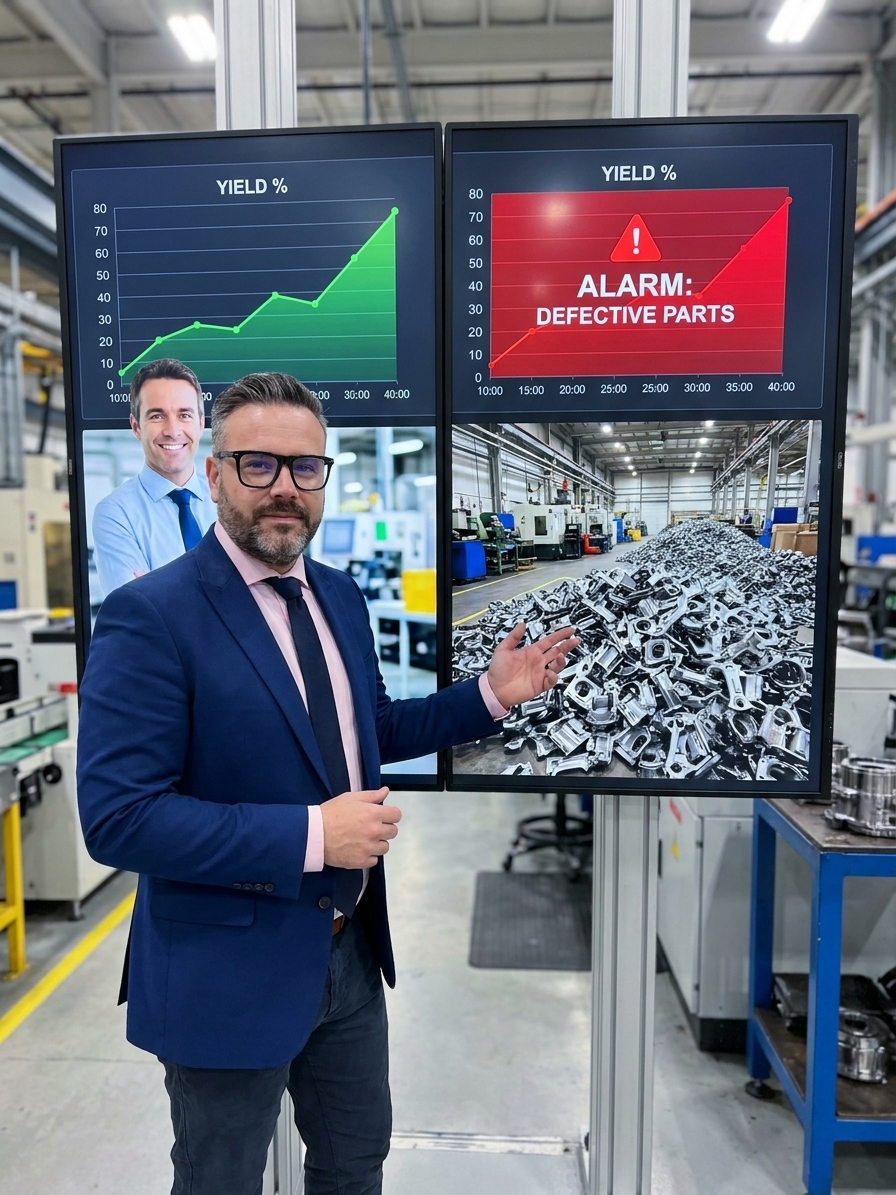
Quality Symmetry: When Your Organization’s Internal Standards Don’t Match What Your Customer Actually Experiences — and the Gap Between Your Scorecard and Their Reality Becomes Your Most Dangerous Blind Spot
You’ve seen it a hundred times. The dashboard glows green. Every KPI hits its target. Your scrap rate is under control, your delivery performance sits at 98.3%, and your latest customer audit closed with zero majors. The quality meeting wraps up in twelve minutes because there’s nothing to discuss. Your team files out, satisfied.
Then the phone rings.
It’s your biggest customer, and they’re not calling to congratulate you. They’re calling because three of the last five shipments had issues that none of your metrics caught. The parts met specification, but they didn’t fit. The documentation was complete, but it described the wrong revision. The packaging was intact, but the labels were for a different part number. Your quality system said everything was fine. Your customer’s experience said otherwise.
This is quality asymmetry — the dangerous gap between what your organization measures and what your customer actually feels. And it’s one of the most pervasive, least discussed quality failures in manufacturing today.
The Mirror That Lies
Most quality systems are built on an assumption so fundamental that nobody questions it: the assumption that if your internal metrics look good, your customer must be satisfied. It’s a mirror logic — measure the process, control the process, improve the process, and the customer will inevitably benefit.
Except they don’t. Not always. And sometimes, not even usually.
The problem isn’t that your metrics are wrong. The problem is that your metrics are incomplete. They measure what’s easy to measure, what’s been historically measured, and what makes your organization look competent during management reviews. But they don’t measure what your customer actually cares about.
Think about it from the customer’s perspective. They don’t care about your Cpk values. They care about whether the part installs correctly on their assembly line. They don’t care about your first-pass yield. They care about whether their line stops because of something you sent them. They don’t care about your ISO certificate. They care about whether they can trust the next shipment without inspecting it themselves.
Your quality system measures the supply. Your customer experiences the demand. When those two perspectives diverge, you have quality asymmetry — a condition where your organization believes it’s performing well while your customer quietly starts looking for alternative suppliers.
Where Asymmetry Hides
Quality asymmetry doesn’t announce itself. It doesn’t show up as a failed audit or a spike in scrap. It hides in the spaces between your measurements — in the aspects of quality that your system was never designed to see.
Specification compliance vs. functional performance. Your parts pass every dimensional check, but the customer’s assembly process requires a tighter fit than your drawing specifies. Technically, you’re right. Practically, you’re wrong. The customer doesn’t care about your tolerance stack-up analysis. They care about whether their operator can assemble the part without a rubber mallet.
Conformance vs. consistency. Every individual shipment meets requirements, but the variation between shipments is driving your customer’s process engineers insane. Batch one is slightly different from batch two, which is slightly different from batch three. Each deviation is within spec, but the cumulative effect is chaos on the receiving end.
Documentation vs. usability. Your PPAP packages are thorough, complete, and technically accurate. But they’re organized in a way that makes sense to your quality engineers, not to your customer’s receiving inspection team. The information is all there, but finding it takes three times longer than it should.
Delivery vs. experience. You shipped on the date you promised. But the truck arrived at 4:47 PM on a Friday, your customer’s dock was already closed, and the parts sat outside all weekend. Your on-time delivery metric looks perfect. Your customer’s experience was a disaster.
Responsiveness vs. resolution. When the customer reports an issue, your team responds within 24 hours. But the response is an acknowledgment, not a solution. The actual corrective action takes six weeks, requires three conference calls, and involves two engineering changes. Your response time metric says you’re excellent. Your customer’s production line says you’re a problem.
Each of these asymmetries shares a common root: your organization optimized for its own measurement system rather than for the customer’s actual experience. And the scary part is that your metrics will never reveal this. You can’t measure a gap between two perspectives when you only have one.
The Anatomy of Asymmetry
Quality asymmetry follows a predictable pattern. Understanding that pattern is the first step toward eliminating it.
Phase 1: The Measurement Lock-In
It starts innocently enough. Your organization establishes a set of quality metrics — probably years ago, probably based on industry standards or customer requirements that were current at the time. These metrics become institutionalized. They’re embedded in your QMS, reported in your management reviews, and tied to your team’s performance evaluations. Over time, they become sacred. Nobody questions them because nobody remembers why they were chosen in the first place.
Phase 2: The Customer Drift
Meanwhile, your customer’s world changes. Their processes evolve. Their expectations increase. Their supply chain strategy shifts. The things they care about today are different from what they cared about three years ago. But your measurement system hasn’t adapted. It’s still measuring the same things it always measured, optimized for a customer requirement that no longer exists.
Phase 3: The Phantom Performance
Your metrics keep improving because your team is genuinely getting better at hitting the targets you’ve set. Scrap goes down. Yield goes up. Audit findings decrease. Your quality system is performing at its highest level ever. The dashboard has never looked greener. Your team is proud, your management is satisfied, and your investor presentations highlight the trend.
Phase 4: The Silent Erosion
But something is happening beneath the surface. The customer is experiencing problems your metrics don’t capture. At first, they’re minor annoyances — a slightly different surface finish, a label that’s hard to read, a packaging configuration that doesn’t match their new automated receiving system. They don’t escalate these issues because individually, none of them crosses the threshold of a formal complaint. But they accumulate.
Phase 5: The Reckoning
One of two things happens. Either the customer finally escalates — usually with a dramatic gesture like a controlled shipping requirement or a supplier quality summit — or they simply stop giving you new business. The first scenario is painful but survivable. The second scenario is fatal, and by the time you notice, the relationship has already migrated to a competitor who was measuring what mattered.
The Customer Lens Framework
Fixing quality asymmetry requires a fundamentally different approach to measurement. Instead of starting with your internal processes and working outward, you start with the customer’s experience and work inward. I call this the Customer Lens Framework, and it has five components.
1. Experience Mapping
Sit down with your customer — not your sales team, not your quality team, but the actual people on your customer’s shop floor who receive, inspect, and use your product. Map their experience with your product from the moment it arrives at their dock to the moment it’s consumed in their process.
You’ll discover things that will surprise you. The way your packaging opens matters. The orientation of parts in the container matters. The clarity of your lot traceability labels matters. None of these show up on a traditional quality dashboard, but every one of them shapes the customer’s perception of your quality.
Document this map. Share it with your entire team. Make it visible. This is what quality looks like from the other side.
2: Asymmetry Indicators
For every metric on your current quality dashboard, ask one question: “Does this measure what we produce, or what the customer experiences?” If the answer is the former, you need a companion metric that captures the latter.
| Internal Metric | Customer Lens Companion |
|---|---|
| Scrap rate | Customer line stop rate |
| First-pass yield | Customer install success rate |
| On-time delivery | Customer dock-to-use time |
| PPAP completion | Customer engineer satisfaction score |
| Response time | Time to effective resolution |
| Audit findings | Customer complaint frequency |
| Cpk values | Customer process capability impact |
The internal metrics aren’t wrong — they’re just half the picture. The companion metrics complete it.
3. Reverse Gemba
You know Gemba — going to the place where value is created. Reverse Gemba means going to the place where your value is consumed. Visit your customer’s facility. Watch how they use your product. See what happens when it works and what happens when it doesn’t. Listen to the language they use. Notice what they measure and what they ignore.
You can’t understand quality asymmetry from your own factory floor. You have to see it through your customer’s eyes. And not once — regularly. Because their reality changes faster than your measurement system does.
4. Feedback Loop Calibration
Most organizations have customer feedback loops. But most of those loops are muffled by layers of interpretation. By the time a customer concern reaches your quality team, it’s been filtered through sales (who want to protect the relationship), filtered through management (who want to minimize the severity), and filtered through your own organization’s tendency to translate complaints into familiar categories.
The fix is a direct line. Your quality engineers should have regular, unmediated conversations with their counterparts at the customer. Not crisis calls. Routine conversations. Monthly check-ins where the question isn’t “Do you have any complaints?” but “What’s making your life harder than it needs to be?”
5. Metric Agility
The most important characteristic of your quality measurement system isn’t its accuracy — it’s its adaptability. Your metrics should evolve as your customer’s needs evolve. This means reviewing your measurement system at least annually, not just for correctness but for relevance.
Ask: “If our customer redesigned their process tomorrow, would our quality metrics still matter?” If the answer is no — or if you’re not sure — you have asymmetry risk.
The Cost of Symmetry
Organizations that close the asymmetry gap don’t just improve customer satisfaction. They unlock a cascade of benefits that compound over time.
Reduced customer audits. When your internal standards match the customer’s actual experience, the need for adversarial audits diminishes. Trust replaces verification. Your customer starts treating you like a partner instead of a risk to be managed.
Premium positioning. Customers pay more for suppliers who understand their experience. Not because you charge more, but because the total cost of ownership — including the hidden costs of dealing with a supplier who’s almost right — is lower with you than with the cheaper alternative.
Proactive improvement. When your metrics are aligned with customer experience, you start catching problems before the customer notices them. Not because you’re faster, but because you’re measuring the right things. The defect that would have been a customer complaint becomes an internal improvement opportunity.
Relationship resilience. When economic pressures force customers to consolidate their supply base, the suppliers who survive are the ones who understood the full experience. Not the cheapest. Not the closest. The ones who were measuring what mattered.
Talent engagement. Quality professionals are frustrated by asymmetry more than almost any other quality failure. They know the metrics don’t tell the full story, but they can’t change the system alone. When an organization commits to symmetry, it signals to its best people that their insights matter. Retention improves. Engagement deepens. The quality function evolves from scorekeeper to strategic partner.
The Symmetry Test
Here’s a simple test. Take your current quality dashboard — the one you present in management reviews, the one your leadership team trusts to represent reality — and answer these questions honestly:
- When was the last time you added a metric because the customer asked for it, not because your internal analysis suggested it?
- Can you name three things your customer cares about that aren’t measured anywhere on your dashboard?
- Has a customer ever been dissatisfied with something your metrics said was performing well?
- Do your quality engineers have direct, regular conversations with their customer counterparts — without sales or management in the room?
- If your customer designed their ideal supplier quality dashboard, would it look anything like yours?
If you can’t answer at least four of these questions favorably, you have asymmetry. Not might have. Have.
Living in Symmetry
The goal isn’t to abandon your internal metrics. They serve an important purpose. The goal is to build a measurement system that reflects both perspectives — yours and your customer’s — with equal fidelity. A system where green on your dashboard means green in your customer’s experience. Where improvement in your metrics translates to improvement in their reality.
This requires humility. It requires admitting that your perspective, no matter how sophisticated, is incomplete. It requires listening to your customer with the same rigor you apply to your control charts. And it requires the discipline to change your measurement system when the world changes — even if it means abandoning metrics you’ve invested years in perfecting.
Quality symmetry isn’t about being perfect. It’s about being honest. Honest about the limits of your own perspective. Honest about the difference between measuring well and performing well. Honest about the fact that the customer’s experience is the only quality reality that ultimately matters.
Your dashboard is a tool, not a mirror. It doesn’t reflect reality — it reflects what you’ve chosen to measure. And if what you’ve chosen to measure doesn’t align with what your customer actually experiences, you’re not managing quality. You’re managing a story.
The organizations that thrive in the next decade of manufacturing won’t be the ones with the most sophisticated dashboards. They’ll be the ones whose dashboards tell the same story their customers would tell. The ones who closed the gap between what they measure and what matters.
The ones who stopped being right and started being real.
Peter Stasko is a Quality Architect with 25+ years of experience transforming manufacturing organizations from compliance-driven systems into customer-focused quality engines. He has worked across automotive, aerospace, and industrial sectors, helping leadership teams see what their dashboards have been hiding.