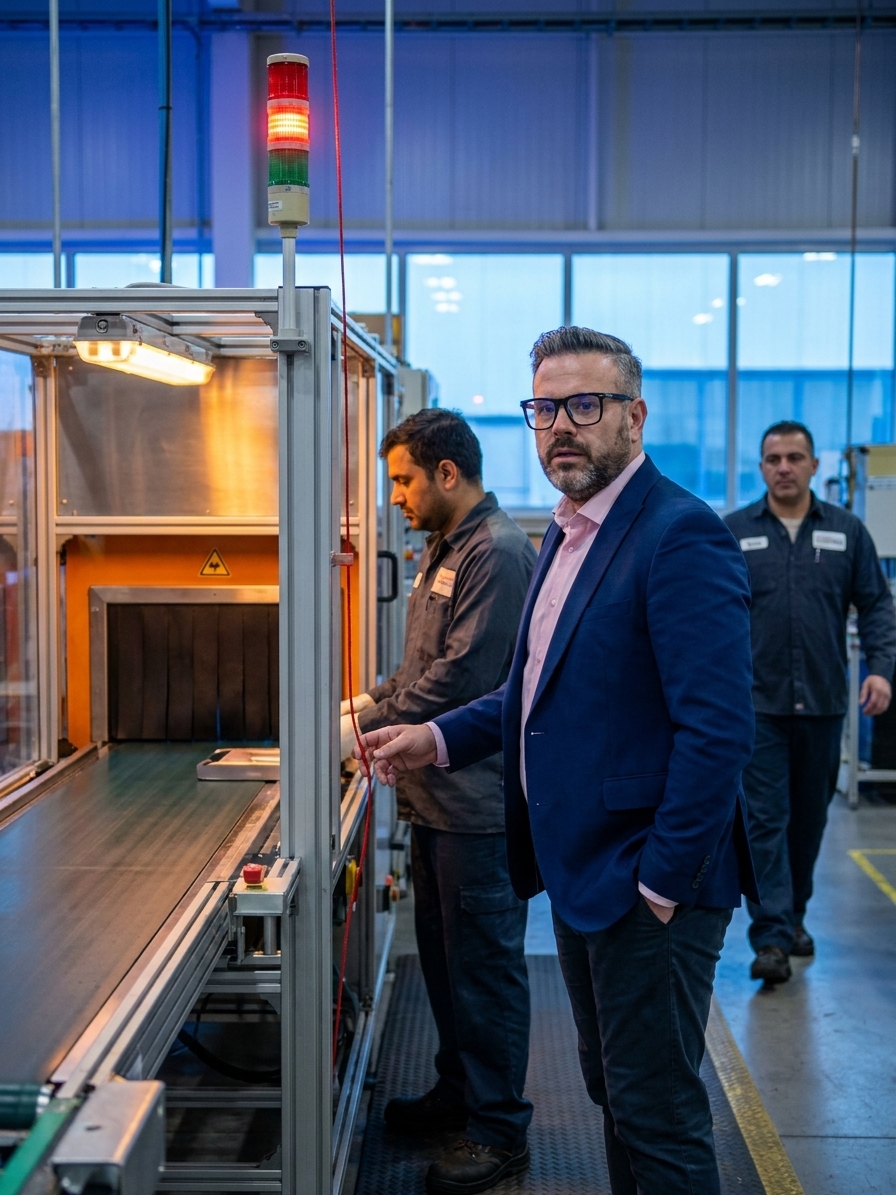
You installed the andon cord. You trained the operators. You told them to pull the cord when something goes wrong, stop the line, and get help. For about two weeks, that is exactly what happened. The team leader arrived, and problems were addressed. Then the cord stopped being pulled.
The cord did not fall out of use because the process improved. It stopped because the response became worse than the problem. The team leader arrived frustrated. The line sat idle while the shift target slipped. The unspoken message rippled across the floor: stop pulling the cord unless it is catastrophic. Operators quickly learned that halting production creates friction, not support.
I have audited plants where the andon system was entirely decorative. The light stack blinked amber so frequently that operators filtered it out as background noise. When asked, supervisors admitted they instruct operators to override the system to maintain OEE. The jidoka principle was funded and installed, but the management structure required to sustain it was never built.
The Four Mechanisms of Autonomous Control
Jidoka is one of the two pillars of the Toyota Production System, alongside just-in-time. The original concept, developed by Sakichi Toyoda in the early 1900s, involved a loom that stopped instantly if a thread broke. The machine detected the abnormality and halted itself before producing a single defective metre of cloth.
This principle requires four sequential mechanisms to function. Each step must be structurally supported by the organisation's standard work. If any single step fails, the entire system degrades into a detection tool that nobody obeys, leaving defects to propagate downstream.
The Jidoka Response Sequence
- 01Detect the AbnormalityA deviation from standard work occurs: a dimension breaches tolerance, a tool wears, or a safety interlock triggers.
- 02Stop the ProcessThe operation halts immediately. No partially completed parts move to the next station.
- 03Restore the ConditionThe team leader assesses the issue and applies an immediate correction to resume the line safely.
- 04Investigate and CountermeasureRoot cause is determined via 8D or A3 methodology, and a permanent fix is installed and verified.
Detection Failure: Alarm Fatigue and Threshold Drift
Detection mechanisms are where most implementations fail. In Toyoda's loom, detection was mechanical and unambiguous: the thread broke, a lever dropped, and the machine halted. There was no threshold to calibrate and no human judgment required. Modern manufacturing is rarely this clean.
Your detection mechanisms are a complex mix of machine sensors, statistical process control triggers, and human observation. An operator encounters a misaligned part and pulls the andon cord. The team leader arrives, looks at it, and instructs the operator to tap it into place. The operator pulls the cord for a dimension sitting at the edge of tolerance. The team leader says it is within spec and to keep running.
Through repetition, the operator recalibrates the threshold. They learn what management actually considers worth stopping for. Simultaneously, sensors generate constant alerts for momentary vibration spikes or microsecond cycle time delays. This creates classical alarm fatigue. A detection system that fires on everything ultimately fires on nothing, and the threshold degrades until the signal is reserved only for catastrophic breakdowns.
The Political Burden of the Line Stop
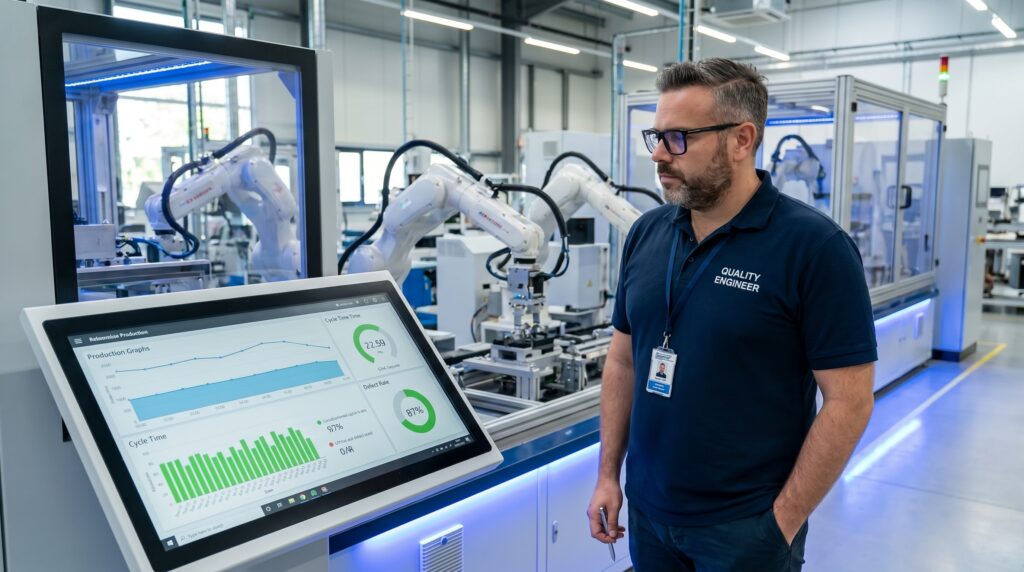
The line stop is the heart of jidoka and the hardest element to sustain. It directly conflicts with how most plants measure performance. When a line halts, the hourly production target is at risk. The plant manager hears about it, and the operator who pulled the cord is unconsciously treated as the problem, not the defect they detected.
This cultural trap is why implementations fail. The principle requires the organisation to structurally value quality over short-term output. Toyota achieved this over decades by separating andon-triggered line stops from standard production hours in their measurement system. When a line stops for quality, the time is classified as an investment in prevention rather than counted against the shift OEE.
At Toyota, the andon response protocol demands the team leader arrives within one minute. Either the problem is fixed on the spot, or the line stays down until a permanent countermeasure is applied. If your team leaders and shift supervisors are measured solely on output, they will find a way to bypass the stop and run the defective material to protect their numbers.
A jidoka system without a structural investigation loop is a smoke detector in a building with no fire department.
Immediate Fixes versus Root Cause Elimination
When the line stops, the immediate correction is straightforward. The part is stuck, so the operator unsticks it. The measurement drifts, so maintenance recalibrates. The tool wears, so it is replaced. This is the correction that gets the line running again, and it is where most organisations stop. They address the symptom and defer the disease.
The real correction requires understanding why the part got stuck and installing a PFMEA-driven countermeasure that prevents the next occurrence. This investigation takes time and requires the involvement of quality engineering or maintenance. Because these resources are busy, the root cause investigation is deferred to the next maintenance window or added to a continuous improvement list that nobody reviews.
Short-Term Correction vs. Long-Term Resolution
What teams do (Firefighting)
- Unstick the jammed part to resume the cycle immediately
- Recalibrate the drifting gauge without tracing the source
- Defer the 8D investigation to an unspecified later date
- Override the andon to protect the hourly production target
What works (Jidoka)
- Maintain the line stop until the immediate hazard is contained
- Log the defect and assign a dedicated investigation owner
- Apply 5-Why analysis while the physical evidence is fresh
- Update the Control Plan and verify the Cpk of the new process
Closing the Loop: The Missing Role
Effective jidoka requires a closed-loop system for every line stop. Every stop generates a record. Every record has an owner, a timeframe, and a verified countermeasure. This requires immense discipline, and discipline requires a specific role that most manufacturing environments lack: a person whose primary job is to close the loop.
At Toyota, this is the group leader. Their job is not to run production. Their function is to solve problems. They take every abnormality detected by the system and ensure it receives a root cause analysis and a permanent countermeasure. They are the mechanism that transforms jidoka from a detection system into a learning system.
Your team leaders are running production. Your quality engineers are completing PPAP submissions. Nobody is structurally responsible for ensuring every abnormality leads to a countermeasure that prevents the next occurrence. The abnormalities accumulate, the same problems recur, and the andon data sits in a log file that nobody opens.
Rebuilding the System: Start with One Station
If your andon cord is ignored and your light stack is decorative, the path forward starts with a single question: when was the last time a line stop led to a countermeasure that prevented a recurrence? If you cannot answer immediately, your jidoka system is fundamentally incomplete.
Start small. Pick one critical station where defects frequently escape. Set up the andon response protocol and train the team leader to arrive within one minute. Track every single stop, investigate every problem while the evidence is fresh, and install verified countermeasures. Measure the problem recurrence rate over ninety days.
Key Metrics for a Functional Andon System
If you can demonstrate success on one line for three months, you will have proven the principle works when the culture supports it. Jidoka is not a sensor on a machine or a dashboard on a screen. It is a structural, measurable commitment to stopping when a process deviates, fixing it properly, and ensuring it never happens again. Scale the culture one team leader at a time.