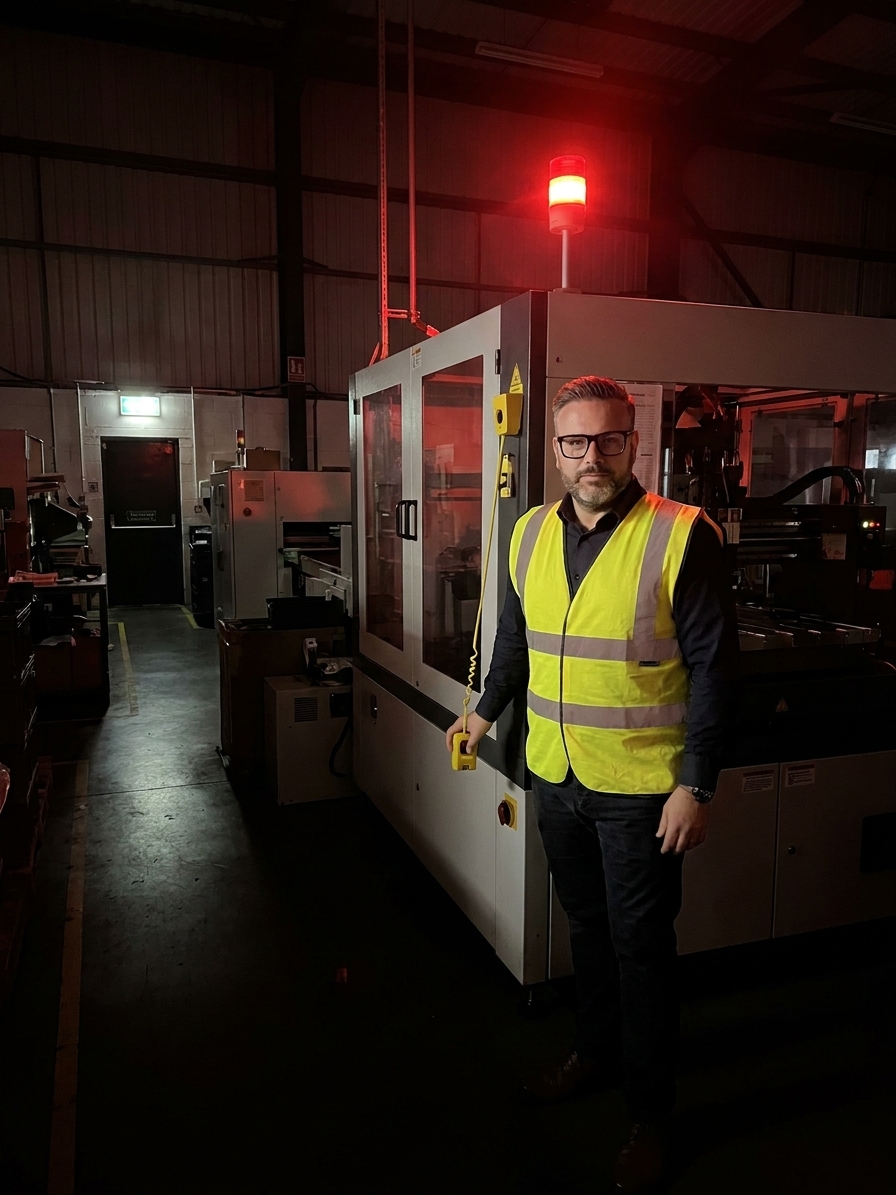
Stop the line. That is the core promise of jidoka, the lean manufacturing principle that gives every machine and every operator the authority to halt production the moment something goes wrong. The concept sounds noble in a conference room. It sounds expensive on a shop floor running at full capacity with a customer waiting.
Sakichi Toyoda built this concept into his automatic looms in the early 1900s. When a single thread broke, a mechanical blade dropped and the loom halted instantly. No defective fabric wove itself into existence, and no quality inspector needed to hunt for hidden flaws in finished cloth. The process itself possessed enough mechanical intelligence to prevent defects from forming.
A century later, most organizations that claim to practice jidoka have hollowed it out into something unrecognizable. The andon cord exists, but nobody pulls it. The line stops, and a supervisor rushes over to restart it as quickly as possible without investigating the fault code. Jidoka degrades from a rigorous quality philosophy into a mere uptime metric, leaving defective parts to flow freely downstream.
The Operational Sequence of Autonomous Defect Prevention
Toyoda's autocop mechanism for his looms was deceptively simple, relying on four sequential principles. First, the machine or operator detects an abnormality. Second, work halts immediately rather than after the current production batch finishes. Third, someone responds to fix or flag the specific root cause. Fourth, a permanent countermeasure is implemented to ensure the same abnormality cannot pass through again.
Notice the strict sequence: detection, stopping, investigation, and prevention. Most companies implementing jidoka get the detection part right. They install error-proofing sensors, machine vision systems, and visual andon signals across their production lines. Then they stumble critically at step two, because stopping production feels like a failure to management rather than a successful catch.
When the sequence breaks at the second step, the entire methodology collapses. A process that does not stop cannot be investigated, which means permanent countermeasures are never developed. The factory floor relies entirely on human vigilance to catch intermittent defects, guaranteeing that quality failures will eventually reach the customer undetected.
This sequence only works when the threshold for triggering a stop is kept deliberately low. If an operator hesitates before pulling the andon cord because they fear the supervisory reaction, the detection phase has already failed. Effective jidoka demands that the physical stop mechanism is treated as the most critical component of the quality system, not an inconvenient obstacle to output.
How Andon Systems Degrade Into Theatre

Walk through any factory that proudly installed an andon system five years ago and ask operators when they last pulled the cord. Watch the shift in body language. Some operators will laugh openly. Others will instinctively look at their supervisor before answering. A few will admit honestly that pulling the cord brings more personal trouble than it actually solves.
The breakdown follows a predictable pattern. An operator notices a misaligned part or a tool that has drifted out of specification. They pull the andon cord and the line stops. A team leader arrives within sixty seconds as the standard work demands. Then the production pressure immediately begins. The shift is behind schedule, so the team leader asks if they can fix the issue while the line keeps running.
The operator says the problem is intermittent and probably will not recur. The team leader overrides the stop, and the line restarts. The defect continues producing itself at random intervals that nobody tracks. After three or four cycles of this behaviour, the operator learns the real lesson: pulling the cord makes you the person who slowed production, so they simply stop pulling it.
Small problems accumulate silently under this dynamic. Eventually, a major defect reaches final assembly or the customer, and management wonders why the expensive andon system failed to catch it. The system failed because the operational culture systematically trained operators to tolerate known abnormalities rather than interrupt the production schedule.
Alarm Fatigue and the Reset Culture
Modern manufacturing equipment generates hundreds of alerts per shift. Vision systems flag cosmetic deviations and temperature sensors trigger warnings. Cycle-time monitors beep constantly when an operation takes a fraction of a second longer than the established standard. Operators sit behind control dashboards bathed in amber and red indicators, overwhelmed by visual noise.
The human brain cannot triage that sheer volume of signals effectively. People desensitize rapidly to non-stop alerts. They develop mental filters, they mute alarms, and they learn to categorize warnings into real problems versus the system being overly sensitive. When every minor deviation triggers an alarm, no deviation feels genuinely urgent to the operator on the floor.
This desensitization feeds directly into a broader reset culture. A machine stops and displays a fault code. The operator knows exactly what to do without investigating: press the yellow reset button, wait three seconds, and press the green start button. The machine hums back to life, production resumes, and the fault code joins thousands of unanalyzed entries in the maintenance database.
This reset behaviour is the direct antithesis of jidoka, yet it thrives in organizations that measure machine availability as a primary KPI. Maintenance teams get bonused on equipment uptime, and operators get evaluated on parts produced per shift. Neither group is rewarded for stopping to ask why a specific fault occurred, so defects continue passing downstream.
Functional Jidoka vs Alarm Theatre
What teams do
- Override line stops to maintain output and hit shift targets.
- Reset fault codes immediately without investigating root causes.
- Leave all original alarms active, creating constant dashboard noise.
- Bonus maintenance teams purely on equipment availability metrics.
What works
- Empower operators to halt production without supervisory approval.
- Require root cause documentation before resetting any machine.
- Classify and silence obsolete alarms to maintain signal clarity.
- Track andon pulls as a positive metric of process engagement.
Engineering the Stop Mechanism Into Equipment
True jidoka builds both detection and response directly into the equipment architecture itself. Limit switches confirm part presence. Torque monitors verify fastener tightness in real time. When a critical process parameter drifts outside its established specification, the machine halts automatically, entirely removing operator judgment from the safety equation.
This requires capital investment in machine design that many companies actively resist. Adding error-detection sensors to a stamping press or engineering a packaging line to stop when a carton is missing its insert adds engineering complexity. Capital expenditure committees routinely defer these quality investments in favour of obvious capacity upgrades that show a clearer return on investment.
I have audited plants where the entire jidoka strategy depended on a single tired operator catching a complex dimensional drift on a high-speed press. People are exceptionally poor substitutes for engineered error detection. They get distracted, fatigued, and complacent over long shifts. Properly designed machines with integrated poka-yoke devices do not.
The financial justification for engineered stops is straightforward once you calculate the true cost of escape. Preventing a single defect at the source saves the compounding cost of rework, scrap, and warranty claims. Sensor technology and industrial machine vision systems have become significantly more affordable, making automated defect prevention highly accessible for critical risk processes.
Jidoka System Health Metrics
Structured Problem Solving After the Halt
When a line stops under a functional jidoka system, the response follows a defined protocol, not a frantic scramble to restart. Immediate triage occurs within the first sixty seconds. The team leader arrives and assesses whether this is a known issue with an existing countermeasure or an entirely new failure mode requiring deeper investigation.
If a standard fix exists, the team applies it immediately. If the issue is novel, they mark the affected parts for 100 percent inspection and physically isolate them. Before the shift ends, the team conducts a preliminary root cause analysis, often using the 5 Whys methodology, and rigorously documents exactly what happened on the shop floor.
Within twenty-four hours, a temporary countermeasure must be implemented to prevent immediate recurrence, and the permanent engineering fix is formally scheduled. Speed of investigation is the critical element here. When problem solving happens immediately while the physical evidence is fresh, root causes emerge naturally.
When the signal-to-noise ratio drops to zero, the entire jidoka system breaks alongside it.
When investigation is deferred to a weekly quality meeting, memories fade and details blur. The analysis devolves into speculation and guesswork. Effective jidoka demands that the problem-solving cycle begins the moment the line stops, treating the halt as the most valuable data collection opportunity in the production sequence.
Rebuilding Trust and Tracking the Right Metrics
If your organization has an andon system that nobody uses, you must systematically rebuild trust. Operators will not stop the line if they believe halting production carries personal risk. This requires consistent, visible behaviour from management. Start by publicly celebrating every single line stop in the daily shift handover meeting.
When an operator catches a problem, management must share the calculated cost avoidance. Tell the team explicitly that their intervention prevented an estimated two hundred defective units from reaching final assembly. Make it overwhelmingly clear that catching problems is a highly valued contribution to the plant's operational success, not an inconvenience to the schedule.
Simultaneously, you must audit and aggressively reduce alarm noise. Classify every alert in the facility as critical, informational, or obsolete. Critical alarms must stop the line and require mandatory human intervention. Informational alerts should log silently to a database for trend analysis. Obsolete alarms should be removed from the interface entirely.
Finally, reframe your core metrics. Track the number of andon pulls per shift with a target that is explicitly nonzero, because zero means people are not reporting. Measure the ratio of problems caught at the source versus those found downstream. Monitor the time elapsed from stop to root cause identification, and ensure the recurrence rate of identical faults trends relentlessly downward.
The Economics of Stopping Production
Jidoka rests on a simple but counterintuitive economic idea: stopping production to fix a problem is vastly more efficient than continuing to produce with a defect. This seems objectively wrong to managers trained to maximize equipment utilization and hourly output. It feels like the plant is losing money every single second the line sits idle.
But the math of defect propagation is unforgiving. A defect caught at the source costs a fraction of one caught at final inspection, which costs a fraction of one caught by the customer. A faulty weld fixed at the welding station takes minutes. The same faulty weld found during final pressure testing costs hours of teardown and rework.
That same faulty weld discovered through a field warranty claim costs thousands of dollars and severely damages your commercial reputation. Jidoka makes this economic case visible by making the invisible cost of quality visible. When a defect passes downstream, it gets absorbed into rework budgets and scrap allowances that nobody questions because they have always been there.
Organizations that practice jidoka successfully see line stops as real-time signals about where to focus improvement energy. Every stop is a gift of process data. Organizations that practice it in name only see stops as interruptions to be silenced, and inevitably, the defects accumulate until they reach the customer.