
A Central European supplier of industrial pumps recently faced an unusual contractual shift. Their largest customer, a chemical group with plants across four countries, stopped requesting equipment deliveries. Instead of buying hardware, they demanded a guaranteed flow rate of 120 cubic metres per hour, twenty-four hours a day, seven days a week, with payment calculated per hour of operation.
This is servitization: the transition from selling physical products to selling the outcomes those products generate. It forces a fundamental rewrite of the quality management system. When the customer pays for guaranteed availability rather than ownership, the moment of risk transfer shifts from the factory gate to the entire operational lifecycle.
In my experience transitioning ISO 9001 systems across automotive and aerospace plants, I have seen how radically the definition of conformance can shift under new business models. Rolls-Royce pioneered Power-by-the-Hour for jet engines. Philips sells Light as a Service rather than light fittings. Kone sells elevator uptime. Every organization making this leap must redefine what constitutes a quality failure.
Redefining Quality Outputs and Measurable Performance
In a traditional manufacturing QMS, quality professionals measure defects, dimensional deviations, and nonconformities against a fixed specification. In a servitized model, the primary outputs are availability, performance, and throughput. These are the exact same three pillars that constitute OEE (Overall Equipment Effectiveness). The critical difference is financial liability: the manufacturer now bears direct responsibility for achieving those metrics in the customer's facility.
The mechanism of the customer complaint is entirely inverted. The customer no longer phones to report a breakdown. Your own telemetry system flags that uptime has dropped below the contractual threshold, triggering an automatic penalty clause. Your QMS must transform from a reactive system of detection and repair into a proactive architecture of prediction and prevention.
This shift demands a fundamental overhaul of the PFMEA (Process Failure Mode and Effects Analysis). Traditionally, engineers evaluate the severity, occurrence, and detectability of a product failure. Servitization introduces a critical new evaluation dimension: the impact of any given failure mode on the Service Level Agreement (SLA). A dimensional deviation previously rated as a minor nonconformity becomes a critical defect if it risks causing a contractually penalized service outage.
Predictive Quality Engineering Replaces Reactive Inspection
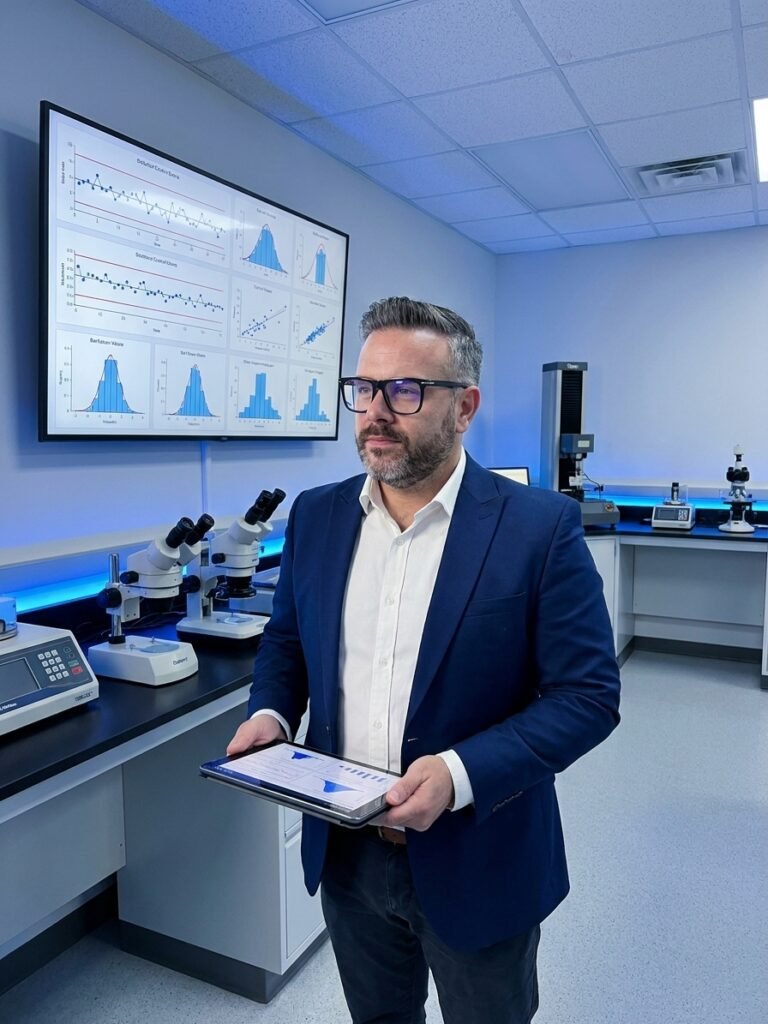
Traditional quality control relies on post-production verification, usually through Statistical Process Control (SPC) sampling or final end-of-line inspection. Servitization demands a predictive system that anticipates degradation before it impacts the operational baseline. You must identify and mitigate failure before the SLA is breached, not after a customer reports a downtime event.
The Digital Twin—a virtual replica of the physical asset—serves as the core mechanism for this predictive approach. Sensors on the installed base continuously compare real-time operational data against the engineering model. A minute deviation in vibration amplitude, temperature, or discharge pressure that a traditional QMS would never capture becomes a critical leading indicator of future bearing failure, triggering an automated maintenance request.
This capability fundamentally alters the Control Plan. Instead of defining tolerances for product geometry, engineers must define performance thresholds for the deployed system. The primary parameters become MTBF (Mean Time Between Failures), MTTR (Mean Time To Repair), mean response time to service requests, and sustained throughput. SPC charts no longer track component dimensions; they track system performance trends.
The Servitized Quality Control Loop
- 01Continuous TelemetryAsset sensors stream performance data (flow, vibration, temperature) to the cloud.
- 02Threshold DetectionSystem identifies a 5% performance drop against the digital twin baseline.
- 03Automated AlertPlatform triggers a maintenance ticket before the SLA uptime guarantee is breached.
- 04Condition-Based InterventionEngineers replace the degrading component during a planned downtime window.
Rebuilding the FMEA around Service Impact
Consider an industrial compressor manufacturer transitioning to a Compressed Air as a Service model. In a traditional PFMEA, the failure of a sealing ring might be evaluated with a Severity of 6, Occurrence of 4, and Detection of 3, yielding an RPN of 72. Under the old paradigm, this risk is documented, accepted, and forgotten.
The servitized model introduces a harsher financial reality. That same seal failure causes an air leak, the compressor cannot deliver the contractually obligated pressure, and the customer's entire production line halts. The Severity rating immediately escalates to an 8, representing a direct SLA breach with associated financial penalties. The Occurrence remains at 4, but the Detection rating drops to 2 because pressure and flow sensors connected to an IoT platform flag the degradation instantly.
The resulting corrective action also evolves. You no longer respond by adding an inspection step at final quality control. The new action is to implement automated pressure trend tracking with a threshold alert at a 5% degradation rate. Furthermore, you add predictive, condition-based replacement of the seal to the maintenance schedule. The FMEA transforms from a product risk assessment into a comprehensive service risk register.
When the customer pays for uptime, a dimensional deviation is no longer a defect; a service interruption is.
Data-Driven Audit Trails and Organizational Integration
A traditional QMS is inherently document-centric. During an ISO 9001 or IATF 16949 audit, the organization presents written procedures, training records, and final inspection certificates. Servitization demands a data-driven architecture. The customer has no interest in reviewing your quality manual; they demand a live dashboard showing real-time asset performance, degradation trends, and predictive accuracy.
This shift changes the fundamental nature of the supplier audit. The lead auditor no longer asks if a procedure for handling nonconforming product exists. They ask for the organization's predictive accuracy rate over the last 90 days. They want to see the ratio of prevented failures to total interventions. They compare the actual MTTR directly against the SLA commitment. ISO 9001:2015, with its core emphasis on risk-based thinking, is structurally prepared for this transition. Unfortunately, many organizations implemented these clauses purely on paper.
Traditional QMS vs. Servitized QMS
Product-Centric Quality
- Conformance to dimensional specification at delivery
- Reactive inspection and end-of-line sorting
- Customer initiates warranty claim upon failure
- Document-centric: procedures, certificates, manuals
Outcome-Centric Quality
- Guaranteed system performance over lifecycle
- Predictive maintenance driven by IoT telemetry
- Internal sensors flag degradation before breach
- Data-driven: live dashboards, MTBF, predictive accuracy
Contractual Risk and Cybersecurity Integration
Servitization physically dissolves departmental silos. Engineering, production, field service, IT, and quality must operate as a unified team. In the traditional model, quality reports a defect to production for containment. In a servitized model, IT detects a sensor anomaly, quality analyzes the performance trend, and service dispatches an intervention simultaneously. This demands new cross-functional competencies and a fundamentally different operational culture.
Defining the SLA itself is a rigorous engineering discipline. If the availability targets are too stringent, the supplier absorbs severe financial penalties during routine maintenance. If they are too loose, the customer perceives a lack of value and terminates the contract. The organization requires a robust measurement system, transparent data reporting, and clear, contractually defined escalation mechanisms for exceptions.
Connecting thousands of distributed assets to a central cloud platform also introduces a new dimension of quality risk. Cybersecurity is no longer an IT concern; it becomes a critical parameter of the QMS. The classic CIA triad—Confidentiality, Integrity, and Availability of data—must be integrated into the quality system. If malicious actors compromise sensor data, your predictive maintenance fails, and your SLA guarantees collapse. ISO 27001 alignment becomes as critical as IATF 16949 compliance.
Practical Implementation Steps for Manufacturers
Organizations do not need to adopt a full Product-as-a-Service model overnight. The most effective starting point for mid-sized manufacturers is a hybrid approach: continue selling the hardware, but attach a premium service package with guaranteed performance outcomes. This allows the organization to build IoT data collection infrastructure, refine predictive algorithms, and establish a baseline for system reliability without betting the entire business on immediate SLA compliance.
The technical transition begins by mapping the current QMS to identify process dependencies that assume quality terminates at the factory loading bay. The next step is defining the exact service KPIs promised to the customer—specifically uptime, response times, and throughput. These metrics immediately replace final yield rates as the primary quality indicators on the management review board.
Quality engineers must subsequently be upskilled. They need to understand data analytics, the statistical methods underpinning predictive maintenance algorithms, and the fundamentals of cloud architecture. The traditional quality inspector role evolves into a systems performance analyst. Building this capability is the critical bottleneck for most mid-market manufacturing firms aiming to compete on guaranteed outcomes rather than hardware margins.
Key Metrics Replacing Final Inspection Yield