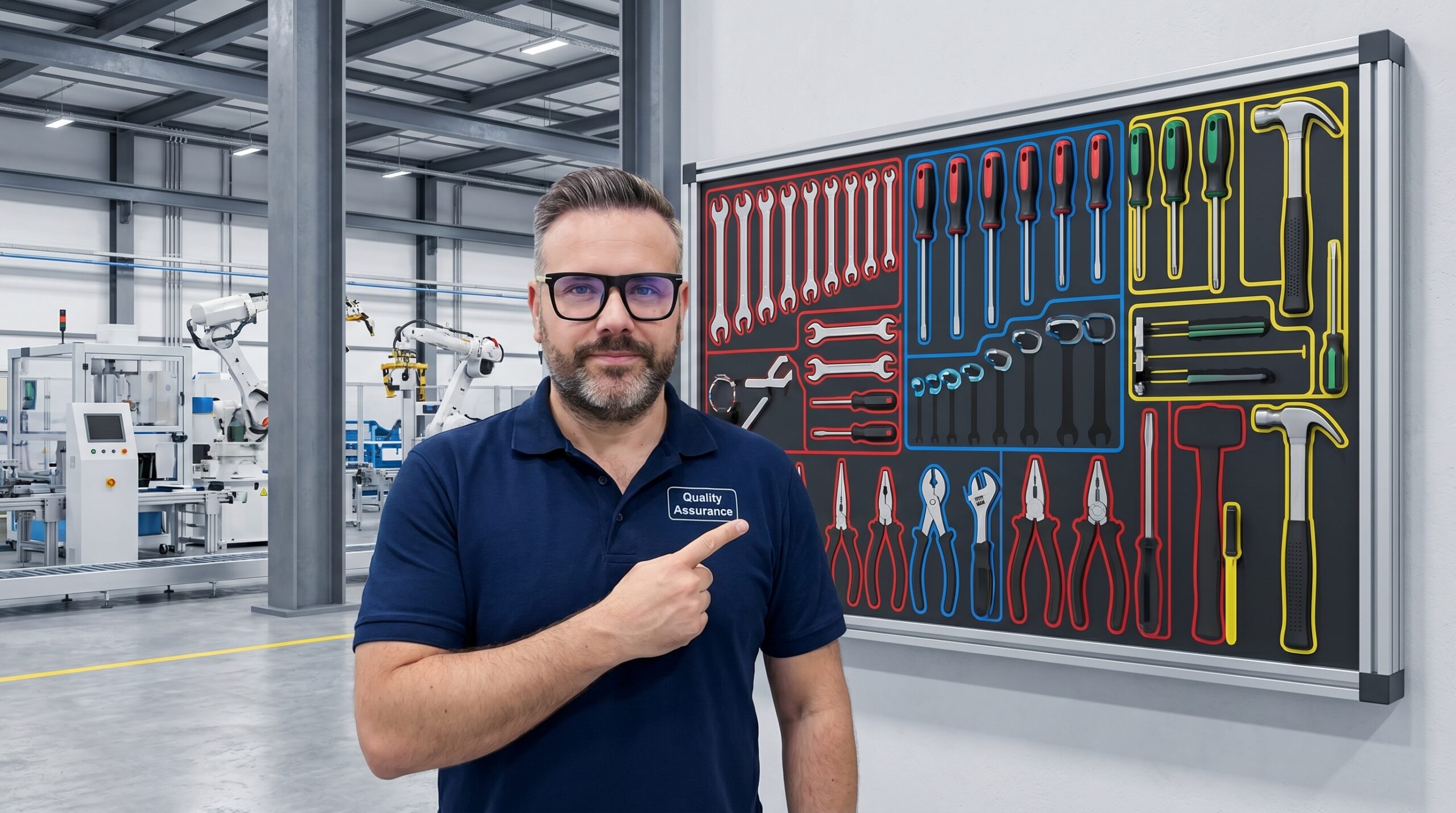
A shadow board is the simplest visual control system on the shop floor, yet plants routinely dismiss it as an aesthetic 5S exercise. This is a fundamental misunderstanding. When designed and governed correctly, a shadow board provides instantaneous verification that every tool is accounted for, replacing minutes of searching with a one-second visual sweep.
I have audited plants where unmanaged tooling directly compromised product integrity. During a transmission assembly audit, we found a 13mm wrench loose inside a housing destined for a customer. The operator’s station was cluttered with fourteen wrenches, three screwdrivers, and stray components. Nobody could confirm if the station was complete. The gap between an unorganised workstation and a field failure is dangerously short.
In aerospace, unaccounted tooling is classified as Foreign Object Debris (FOD), and it is a critical safety risk. In automotive, a wrench left in a gearbox housing causes warranty claims, recalls, and potentially catastrophic field failures. Shadow boarding eliminates this risk by enforcing tool accountability at the point of use, directly supporting compliance with AS9100 and IATF 16949 requirements for monitoring and measurement resources.
The Mechanism of Visual Control
Effective visual control relies on the principle of immediate anomaly detection. An operator using twenty tools per shift cannot reliably count them all during a shift handover. Without a defined location for each item, the handover requires opening drawers, checking under benches, and searching bins. This takes time and invites human error.
A shadow board replaces the checklist with a silhouette. If the outline of a tool is visible, the tool is missing. If the outline is filled, the tool is in its designated location. There is no counting, no searching, and no ambiguity. This one-second verification shifts tool accountability from a supervisory task to an operator standard.
Checklist vs. Shadow Board Verification
Standard Workstation Check
- Operator manually counts tools
- Requires opening drawers and bins
- Verification takes 5-15 minutes
- High risk of overlooking missing items
Shadow Board Verification
- Missing tools instantly visible
- Visual sweep takes under 5 seconds
- Verification requires zero physical searching
- Zero ambiguity in handover status
Implementation: Designing the System
Implementing a functional shadow board requires rigorous engineering, not just a panel and a marker. The first step is auditing the actual work sequence to identify every tool, fixture, and gauge used during a standard shift. Rarely used items must be relocated to a central crib. Only high-frequency tools belong on the shop floor panel.
Layout must mirror the sequential flow of the standard work. If the operator picks up a torque wrench, then pliers, then a calliper, the tools must be arranged left-to-right in that exact order. Placing them randomly forces unnecessary motion, violates ergonomic principles, and increases cycle time.
The physical design must ensure durability and contrast. Milled outlines in high-density foam or laser-cut plastic withstand industrial use far better than printed tape. The background colour must provide high contrast against the tool. A dark wrench requires a light background; a silver gauge requires a dark background to ensure the empty space is visible from a distance.
Tiered Integration for Quality Assurance
The baseline level of shadow boarding uses two-dimensional silhouettes painted or milled onto a flat surface. This is effective for stable environments but remains a passive system. It relies entirely on the operator’s willingness to look at the board.
The intermediate level introduces colour coding. Assembly tools, measurement gauges, and cleaning materials are separated by board colour or background foam. This reduces the risk of using a contaminated tool in a clean environment, or mistaking a similar-sized tool for the correct one.
The advanced level integrates the shadow board with active andon or MES (Manufacturing Execution System) logic. Tooling is fitted with RFID tags or sensors. If a tool is removed from its cradle and not returned within a specified cycle time, the system flags a fault. This prevents the line from advancing or shipping until the anomaly is cleared.
Shadow Board Maturity Levels
- Level 3: System InterlockedRFID or sensor integration with MES; line blocks if a tool is unaccounted for.
- Level 2: Colour CodedTools segregated by application to prevent cross-contamination and misapplication.
- Level 1: Silhouette OutlinesPassive visual outlines requiring manual operator verification.
Supporting IATF 16949 and VDA 6.3 Audits
Standards mandate systematic control of tooling. IATF 16949 Clause 8.5.1 requires the monitoring and measurement of resources at point of use. A well-maintained shadow board provides immediate, visible evidence of compliance. It demonstrates that the organisation controls its measurement devices and prevents unauthorised or incorrect tool usage.
In a VDA 6.3 process audit, specifically question P6.2.3 regarding the suitability of resources, a shadow board serves as primary evidence. It proves that the correct tools are available, calibrated, and stored properly. When an auditor can verify tooling status at a glance without pulling paperwork, the audit proceeds faster and with fewer nonconformities.
Visual control is not about keeping the floor clean; it is about exposing abnormality the second it occurs.
Furthermore, shadow boards directly support traceability. When a specific torque wrench or fixture is recalled for recalibration, the empty silhouette immediately identifies which station is affected. There is no need to shut down the entire line to locate a single missing gauge.
Common Implementation Failures
The most frequent failure is overpopulation. Plants attempt to place every tool ever used at the station onto the board. The result is a cluttered wall where finding the correct tool takes longer than searching a drawer. A shadow board must contain only the tools required for the current standard work.
Designing the board in an engineering office without operator input guarantees failure. Engineers understand process flow, but operators know the physical realities of the station. If the panel forces the operator to reach awkwardly or break their work sequence, they will abandon the board and lay tools on the bench.
Static systems degrade. When a product changes, the tooling changes, but the shadow board often remains unchanged. Outdated silhouettes become irrelevant, and operators lose trust in the visual control. The board must be reviewed and updated during every PFMEA review and production changeover to maintain its integrity.
Finally, a shadow board without governance becomes decorative. Rules must be absolute: every tool returns to its cradle immediately after use, and a missing tool halts production. LPA (Layered Process Audits) and shift handovers must explicitly verify the board’s completeness. Supervisory enforcement is what converts a foam panel into a quality system.