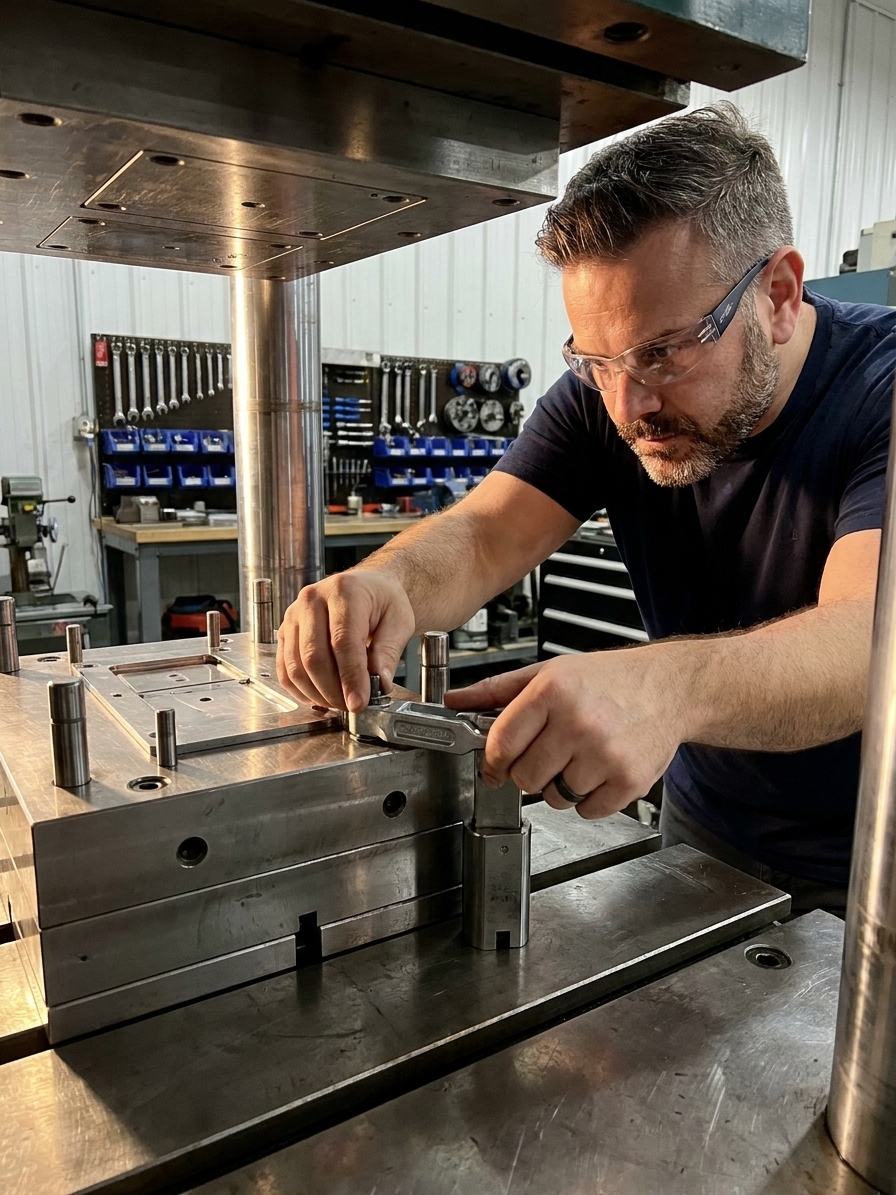
Shigeo Shingo's work at Toyota in the early 1970s proved that prolonged machine changeovers are a choice, not a technical constraint. By separating internal tasks requiring a stopped machine from external tasks that can be performed while it runs, Shingo demonstrated that changeover times could collapse from hours to single-digit minutes. This methodology, Single-Minute Exchange of Die (SMED), remains a foundational element of lean manufacturing and continuous improvement programmes worldwide.
Fifty years later, the vocabulary is everywhere, but the execution is largely absent. I have audited plants where management claims to have implemented SMED, yet the operators still spend thirty minutes fetching tools and verifying parameters while the press sits idle. Companies buy the concept, borrow the terminology, and schedule the workshops, but they do not actually change the system. They simply relabel their existing inefficiency as optimised.
The result is a pervasive and costly failure. Plants operate with the illusion of agility while bleeding capacity to unoptimised changeovers. To reclaim that capacity, quality and production engineers must stop treating SMED as an event and start dismantling the specific structural mechanisms that sabotage changeover reduction on the shop floor.
Separating Internal from External Activities
Before addressing the failure modes, we must define the discipline of task separation. Internal activities are tasks that absolutely require the machine to be stopped: removing the old die, installing the new one, and mechanical testing. External activities are tasks performed while the machine is still running the current production batch, such as transporting the next die, pre-heating tooling, gathering clamps, and pre-setting CNC parameters.
The first phase of SMED is to move as many internal activities to external time as possible. When the machine stops, operators should only execute the physical steps that demand an idle state. Everything required for the changeover must already be staged at the point of use. This requires precise scheduling and rigid logistical discipline, not just mechanical adjustments.
The second phase involves systematically eliminating or simplifying the remaining internal activities through engineering. Teams must standardise die heights, implement quick-clamp mechanisms, and utilise locating pins to eliminate iterative adjustments. If your changeover process still requires a technician to tap a die into alignment with a dead-blow hammer, you have not completed this phase. You have merely accelerated the fastening process.

The Kaizen Theatre and Scheduling Disconnect
The most common failure mode is the isolated kaizen event. A cross-functional team spends three days recording the changeover, identifying internal and external tasks, and implementing rapid fixes. The team successfully reduces changeover time by thirty to fifty percent during the workshop. Photos are taken, leadership is briefed, and the event is declared a success.
Within six weeks, the changeover time creeps back to its original baseline. The improvements decay because the quick fixes were never integrated into the daily production schedule. The workshop identified external activities that should be done before the machine stops, but the production planning system still allocates zero time for operators to perform this pre-staging. The machine stops, and the operator immediately begins fetching tools, reverting the changeover to its previous state.
SMED is an operational system, not a workshop. Sustaining the gains requires you to alter the master production schedule, reassign operator responsibilities, and restructure tool management. If the scheduler does not explicitly programme external preparation tasks into the daily run, the workshop was merely performance art. Without systemic integration, the mechanical improvements collapse under the weight of standard operating routines.
Misclassified Tasks and the False Baseline
The second failure mode traps even experienced lean practitioners. During analysis, teams categorise tasks by observing the current changeover and asking if the step requires a stopped machine. This approach builds the entire SMED analysis on decades of accumulated bad habits and unexamined routines.
An operator might spend twelve minutes during a stoppage walking to a tool crib, locating a specific wrench, and retrieving fasteners. The analysis team labels this as an internal task because the operator performs it while the machine is idle. But fetching tools requires absolutely no machine interaction. It is an internal task only because nobody questioned the preparation sequence and staged the tools beforehand.
Teams take the existing sequence, optimise within those flawed labels, and miss the core objective. The analytical question must shift. Before categorising any task, ask if the action could be completed prior to the stoppage, assuming the preparation was properly organised. If the answer is yes, you are looking at an external task currently trapped inside the internal window by poor logistics.
Unstandardised Tooling and the Adjustment Trap
Shingo's most critical technical contribution was the elimination of adjustment. Iterative adjustments—aligning the die, testing the part, re-aligning, and shimming—represent the largest waste in changeover. The solution is mechanical: employ locating pins, standardise die heights, and engineer quick-clamp systems so that tooling drops into the correct position with zero trial-and-error.
Standardisation requires precision machining of die components and disciplined storage to protect reference surfaces. Because this is difficult and unglamorous, organisations often skip it. Instead, they purchase quick-change tooling systems that accelerate bolt removal but do nothing to address alignment. The bolts come off faster, but the changeover time remains static because the operator still spends twenty minutes manually shifting the die into position.
Fastening improvements are secondary. The adjustment time is the changeover time. If your process relies on operator feel, dial indicators, and repetitive test cycles to achieve first-piece acceptance, you have not eliminated the bottleneck. You have simply bought expensive clamps for a fundamentally flawed mechanical process.
| Changeover Phase | Common Approach | True SMED Approach |
|---|---|---|
| Tool Preparation | Operator searches for tools during stoppage | Kit cart staged at machine prior to stoppage |
| Die Fastening | Standard bolts removed with impact wrench | Quick-clamp mechanisms requiring no tools |
| Die Alignment | Operator uses hammer and dial indicator | Locating pins ensure zero-adjustment drop-in |
| First-Piece Approval | Quality technician measures part at lab | Operator uses in-process gauging at machine |
First-Piece Inspection as a Hidden Bottleneck
A changeover is not complete until the first conforming part is approved. Many facilities reduce their mechanical die-change time but completely ignore the qualification phase. The period between machine setup and first-piece approval frequently takes longer than the physical changeover itself, completely negating the mechanical improvements.
The operator runs a test part and waits for the quality technician to measure it. If the part is out of tolerance, the operator adjusts the die and runs another test. Each iteration consumes fifteen to thirty minutes, particularly if the technician is covering multiple production lines. This cycle of trial and error punishes any deviation in setup accuracy and creates a massive bottleneck in OEE (Overall Equipment Effectiveness).
True SMED addresses this by pre-setting process parameters so the first part is intentionally close to nominal, not just acceptable for testing. It also requires shifting measurement to the point of use. You must equip operators with functional gauges and train them to perform first-piece verification immediately, eliminating the wait time for a roaming quality inspector. If your mechanical changeover is ten minutes but first-piece approval takes forty-five, you have relocated the bottleneck, not eliminated it.
If your mechanical changeover is ten minutes but first-piece approval takes forty-five, you have relocated the bottleneck.
The Discipline of Changeover Measurement
If you ask a plant manager for the average changeover time of a specific press and the answer is an estimate, SMED will fail in that facility. What gets measured gets managed; what gets estimated gets ignored. Effective changeover reduction demands granular, visible data, not subjective operator feedback or monthly production summaries.
SMED System Health Indicators
Every changeover must be timed from start to finish, with key sub-steps recorded independently. Die-out time, die-in time, and first-good-part time must be logged on a board visible at the machine, not buried in a spreadsheet. This visibility forces immediate accountability and highlights variation in operator performance or tooling conditions.
When Tuesday's changeover takes fifteen minutes and Thursday's takes thirty-five, you must investigate the deviation immediately. Without tracking this data, there is no baseline to measure against and no mechanism to detect regression. The discipline of measurement drives the discipline of improvement. Without it, the SMED workshop produces a temporary spike in efficiency, and because nobody monitors the baseline, nobody notices when the gains evaporate.