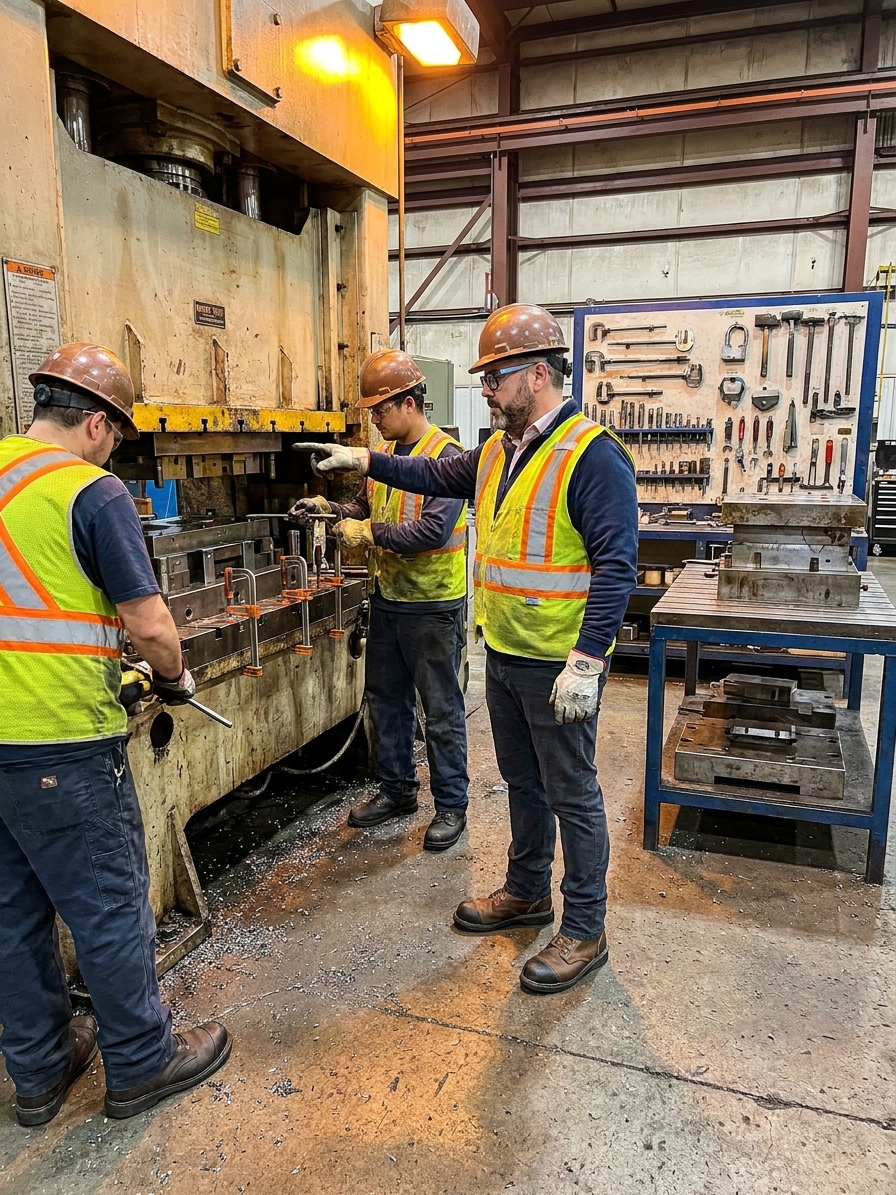
Single-Minute Exchange of Die (SMED) is one of the most universally recognised Lean tools. Developed by Shigeo Shingo at Toyota in the 1950s and 1960s, it fundamentally changed how manufacturers think about setup operations. The concept is elegant: separate setup activities into internal operations that require the machine to be stopped, and external operations that can be performed while the machine is still running. Then systematically convert as many internal operations as possible into external ones, and streamline what remains.
The mathematics are compelling. If a stamping press runs fifteen changeovers a week and each one takes three hours, cutting that to thirty minutes yields over five hundred hours of recovered capacity per week without buying a single new machine. Done correctly, SMED unlocks small-batch flexibility, slashes work-in-progress inventory, and allows a plant to respond to customer demand in real time.
Yet in my experience auditing and recovering manufacturing plants across automotive and industrial sectors, the methodology rarely sticks. A consultant or internal Lean champion runs a kaizen event. The team video-records a changeover, analyses every step, and orders quick clamps. The setup time drops during the event week. Six months later, it has crept back to baseline. The problem is not that SMED does not work. The problem is that most companies treat it as a one-time engineering project rather than an ongoing operational discipline.
The Typical Trajectory of a Failed Implementation
Here is what happens on the factory floor. A SMED kaizen event begins with high enthusiasm. The team creates a detailed spaghetti diagram of operator movement, identifies dozens of improvement opportunities, and stages external setup tables. Standard work is rewritten. Quick clamps are ordered and installed. The changeover time drops from four hours to ninety minutes during the event week, and everyone celebrates the apparent victory.
Then the team disbands. The external setup tables slowly migrate back into storage. Operators revert to hunting for tools during the changeover because the shadow boards were never enforced. The quick clamps fail because maintenance never calibrated the hydraulic unit. No one updates the video analysis when the process changes, and the recording is buried in a shared drive where nobody can find it. The changeover time regresses to three hours and forty-five minutes.
What went wrong is that the organisation invested in mechanical improvements but neglected the systemic conditions that make those improvements hold. They treated the video as the deliverable rather than the diagnostic tool. They failed to define a changeover team, failed to measure the baseline honestly, and failed to capture mechanical modifications in their engineering change order system. The framework collapsed because it had no scaffolding.

The Core Failure: Internal-to-External Conversion Never Happens
The heart of SMED is the internal-to-external conversion. This requires something most plants resist: staging materials and tools before the machine stops. Operators need to prepare dies, fixtures, bolts, and measuring instruments in advance, often twenty or thirty minutes before the actual changeover begins. This preparation must happen during the previous production run.
In practice, the previous job runs until the last possible second because every minute of production counts against the schedule. When the machine finally stops, operators scramble to find tools and materials during the changeover. The external preparation that should have happened during the previous run gets absorbed into the internal time, defeating the entire purpose of the methodology.
The fix requires leadership conviction. Build external setup into the production schedule. The last fifteen minutes of a run are not production time; they are next-job preparation time. This looks like giving up capacity. It is not. You are investing it in flexibility. Without this shift, the mathematical foundation of SMED collapses and no amount of quick-clamp hardware will save you.
Hardware Without Standard Work Is Scrap Metal
I have visited plants where tens of thousands of dollars were spent on hydraulic clamping systems, quick-change die plates, and pre-set tooling. On the shop floor, operators were still bolting things down manually because the new system did not hold tolerance, or because maintenance had never calibrated the hydraulic unit. The hardware degraded into unused capital equipment because standard work was never updated.
Mechanical improvements are necessary but insufficient. Every mechanical modification from a SMED event must be paired with a revised standard work document, a training session for all affected operators across all shifts, and a thirty-day audit cycle to verify adoption. If the standard work does not photographically document each step, assign it to a named role, and specify tool locations, it will not survive contact with the factory floor.
Engineering changes suffer the same fate. A locating pin shears off and is not replaced because it is not in the spare parts list. A pre-set mark wears away and is not re-machined. An intermediate plate is removed during a maintenance overhaul and never reinstalled because the procedure does not mention it. Every mechanical modification must enter the CMMS, the preventive maintenance schedule, and the spare parts inventory. If your maintenance system does not know about it, it does not exist.
Why SMED Sustains in Some Plants and Fails in Most
What teams do
- Treat the changeover video as a deliverable and file it in a shared drive
- Run production until the last second, then scramble for tools during setup
- Install quick clamps but leave standard work documents unchanged
- Assign whoever is available to the changeover with no defined roles
What works
- Re-record changeovers quarterly, compare them, and use them in onboarding
- Dedicate the last fifteen minutes of a run to staging the next job
- Pair every mechanical improvement with revised standard work and a thirty-day audit
- Assign specific changeover roles and rotate operators through deliberate practice
Measurement, Teams, and the Pit Stop Standard
Most plants do not know their current changeover time honestly. They know what the ERP system says the changeover should take. They may know the last recorded time from a SMED event eighteen months ago. But they do not measure changeover time routinely, with consistent definitions of start and finish. Does the clock start when the last good part comes off the machine, or when the operator begins preparing? Does it end when the first good part is produced, or when the machine reaches full cycle time?
Inconsistent measurement makes it impossible to track whether you are improving or regressing. Define changeover time with a precise, unambiguous start and end point. Measure it every time. Track it on a run chart visible to the production team, not in a spreadsheet reviewed by management monthly. Trend it weekly. The act of honest measurement drives immediate behavioural change on the floor.
Your changeover time is not a technical problem. It is a management problem.
In high-performing plants, changeovers are choreographed. Each operator knows their role, their sequence, their tools, and their position. It looks like a Formula 1 pit stop. In most plants, changeovers are improvisational. Whoever is available pitches in. The die is staged differently depending on which shift is running. One operator sets the first piece; another checks it twenty minutes later. Assign specific changeover roles visually. Define who retrieves the die, who prepares tools, who cleans the machine bed, and who performs the first-article check.
The Sustained Changeover Sequence
- 01T-minus 15 minutesNext-job staging begins: dies, fixtures, and measuring tools moved to point of use
- 02Machine stopPrevious run ends; internal changeover begins with all materials pre-staged
- 03Parallel operationsAssigned roles execute in sequence: clean bed, mount die, set stops, secure clamps
- 04First-article checkDesignated operator verifies dimensions against control plan before cycle resumption
The Four Pillars Framework for Sustaining SMED
After implementing and recovering SMED programs across automotive, electronics, consumer goods, and heavy machinery sectors, I have developed a framework that prevents regression. I call it the Four Pillars: Measurement, Standardisation, Practice, and Ownership. Each pillar addresses a specific systemic failure that causes mechanical improvements to degrade.
Pillar 1 is Measurement. Install a simple changeover log at each machine, whether paper, whiteboard, or digital. Record the start time, end time, operator names, and issues encountered. Review the log daily during the first ninety days, then weekly. You cannot improve what you do not measure consistently. The log makes the gap between planned availability and actual setup time visible to the people who can close it.
Pillar 2 is Standardisation. Every changeover has a documented standard work sheet with photographs, not just text descriptions. Each step is assigned to a named role. Tools are shadow-boarded and positioned at point of use. The standard is version-controlled and updated whenever a process change is made. Pillar 3 is Practice. Run monthly changeover drills where the team performs the setup while being timed and observed. This is how Formula 1 pit crews achieve two-second tyre changes: not through hardware alone, but through relentless, deliberate practice.
Pillar 4 is Ownership. Assign a changeover owner for each critical machine, typically a senior operator or team leader. This person maintains the standard work, updates the changeover log, orders spare parts for modified components, and trains new operators. Without clear ownership, the system drifts. The owner is the single point of accountability who ensures that the scaffolding holds after the kaizen event ends.
Financial Proof: A Tier-1 Automotive Recovery
Consider the numbers from a real engagement at a tier-1 automotive supplier. The plant was running sixteen changeovers per week on a stamping press, averaging two hours and forty minutes per changeover. Total weekly changeover time was forty-two hours and forty minutes, the equivalent of more than one full shift of lost capacity. They needed to absorb a volume increase without purchasing additional equipment or adding a shift.
Through a disciplined SMED implementation using the Four Pillars framework, they reduced average changeover to fifty-two minutes within four months and sustained it at forty-eight minutes at the twelve-month mark. The recovered capacity, roughly thirty hours per week, allowed them to absorb the volume increase entirely. The total investment was twelve thousand dollars in mechanical modifications and approximately two hundred hours of internal labour.
The payback period was under three weeks. The difference between this outcome and the typical six-month regression was not the tools or the technique. It was the commitment to measurement, standardisation, practice, and ownership. The mechanical improvements were standard: quick clamps, locating pins, and a pre-set staging table. The systemic discipline was what held them in place.
When SMED Is the Wrong Answer
SMED is not universally applicable, and deploying it where it does not belong wastes resources. If a plant runs a single product with infrequent changeovers, the return on investment will be low regardless of execution. If the bottleneck is downstream in inspection, packaging, or material handling, reducing changeover time will not increase throughput. It will simply move the waiting and may worsen WIP accumulation at the constraint.
If the demand profile is stable and predictable, large-batch production may be economically optimal, and the flexibility gains from fast changeovers may not justify the investment of management attention and capital. SMED delivers the highest value in environments with high product mix, volatile demand, or where work-in-progress reduction is a strategic priority driven by customer requirements or cash flow constraints.
Before launching a SMED program, map the value stream and verify that faster changeovers will actually address a binding constraint. Apply the theory of constraints first. If the changeover operation is not the bottleneck, improving it will not increase overall equipment effectiveness or plant throughput. The discipline of SMED is worth nothing if applied to the wrong process.