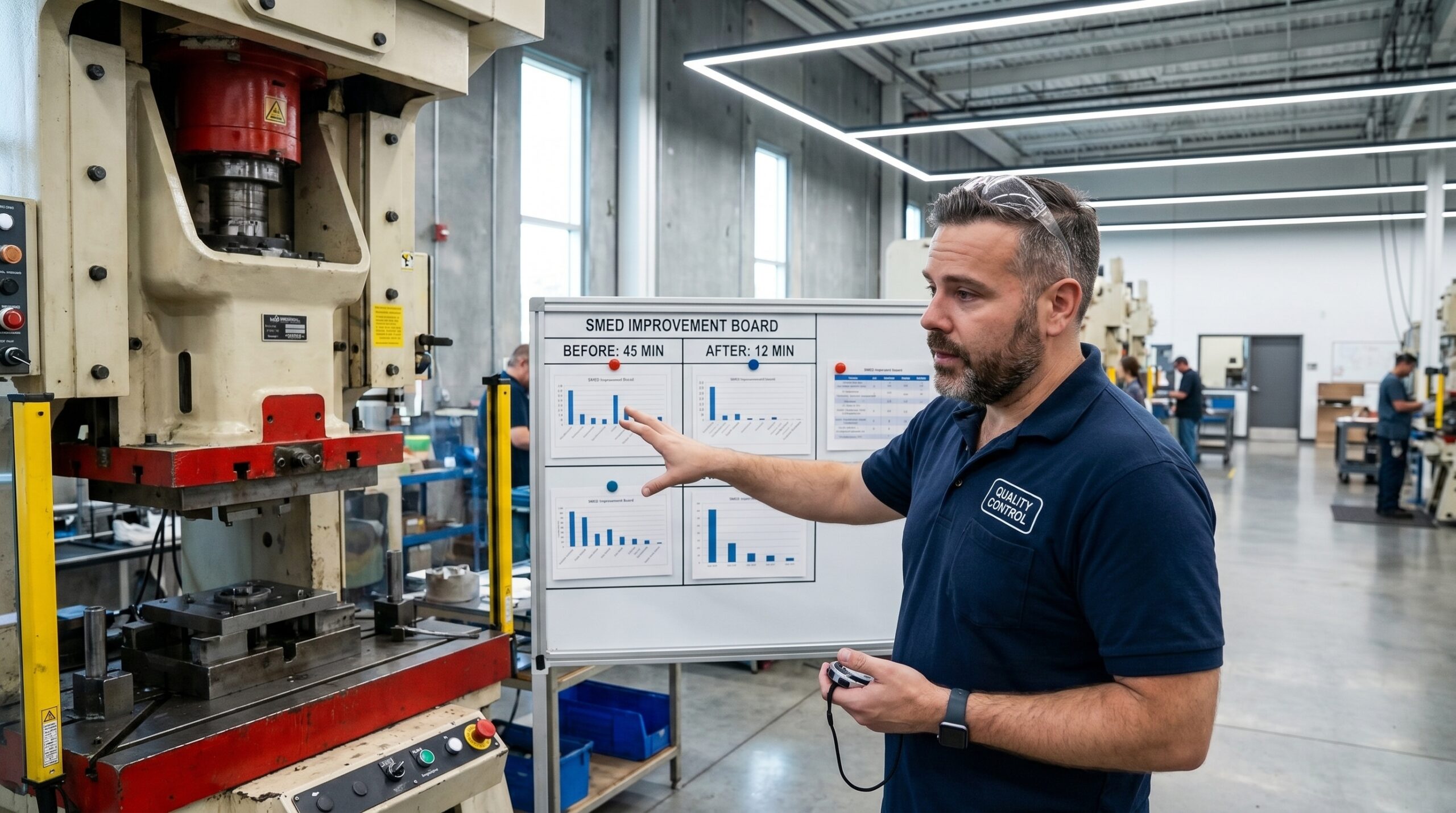
Single-Minute Exchange of Die (SMED) is the systematic reduction of equipment setup time. Developed by Shigeo Shingo at Toyota and Mazda in the 1960s and 1970s, the methodology fundamentally altered the economics of batch manufacturing. Yet, most manufacturing facilities today still operate with changeovers that consume hours of capacity when they could take minutes.
The persistence of long setup times is rarely a technology problem. It is a classification problem. Planners, engineers, and operators accept historical setup constraints as fixed, building large buffers of work-in-process inventory to compensate. They run massive batches because the cost of stopping the machine seems too high. This drives up lead times and conceals quality defects.
Implementing SMED correctly requires demolishing the assumption that every setup task requires the machine to be stopped. It demands rigorous process observation, the physical reorganization of the workspace, and the elimination of mechanical adjustments. The objective is not incremental improvement. The objective is a single-digit-minute changeover.
Separating Internal and External Work
SMED rests on one foundational principle: not all setup tasks are equal. Internal tasks are those that can only be performed when the equipment is stopped, such as removing the old die and running the first trial part. External tasks are those that can be performed while the machine is still running its current production, such as gathering tools, pre-staging materials, and transporting the next tool to the line.
The first operational step in SMED is separation. Document every step of the current changeover and classify it strictly as internal or external. The goal is to reorganize the sequence so that all external tasks happen entirely outside the machine stop window. This alone typically cuts setup time in half before any hardware is modified.
In most uncontrolled changeovers, operators fetch tools, read instructions, and search for fasteners while the machine sits idle. I have audited plants where 50 to 70 percent of recorded setup time consisted of external tasks being performed as internal tasks. Moving these tasks out of the downtime window requires no capital investment, only discipline.
To identify this waste, use a setup observation sheet during a live changeover. Record what actually happens, not what the standard operating procedure dictates. Better yet, record the entire process on video. Walking across a facility to find a specific wrench is invisible on a production report, but on video, the wasted capacity becomes impossible to defend.

Converting Internal Tasks to External Operations
Once external tasks are properly separated, the next objective is conversion. This involves modifying the process so that a task currently classified as internal—requiring the machine to be stopped—can be performed externally while the machine is still running. This requires mechanical ingenuity and changes to tooling management.
A primary conversion strategy is standardizing the mounting interface through adapter plates. If every die or mold has a different bolt pattern, nothing can be pre-aligned. By outfitting all tools with a common adapter, operators can pre-mount and pre-align the new tool on a rolling cart while the previous job is still running.
Thermal management is another critical conversion lever. In die-casting and injection molding, the new tool must reach operating temperature before production can begin. If the tool is pre-heated in an auxiliary oven during the current production run, the internal setup time is drastically reduced. Quick-connect fittings for hydraulic, pneumatic, and cooling lines function the same way, eliminating the internal time spent manually disconnecting and reconnecting utilities.
Stage 1 vs. Stage 2 SMED Application
Stage 1: Separation
- Reorganizes existing workflow
- Requires zero capital investment
- Identifies external tasks done during downtime
- Typically reduces setup time by 50%
Stage 2: Conversion
- Modifies tooling interfaces and staging
- Requires engineered adapter plates and carts
- Shifts internal heat-up and alignment externally
- Drives setup time into single-digit minutes
Streamlining Remaining Internal Operations
After conversion, the facility is left with only those tasks that genuinely cannot be performed while the machine is running. Stage three focuses on streamlining these remaining internal operations through elimination and standardization. The primary targets for elimination are adjustments.
Adjustments—shimming, dialing in, and aligning—are the silent killers of setup time. Shingo argued that adjustments are evidence of inadequate standardization. If a die requires an operator to manually dial it into position, the process is uncontrolled. By implementing fixed stops, locating pins, and standardized dimensions, the need for adjustment disappears. The tool only fits in one position: the correct one.
Next, eliminate fasteners where possible. A bolt requires multiple turns and wastes internal time. Hydraulic clamps and toggle clamps require a single motion to secure. If a fastener is strictly necessary, use bolts with truncated threads that engage quickly. Finally, utilize parallel operations. Assigning two operators to work simultaneously on opposite sides of a machine halves the internal time compared to a single operator walking back and forth.
Adjustments are evidence of inadequate standardization. If the process requires an operator to dial it in, the process is out of control.
The Mathematics of Batch Sizing
Changeover reduction is not an exercise in operational tidiness; it fundamentally alters production economics. The traditional Economic Order Quantity (EOQ) model calculates optimal batch size based on the assumption that setup cost is high. Therefore, long setups dictate large batches, which in turn drive up work-in-process inventory and extend lead times.
SMED attacks the EOQ equation directly. By drastically reducing setup time, the cost of a changeover approaches zero. When changeover cost drops, the economic justification for massive batches disappears. A facility can produce smaller lot sizes, switch products more frequently, and level production according to actual customer demand rather than internal machine constraints.
The mathematical relationship is absolute. Halving your setup time allows you to halve your batch size without losing production capacity. This halves your work-in-process inventory, frees up cash flow, and prevents the accumulation of obsolete stock. Toyota leveraged this logic to run mixed-model schedules with 100-piece batches while Western competitors were running 10,000-piece batches to amortize their multi-hour setups.
Capacity Triggers for Batch Economic Shifts
Overcoming Organizational Resistance
The most common barrier to SMED is the argument that there is no time to improve the changeover. The plant is behind on production, so management demands output, not process engineering. This creates a vicious cycle: long changeovers consume capacity, creating an urgency that prevents the very improvements needed to free up capacity.
Break this cycle by choosing one constraint machine. Execute a rapid SMED event, implement the quick wins from the separation phase, and demonstrate the time savings. The freed capacity serves as the proof point for expanding the methodology. Arguing for a plant-wide rollout without a demonstrated local success will fail.
Operator resistance is the second major hurdle. Experienced operators have developed personal shortcuts for complex changeovers. Handing them a new, rigid SMED standard feels like an erosion of autonomy. The solution is direct involvement. Operators must be the ones identifying waste during the video analysis and proposing mechanical modifications. SMED done to operators is resented; SMED designed with operators is sustained.
A Field-Tested Implementation Sequence
Sustainable SMED requires a structured, time-bound execution. Begin by selecting the changeover that causes the most operational pain—the longest duration, the most frequent occurrence, or the one that dictates the master production schedule. Do not attempt simultaneous pilot programs across different departments. Isolate one target, document the baseline, and analyze the mechanics.
Implement the new process under real production conditions. Time the new changeover strictly from the last good part of the previous run to the first good part of the next run. Finally, lock in the gains. If you do not update the standard work instructions, install visual management aids like tool shadow boards, and enforce the new pre-staging checklists, the process will regress to its historical baseline within weeks.
The Five-Phase SMED Kaizen Sequence
- 01Document BaselineVideo the entire changeover; record every step from last good part to first good part.
- 02Classify TasksCategorize every action as internal or external; quantify the waste in searching and walking.
- 03Redesign WorkflowMove external tasks outside the stop window; design pre-staging carts and standardized kits.
- 04Streamline InternalEliminate manual adjustments using locating pins; replace bolts with hydraulic clamps.
- 05StandardizeUpdate SOPs, train all shifts, and implement visual controls to prevent regression.