SMED
— Single-Minute Exchange of Dies: When Your Changeover Stops Being a
Coffee Break for the Entire Factory and Starts Being a Competitive
Weapon
How Shigeo Shingo’s deceptively simple idea turned setup time
from a cost center into a profit engine — and why most companies still
do it wrong.
The Six-Hour Graveyard
Picture this. It’s 1982, a mid-sized stamping plant in Nagoya, Japan.
The press operator pulls the last good part from die set number seven,
wipes his hands on a rag, and signals the changeover team. What happens
next has happened the same way for years.
The power cuts. The old die is unbolted — forty-two bolts, each one
requiring a wrench, each one fighting against years of accumulated grime
and thread damage. The crane swings into position. The old die is lifted
out, carried to storage, deposited. The new die is retrieved,
positioned, lowered. Then the real pain begins: shimming, aligning,
adjusting, test-running, measuring, readjusting. Bolts are torqued. The
first trial parts are dimensionally checked. They fail. More shimming.
More trials. More failures.
Six hours later, the press runs again. Six hours of dead time. Six
hours of a multi-million-yen machine sitting idle while a team of four
technicians wrestled with a task that added exactly zero value to the
product.
Now picture the same plant, twelve months later. Same press. Same die
change. The operator pulls the last part and triggers a countdown timer.
Ninety seconds. One clamp release. The old die slides out on precision
rails. A pre-staged cart rolls into position. The new die slides in. Two
hydraulic clamps engage. The first trial part runs. Good. The timer
stops.
Eight minutes and forty-three seconds.
Not six hours. Not four hours. Not even one hour. Under ten minutes —
single-digit minutes. That’s what Shigeo Shingo called “single-minute
exchange of dies,” and the transformation you just witnessed didn’t
require new equipment, a bigger budget, or a miracle. It required a
different way of thinking about the work that happens between
the work.
The Man Behind the Minutes
Shigeo Shingo was not a man who accepted “that’s how we’ve always
done it” as an answer. An industrial engineer by training and a
relentless observer by nature, Shingo spent decades studying
manufacturing processes with the intensity of a surgeon studying
anatomy. He believed that every operation — even the ones nobody
questioned — contained waste waiting to be exposed.
In the late 1960s and early 1970s, Shingo was consulting for Toyota
and its supplier network when he encountered a stubborn problem. The
economic batch size calculation that governed production planning said:
the longer your setup takes, the more parts you should run before
switching. Long setups meant large batches. Large batches meant
high inventory. High inventory meant waste — the very thing Toyota was
trying to eliminate through its emerging Toyota Production System.
The conventional solution was predictable: buy faster machines,
automate the changeover, invest capital. Shingo’s solution was radical
in its simplicity: study the setup itself, separate what must be
done while the machine is stopped from what can be done while it’s
running, and then systematically eliminate, simplify, or convert every
remaining step.
He didn’t write a textbook about it. He went to the gemba — the
actual shop floor — and he watched. He timed every motion. He questioned
every bolt. And in 1969, at Mazda’s Hofu plant, he achieved something
that changed manufacturing forever: a 1,000-ton press changeover reduced
from four hours to under three minutes.
Three minutes. For a thousand-ton press.
The SMED methodology was born. And fifty-seven years later, most
manufacturing plants in the world still haven’t fully implemented it.
Let’s talk about why.
The Core Logic: Two Kinds of
Work
SMED rests on one foundational insight that is simultaneously obvious
and almost universally ignored: not all setup tasks are created
equal.
Shingo divided setup operations into two categories:
Internal Setup (IED
— Internal Exchange of Die)
Tasks that can only be performed when the machine is
stopped. Removing the old die. Installing the new die. Adjusting
alignment. Running the first trial piece. Every minute spent here is a
minute of lost production.
External Setup (OED
— External Exchange of Die)
Tasks that can be performed while the machine is still
running the previous job. Gathering tools. Pre-staging the new
die. Pre-heating molds. Transporting materials to the machine.
Transporting the old die away. These tasks consume time but not
machine time.
The first and most powerful step in SMED is simply separating
internal from external. Not eliminating anything yet. Not
investing in new technology. Just asking the question: “Does this
step require the machine to be stopped?” If the answer is no, move
it. Do it before the machine stops or after it starts again.
You would be amazed — genuinely amazed — at how many setup tasks are
performed during machine downtime that could have been done an hour
earlier. Tools that are fetched only after the machine stops. Bolts that
are searched for in a drawer while the press sits idle. Instructions
that are read for the first time when the clock is already running.
Shingo observed that in most factories, 50 to 70 percent of
setup time consisted of external tasks being performed as internal
tasks. Simply reorganizing the workflow — moving external tasks
outside the stop window — typically cuts setup time in half before any
other improvement is made.
Half. Before you change a single tool, buy a single clamp, or modify
a single fixture.
The Three Stages of SMED
Shingo structured the methodology into three conceptual stages, each
building on the last. Think of them as waves — each one reveals a new
layer of waste that the previous layer had hidden.
Stage One: Separate
Internal and External
This is the foundation. Document every step of the current
changeover. Time each one. Categorize each as internal or external. Then
reorganize the sequence so that all external tasks happen before the
machine stops or after it restarts.
The practical tools for this stage are deceptively simple:
- Setup observation sheet: A trained observer records
every action, every walk, every wait, every search during a live
changeover. Not what the SOP says should happen — what actually
happens. - Video analysis: Record the entire changeover on
video. Then sit down with the team and watch it together. The waste
becomes visible in a way that no report can convey. Walking across the
shop floor to retrieve a tool is invisible on paper. On video, it’s
painful. - Parallel operations mapping: Identify which tasks
can be done simultaneously by different people rather than sequentially
by one person.
A Stage One application in a pharmaceutical packaging plant I
consulted for reduced a format changeover from 3 hours and 20 minutes to
1 hour and 45 minutes. No capital investment. No new equipment. Just
reorganization of existing tasks. The team was stunned. They had been
living with that waste for years and never seen it.
Stage Two: Convert
Internal to External
Now the thinking deepens. Having already separated internal from
external, the next question becomes: which of the remaining
internal tasks can we convert to external? Can we modify the
process so that something that currently requires the machine to be
stopped can now be done while it’s running?
Common conversion strategies include:
- Pre-staging dies and fixtures on rolling carts:
Instead of fetching and positioning the new die after the machine stops,
have it sitting on a precision-aligned cart, ready to roll into position
the moment the old die is removed. - Pre-heating molds and dies: Many molding and
die-casting operations require the new tool to reach operating
temperature. If you heat it in an oven while the machine is still
running the previous job, you eliminate a massive chunk of warm-up
time. - Using intermediate fixtures and adapter plates: If
every die has a different bolt pattern, you can’t pre-align anything.
But if you standardize the mounting interface — a common adapter plate
that accepts multiple dies — you can pre-mount and pre-align the new die
on its adapter while the machine runs. - Using quick-connect fittings for utilities:
Hydraulic lines, cooling water, electrical connections — these are often
disconnected and reconnected one at a time during internal setup.
Quick-connect couplings allow instant engagement and disengagement.
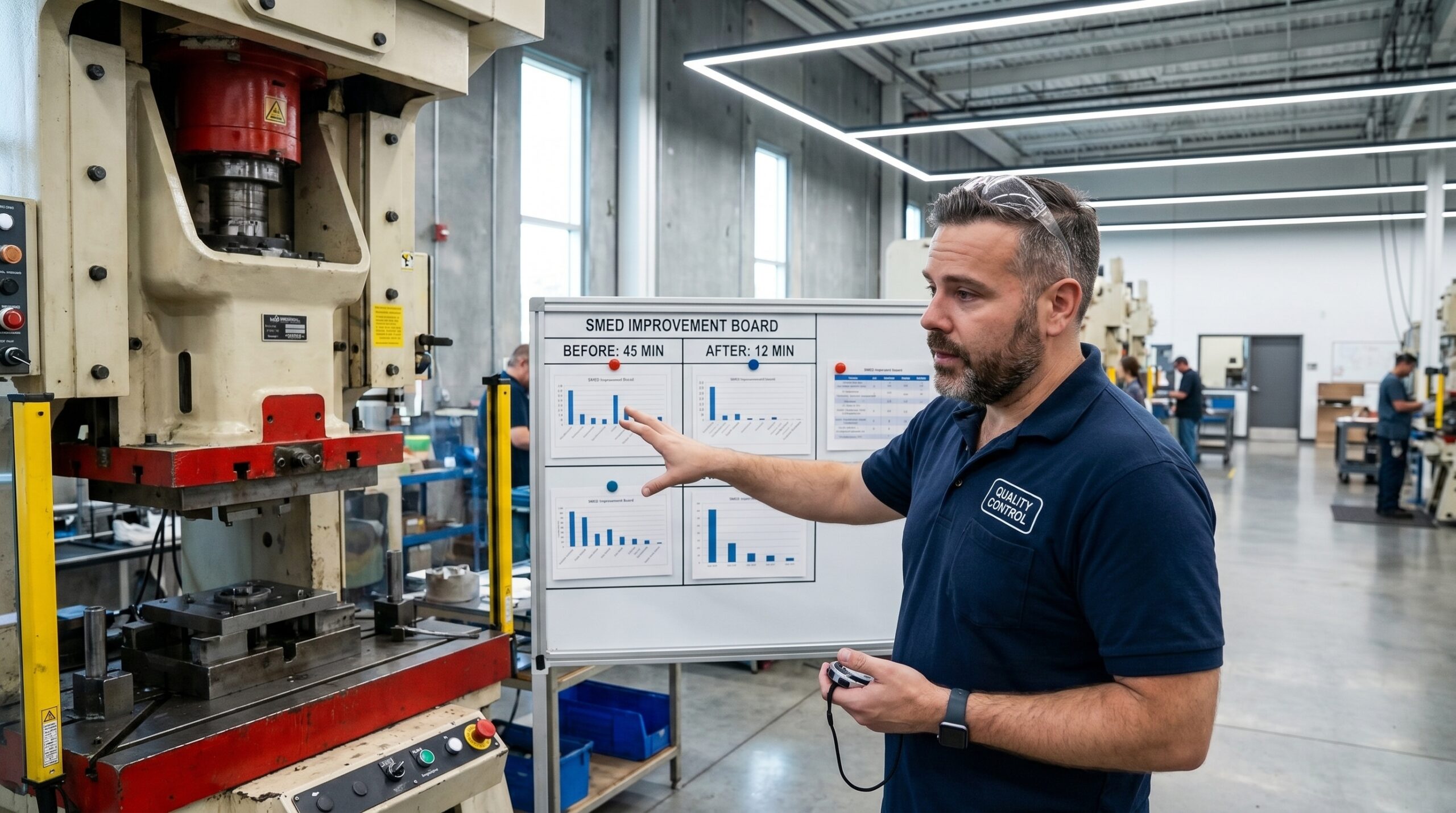
A Tier 1 automotive supplier I worked with converted their injection
molding changeover from 45 minutes to 12 minutes primarily through
adapter plates and pre-staged material carts. The adapters cost $3,000
per mold. The downtime savings were $180,000 per year per machine.
Stage
Three: Streamline Remaining Internal Operations
Now you’re left with only those tasks that genuinely cannot be moved
outside the machine stop window. The final stage attacks these with
elimination and simplification:
- Eliminate adjustments: Adjustments — shimming,
aligning, dialing in — are the silent killers of setup time. Shingo
argued that adjustments are evidence of inadequate standardization. If
you use fixed stops,定位 pins (locating pins), and standardized
dimensions, the need for adjustment disappears. The die doesn’t need to
be “dialed in” because it only fits in one position — the correct
one. - Eliminate fasteners where possible: Shingo famously
observed that bolts are often used where clamps would be faster. A bolt
requires multiple turns. A hydraulic clamp requires one motion. A toggle
clamp requires one flip. If something must be bolted, use bolts with
truncated threads that engage quickly. - Use parallel operations: Have two people working
simultaneously on opposite sides of the machine instead of one person
walking back and forth. - Standardize tooling dimensions: If every die has
the same height, width, and mounting pattern, changeover becomes a swap
operation rather than an engineering exercise.
The
Mathematics of Changeover: Why This Matters More Than You Think
SMED isn’t just about saving a few minutes. It fundamentally changes
the economics of production.
The traditional Economic Order Quantity (EOQ) model says that the
optimal batch size is a function of setup cost and inventory carrying
cost. High setup cost → large batches → high inventory. But in a lean
system, inventory is waste. So the goal becomes: reduce setup
cost to reduce optimal batch size.
Consider a machine with: – Setup time: 4 hours – Run rate: 100
parts/hour – Demand: 500 parts/day
With a 4-hour setup, running less than a full day’s production is
wasteful — you’d spend almost as much time setting up as producing. So
the natural tendency is to run large batches, build inventory, and
switch infrequently.
Now reduce the setup to 10 minutes. Suddenly, you can afford to run
smaller batches. You can respond to demand changes faster. You can
produce a mixed model schedule without catastrophic downtime.
Work-in-process inventory drops. Lead times shrink. Flexibility
increases.
The mathematical relationship is brutal in its clarity: halve
the setup time, and you can halve the batch size without losing
capacity. This means halving your work-in-process inventory,
halving your lead time, and dramatically improving your ability to
respond to customer demand.
Toyota understood this decades before its Western competitors. While
American plants were running 10,000-piece batches because their setups
took hours, Toyota was running 100-piece batches because their setups
took minutes. Same machines. Same products. Fundamentally different
economics.
The Human Factor:
Why SMED Fails in Practice
If SMED is so powerful and so logical, why hasn’t every factory in
the world implemented it? The answer has nothing to do with technology
and everything to do with human behavior.
“We don’t have
time to improve the changeover.”
This is the most common objection, and it’s a trap. The plant is
behind on production, so there’s no time to stop and improve the
process. But the reason the plant is behind is that too much time is
being lost to changeovers. It’s a vicious cycle: bad changeovers consume
capacity → capacity shortfall creates urgency → urgency prevents
improvement → bad changeovers persist.
The only way out is to break the cycle deliberately. Choose one
machine. Choose one changeover. Apply SMED. Prove it works. Use the
freed capacity to justify doing more.
“Our changeovers are
too complex for SMED.”
SMED has been successfully applied to: – Plastic injection molding
(35 min → 3 min) – Stamping presses (4 hr → 8 min) – CNC machining
centers (65 min → 7 min) – Paint booth color changes (45 min → 5 min) –
Pharmaceutical packaging lines (3.5 hr → 35 min) – Food processing
(flavor/recipe changes) (90 min → 15 min) – Printing presses (color
changes) (60 min → 12 min)
Complexity is not a barrier. Complexity is a signal that there’s more
waste to eliminate.
“We already did SMED.”
Did you? Or did you do Stage One (separate internal from external),
get a 40% reduction, declare victory, and stop? Most SMED
implementations achieve the easy gains in Stage One and then lose
momentum. The deep transformations — the elimination of adjustments, the
standardization of interfaces, the conversion of internal operations —
require sustained effort and creative thinking. They’re harder. They’re
also where the real breakthroughs live.
“Operators resist the
changes.”
Of course they do. Changeover has been “their” work for years.
They’ve developed personal techniques, shortcuts, and rhythms. SMED asks
them to abandon all of that and follow a standardized, timed process. It
can feel like a loss of autonomy.
The solution is involvement. Operators must be part of the SMED team
from the beginning. They must be the ones identifying waste, proposing
improvements, and testing ideas. SMED done to operators is
resented. SMED done with operators is owned. And owned
improvements are sustained improvements.
A Practical Implementation
Roadmap
If you’re reading this and thinking “I need to do this in my plant,”
here’s a field-tested approach:
Week 1: Select the target. Choose the changeover
that causes the most pain — the longest duration, the most frequent
occurrence, or the one that constrains the schedule. One machine. One
changeover. Don’t try to boil the ocean.
Week 2: Document the current state. Video-record the
complete changeover from the last good part of the old run to the first
good part of the new run. Have an observer record every step, every
walk, every wait, every tool retrieval, every conversation. Build a
detailed step-by-step map with timestamps.
Week 3: Analyze and categorize. Sit down with the
team — operators, maintenance, engineering — and classify every step as
internal or external. Identify the “moments of waste”: searching,
walking, adjusting, waiting. Quantify them. Make the waste visible.
Week 4: Redesign the process. Move all external
tasks outside the machine stop window. Design pre-staging protocols.
Create standardized tool kits. Implement quick-connect solutions. Assign
parallel operations. Build the new standardized work sequence.
Week 5: Implement and measure. Execute the new
changeover process under real production conditions. Time it. Compare to
baseline. Identify remaining opportunities. Iterate.
Week 6: Standardize and sustain. Document the new
process as the standard. Train all operators. Create visual aids at the
machine — setup sequence boards, tool shadow boards, pre-staging
checklists. Establish a regular audit cadence to prevent regression.
Beyond: Expand. Apply the same methodology to the
next changeover. And the next. Build internal capability. Train SMED
practitioners. Make rapid changeover a core competency, not a one-time
project.
The Deeper Lesson:
Seeing Waste Everywhere
SMED is ultimately about seeing. It’s about standing in front of a
process that everyone accepts as “normal” and asking: what if it
didn’t have to be this way?
Shigeo Shingo didn’t invent new technology. He didn’t build better
machines. He watched. He questioned. He challenged assumptions that had
been unchallenged for decades. And in doing so, he changed the
fundamental economics of batch manufacturing.
The next time you walk past a machine sitting idle during a
changeover, ask yourself: how much of that waiting is necessary,
and how much is just… tradition?
The answer might surprise you. And it might just change
everything.
Peter Stasko is a Quality Architect with over 25
years of hands-on experience in manufacturing excellence, quality
systems, and operational transformation. He has led SMED implementations
across automotive, pharmaceutical, and consumer goods industries,
helping plants reduce changeover times by 60-90% without capital
investment. Peter specializes in making complex methodologies practical,
accessible, and results-driven — because the best improvement system is
the one people actually use.