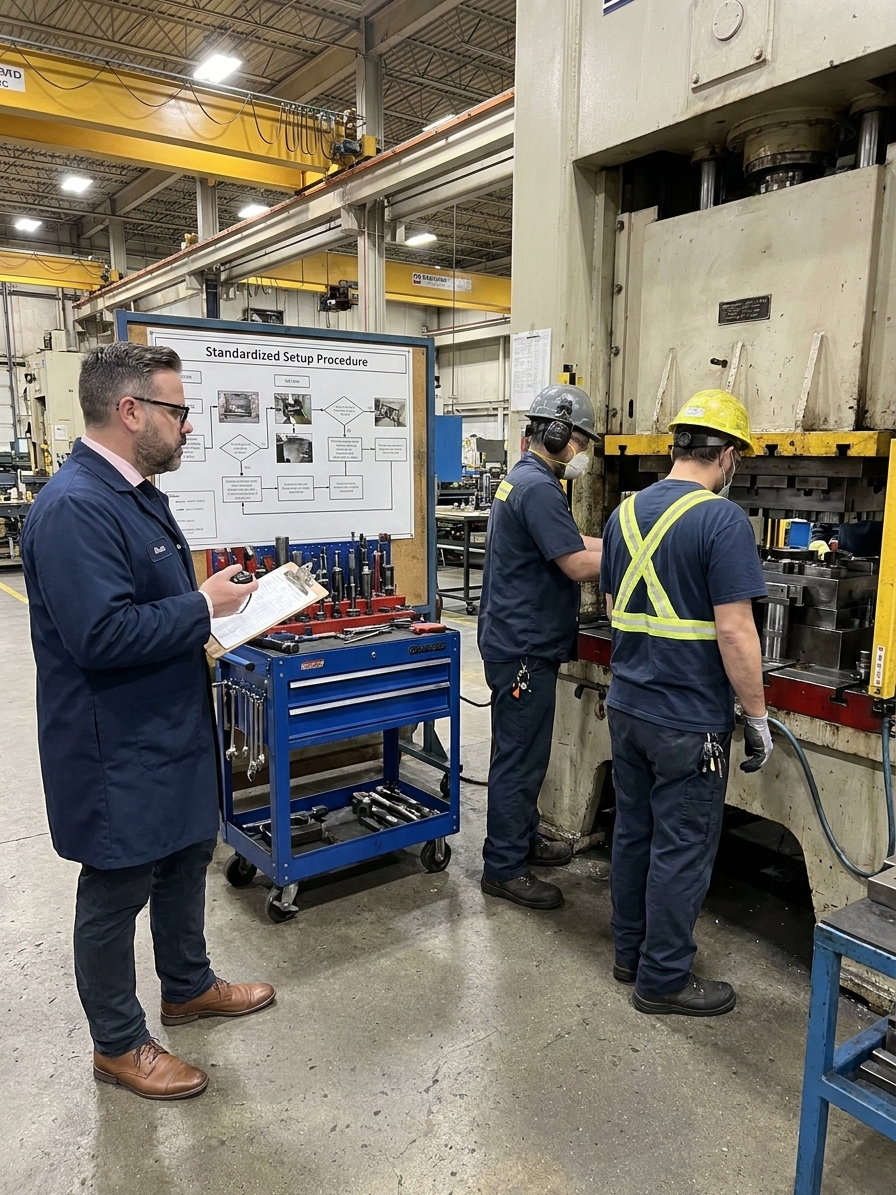
Most SMED implementations are structured as one-time optimization events. A consultant arrives with a stopwatch, a changeover is video-recorded, and quick wins are implemented. The changeover time drops. Leadership applauds the 47-minute reduction. Six months later, the changeover creeps back to its original duration because nobody maintained the standardized procedures.
When changeover reduction is treated as an event, the systematic approach Shigeo Shingo developed at Toyota in the 1950s loses its purpose. The goal was never just a lower number on a chart. The goal was manufacturing flow: the ability to produce what the customer wanted, when they wanted it, without the penalty of long setups forcing massive batch sizes.
I have audited plants where the SMED report was framed on the wall while the actual changeover had regressed by 40 percent. The flexibility the methodology was supposed to deliver became the exact opposite: massive inventory built in long runs because nobody on the floor dared switch the line. The gap between the report and reality is where the real work begins.
The Four Stages of Genuine SMED
Single-Minute Exchange of Die targets single-digit-minute changeovers through four distinct technical stages. The first stage separates internal setup, done while the machine is stopped, from external setup, done while the machine is still running. Most plants fail at this baseline distinction. Operators routinely stop the press, then walk to the warehouse to find tools, converting external preparation into wasted internal time.
The second stage converts internal time to external time. This is where the real production capacity is recovered. Pre-heating dies, pre-positioning tools on staging carts, and pre-setting gauges are done while the current product is still running. Every second of internal time converted to external time is a second of recovered press uptime.
The third stage streamlines the remaining internal setup. Bolts are eliminated in favor of quick clamps. Heights are standardized so no adjustment is needed. Locating pins replace manual alignment. The fourth stage eliminates adjustments entirely. If an operator is adjusting a die position, the die design is wrong. The target is definitive setup: the die drops in, the pins locate, the clamps lock, and the press runs.

The One-Time Event Trap and the Good Enough Plateau
The kaizen week ends, the team disbands, and the video camera goes back into the cabinet. The quick-clamp bolts installed during the event break, and maintenance replaces them with standard bolts to get the line running. The pre-staging cart is repurposed for another cell. Tools go missing from the standardized shadow board and are never replaced. Without ownership, the improvements decay.
Plants often reduce a changeover from 90 minutes to 45 minutes and stop. The production scheduler can tolerate 45 minutes, operators stop complaining, and leadership has a number for the quarterly review. But a 45-minute setup remains a massive penalty. It forces the scheduler to build large batches to amortize the cost, work-in-process piles up between operations, and the plant loses its ability to respond to customer demand changes.
The facilities that pioneered this methodology never stopped attacking the waste in the process. They reduced press changes from hours to minutes, and minutes to seconds, by treating changeover reduction as a permanent operational discipline. They never accepted the plateau because they understood that any setup time exceeding a few minutes dictates batch size and locks up working capital.
Engineering Out the Adjustment Addiction
Adjustments are the single biggest time sink in a changeover. An operator spending twenty minutes tweaking die positions and fine-tuning pressures is compensating for a process that was never properly standardized. Plants that are serious about setup reduction engineer these variables out of existence rather than relying on floor-level craftsmanship.
They design dies that locate themselves using kinematic mounts. They use precision shims of known thicknesses instead of trial-and-error positioning. They map process parameters for every product and load them as recipes directly into the machine controller. No operator judgment is required, and the first part produced after a changeover is a good part.
Most plants refuse to make this engineering investment. They reorganize the work area and create standardized checklists, then wonder why their changeover reduction has stalled. They have exhausted the organizational improvements and hit the engineering wall. Further gains require capital projects, self-locating tooling, and sensor-verified positioning.
The SMED Sustainment Gap
What teams do during the event
- Record setup times with a consultant's stopwatch
- Install quick clamps to replace manual bolts
- Stage tools on a dedicated mobile cart
- Celebrate the initial 50% time reduction
What sustains the gain
- Log setup times in the MES and trend them daily
- Maintain clamp inventory and audit standard work
- Assign explicit ownership of the staging area
- Attack remaining adjustments via engineering roadmap
The External Setup That Never Happened
A common failure mode is claiming external setup without actually executing it. The die is supposed to be pre-heated while the current product runs, but the pre-heater broke months ago and nobody submitted a work order. The new material is supposed to be queued at the line, but the warehouse hasn't received the signal. The machine stops, and the external preparation instantly becomes internal time.
This failure is directly tied to Total Productive Maintenance. Dies and fixtures that are poorly maintained stick, jam, and misalign. A well-maintained die drops into the press cleanly. A neglected one requires hammering, prying, and persuasion. If your 5S foundation is weak, operators cannot find tools in under ten seconds, and your external setup time is an illusion.
The measurement gap accelerates this decay. If you do not measure changeover time consistently, you cannot manage it. Many plants measure setup time during the event, track it for a few weeks, and then stop. Worse, they fail to define what changeover complete means. If the system does not clearly mark the transition from the last good part of Product A to the first good part of Product B, the numbers are fiction.
Standard work that isn't audited isn't standard. It is a suggestion that will eventually be ignored.
Building a System That Sticks
Real setup reduction is measured every single time. The changeover time goes into the production tracking system, is logged on the shift handover report, and appears on the shop floor board. Deviations trigger an 8D investigation. The data is visible to operators, supervisors, and management, making the capability measurable rather than aspirational.
External setup becomes a strict prerequisite, not a suggestion. A checklist is verified before the machine is permitted to stop. If the tools are not staged, the die is not pre-heated, and the material is not queued, the changeover does not begin. This rule requires a changeover team or an explicitly designated owner who plans, rehearses, and executes the sequence like a racing pit crew.
The culture actively rewards small batches. Plants running large batches because it appears more efficient are gaming their own metrics by ignoring inventory carrying costs, obsolescence risk, and delayed response times. Changeover reduction makes pull systems viable, directly improving OEE by cutting availability loss without inflating batch sizes to hide the downtime.
The Setup Reduction Execution Sequence
- 011. Measure baselineLog setup times for 30 days, breaking down prep, stop, and first-good-part times.
- 022. Eliminate obvious wasteStage tools, organize the area, and standardize sequences for a fast 30-40% gain.
- 033. Convert internal to externalPre-heat dies and pre-stage materials while the machine is still running.
- 044. Engineer out adjustmentsImplement self-locating dies and recipe-driven parameter control.
- 055. Audit standard workVerify the procedure regularly to prevent regression to old habits.
Integrating SMED Into the Quality System
Changeover reduction cannot exist in isolation from the broader quality management system. IATF 16949 and AS9100 demand controlled processes, and an uncontrolled setup is a source of process variation. If your PFMEA does not identify setup variation as a risk, your preventive action plan has a blind spot. Integrating setup times into your OEE tracking and capacity planning is mandatory.
The PPAP process provides a mechanism for locking in setup improvements. When you engineer a new quick-clamp system or change a die locating mechanism, that change must be validated. The revised setup procedure becomes part of the Control Plan, and operator training is updated accordingly. This prevents the engineering improvement from degrading back to the old method.
Without this systemic integration, the gap between the quarterly review slide and the shop floor reality will continue to widen. The uncomfortable truth is that sustaining SMED requires more engineering discipline, quality system rigor, and daily measurement than initiating it. The plants that succeed ask one question every single day: how long did the changeover actually take, and what are we engineering out of the next one?