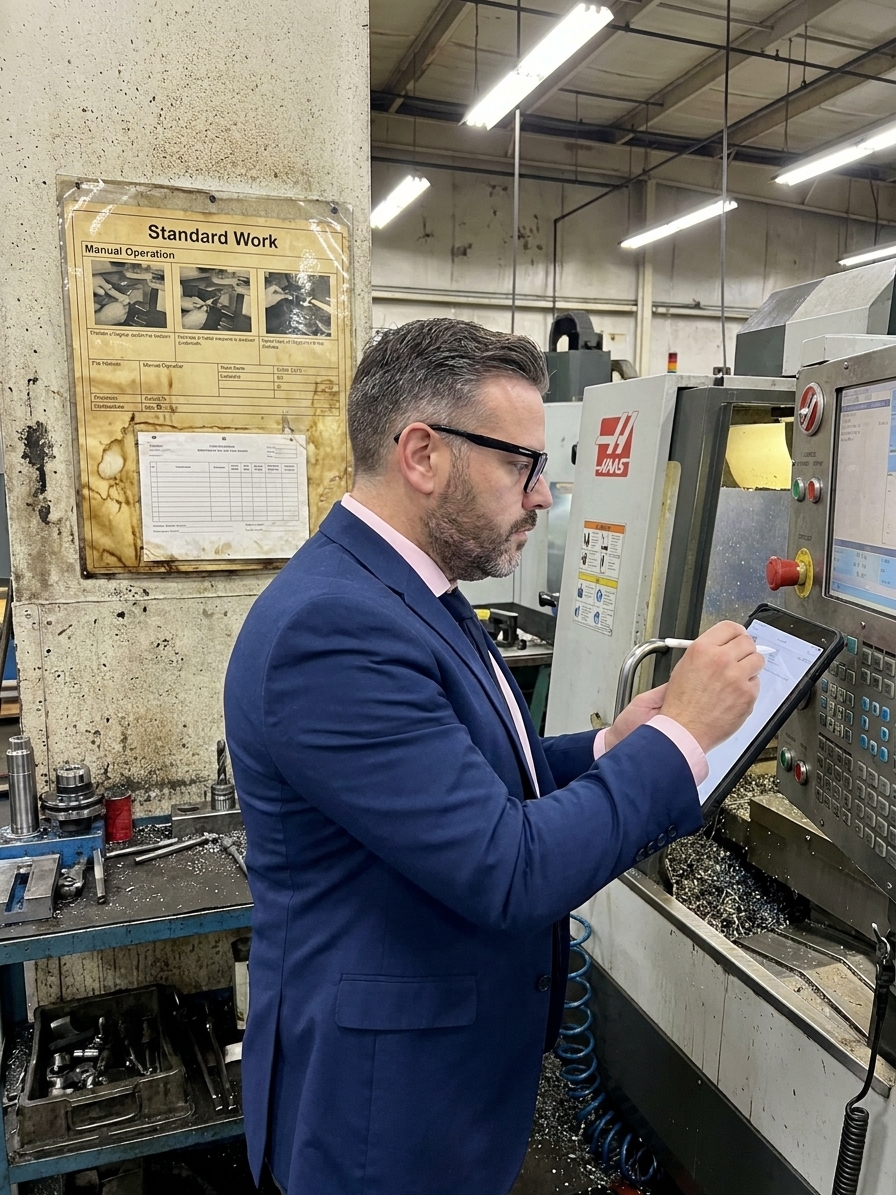
Standard Work is the documented, observed, and agreed-upon best method for performing a task. It is the current best-known way, captured as a baseline for continuous improvement. The Toyota Production System is built on it, and every credible lean framework demands it. Yet in the majority of factories I audit, Standard Work is functionally dead.
The documents still exist. They live in bright binders mounted at workstations and appear in ISO 9001 and IATF 16949 audit checklists. But they are not alive. Nobody follows them, nobody updates them, and nobody uses them as a basis for improvement. They are tombstones marking a process that was studied once, documented once, and then abandoned.
The tragedy is that Standard Work is not complicated. You figure out the best way to do something, write it down, train everyone to it, and then improve it. Yet organisations that attempt it usually end up with documents that are ignored, outdated, or actively misleading. Across hundreds of facilities, I see the same four failure modes destroying this fundamental tool.
The Document Written and Forgotten
The most common failure mode is entirely predictable. An engineer or quality manager, responding to an audit finding or customer complaint, decides to implement Standard Work. They go to the gemba, watch the process, time the cycles, and document every step with meticulous care. They create Standard Work Combination Sheets with cycle times, takt times, and walk patterns plotted in perfect detail.
They laminate the documents, mount them at the workstation, train the operators, and check the box. Then they leave. The document is never updated. The process changes — a new fixture is added, a step is reordered, a different material arrives — but the Standard Work stays frozen. Within three months, the document no longer reflects reality. Within a year, it has become invisible furniture.
This is the fundamental misunderstanding: Standard Work is not a document, it is a practice. The document is merely the artifact. If the practice of observing, updating, and improving does not continue, the document becomes a lie. A Standard Work sheet that does not reflect the actual process is worse than no document at all, because it creates the illusion of control where none exists.
I have seen external auditors review Standard Work documents that were five years old, compare them to the actual process being performed three feet away, and note no discrepancy on their audit report. The operators were doing something completely different. But the auditor checked the box because the document existed and the operator signed the training record. Compliance cultures measure the presence of the document instead of the accuracy of the standard.
The Standard Nobody Agreed To
The second failure mode is more subtle. In many organisations, Standard Work is written by engineers, not by the people who actually do the work. An industrial engineer sits at a desk, studies process data, and writes the standard. The document is then deployed to the floor through a brief training session, and operators are expected to comply.
The people doing the work were not involved in creating the standard. They possess practical knowledge the engineer lacks — the micro-adjustments, the workarounds, and the physical realities of the workstation. When the standard is imposed from above without incorporating this knowledge, the outcome is either silent rebellion or institutionalised inefficiency.

In the first scenario, operators nod politely during training and go back to their own methods. The engineer, having moved on, never notices. In the second scenario, operators actually comply, and the process gets worse. The theoretical best method did not account for material variation or machine idiosyncrasies. By forcing compliance to a suboptimal standard, the organisation institutionalises a worse process than what operators had developed through years of tacit learning.
The solution is structural: involve operators in creating the standard. This requires time — time for the engineer to observe, time for the operator to contribute, and time for iteration. Standard Work that is co-created takes longer to develop but is vastly more durable. People follow standards they helped write. People ignore standards imposed on them.
The Standard That Is Never Improved
The third failure mode cuts to the heart of the concept. The phrase current best-known method contains a critical word: current. Standard Work is not the final answer. It is the starting point for the next improvement. When someone finds a better method, you update the standard so everyone benefits immediately.
This is the improvement engine Toyota made famous: Standard Work, kaizen, new Standard Work, kaizen. Each cycle raises the baseline. The standard is not a ceiling; it is a floor that keeps rising. In most organisations, the floor never moves. There is no mechanism for operators to suggest improvements and no regular cadence for review.
The Standard Work Improvement Cycle
- 01Observe and DocumentRecord the actual current best-known method as performed on the shop floor, capturing operator knowledge.
- 02Train and StabiliseRoll the documented standard out to all shifts, ensuring consistent execution and gathering feedback.
- 03Identify GapFind a deviation, bottleneck, or operator workaround that outperforms the current baseline.
- 04Kaizen and UpdateTest the improvement, verify the results, and immediately update the Standard Work document.
Instead of an improvement engine, the culture says: if you are doing something different from the standard, you are out of compliance. Every small innovation and efficiency gain operators discover is lost. It lives in the operator's hands and dies there. The next operator who takes over the workstation never inherits the improvement, and the organisation pays for the same learning repeatedly.
This is the most expensive failure mode because it is a failure of learning. An organisation that cannot capture improvements in its standards cannot learn. It is doomed to repeat the same mistakes and rediscover the same solutions forever, trapping institutional knowledge in individual headcount.
The Standard Used as a Weapon
The fourth failure mode is the most destructive. In some organisations, Standard Work is not a tool for improvement but a weapon for discipline. When something goes wrong — a defect, a delay, an injury — the first question asked is whether the operator followed the standard. If the answer is no, the operator is blamed, the investigation ends, and the root cause is recorded as operator deviation.
When Standard Work becomes a blame instrument, operators stop deviating even when the standard is demonstrably wrong. They follow the procedure exactly as written, even when they can see it producing defects, because the consequence of deviating is punishment. Quality drops, throughput drops, but the compliance metrics look perfect on paper.
Operators also start hiding deviations. When they discover a better method, they do not report it. When the standard produces a bad result, they find an undocumented workaround. The gap between the documented process and the actual process grows wider every day, but nobody can see it because everyone has learned to perform compliance for the auditors.
I have seen factories where the Standard Work compliance rate was 100 percent on paper and the defect rate was 25 percent in reality. Every operator was following the standard, and every operator was producing scrap. The standard was wrong, but nobody could say so without admitting deviation. So they followed the wrong standard and blamed the materials.
Rebuilding the Practice of Standard Work
Standard Work can be resurrected, but it requires a structural shift in how the documents are managed and perceived. The first requirement is to make the standard observable. Standard Work must reflect what is actually happening, not what an engineer theorises should happen. Go to the gemba, watch the process, and document reality. If operators have developed different methods, document all of them and let the team select the best one.
Compliance Culture vs. Improvement Culture
Compliance Culture
- Deviations are punished and hidden
- Audits verify paperwork exists
- Standards are static and permanent
- Root cause is automatically operator error
Improvement Culture
- Deviations are investigated as potential improvements
- Audits verify the standard matches reality
- Standards are updated continuously
- Root cause examines the process, not the person
The second requirement is to make the standard living. Put a mandatory review date on every Standard Work document. Assign a specific owner — a team leader or supervisor who works in that area, not a distant engineer. Schedule a monthly or quarterly review. Make it easy for operators to propose changes through a simple suggestion card or a five-minute shift huddle. When someone proposes an improvement, test it, and if it works, update the standard the same day.
The third requirement is to make the standard a shared commitment. Stop using Standard Work as a blame instrument. When a defect or deviation occurs during an 8D investigation, the question must shift from asking if the operator followed the standard, to asking if the standard itself is correct. This moves the focus from individual blame to system improvement.
A Standard Work document that does not reflect the actual process is worse than no document at all.
Measuring What Actually Matters
If your Standard Work documents are more than six months old and have not been reviewed by the people who do the work, they are not standards. They are artifacts of a system that once functioned and has decayed into compliance theater. You can measure the health of your Standard Work system with one simple question: when was the last time an operator proposed an improvement that was incorporated into the standard?
If the answer is never or unknown, your system is fundamentally broken. You have documents, but you do not have standards. You have compliance, but you do not have learning. You have the appearance of control, but you do not have operational excellence.
The organisations that get Standard Work right — observing reality, keeping it living, treating it as shared — do not just have better compliance metrics. They have higher Cpk values, fewer customer escapes, and more stable processes. Standard Work done correctly is about respect for the people who do the work and the knowledge they hold. The standard is not the document. The standard is the practice.