I have audited plants where three shifts produce the same part to the same specification, yet deliver radically different quality outcomes. Shift A carefully verifies every step and runs a 0.3% scrap rate. Shift B prioritises rhythm and flow, hitting 1.8% scrap. Shift C relies on veteran shortcuts, pushing scrap to 3.4%. Management often tolerates this because the plant averages out to an acceptable internal figure.
This tolerance collapses during a customer audit. When an IATF 16949 auditor asks to see the standardised work instructions, the documentation usually says 'install component' or 'secure fastener.' Every shift is technically compliant because the document is hopelessly ambiguous. The worst enemy of standardisation is not operator rebellion; it is procedural vagueness that permits wide interpretation.
Standard work is the documented, verified, and agreed-upon best-known method for performing a task. It is not a rigid script designed to turn operators into machines. It is the baseline you must establish before you can execute continuous improvement. Without a stable, standardised process, any attempt at root cause analysis during an 8D investigation becomes guesswork.
Building the Five Elements of Standard Work
Effective standard work requires five interconnected elements. Most organisations handle the first one, writing a procedure, and ignore the rest. This is why quality management systems fail to control variation on the shop floor. The elements must work together to transform a documented process into a reliable, repeatable outcome.
First, you need the current best method. This is a specific sequence of actions, not vague directives. Instead of 'align carefully,' the standard must dictate 'align notch A with mark B, apply 12 Nm torque using calibrated wrench #7.' The specificity must match the criticality of the step and the skill level of your newest qualified operator. If a novice cannot follow it, the standard is insufficient.
Second is takt time, which sets the rhythm of production. Standard work must be achievable within customer demand. If your best method takes five minutes but takt demands three and a half, you do not force operators to speed up. You improve the method or rebalance the line. Third is the precise work sequence. Changing the order of assembly tasks alters ergonomics, cycle time, and ultimately the Cpk of the process.

Completing the Framework: Stock and Visual Management
The fourth element is standard in-process stock. You must define exactly how many pieces belong at each station to maintain flow. Too little stock creates rushing and increases the risk of defects. Too much stock masks process imbalances and creates complacency. The right quantity establishes the precise conditions required for quality.
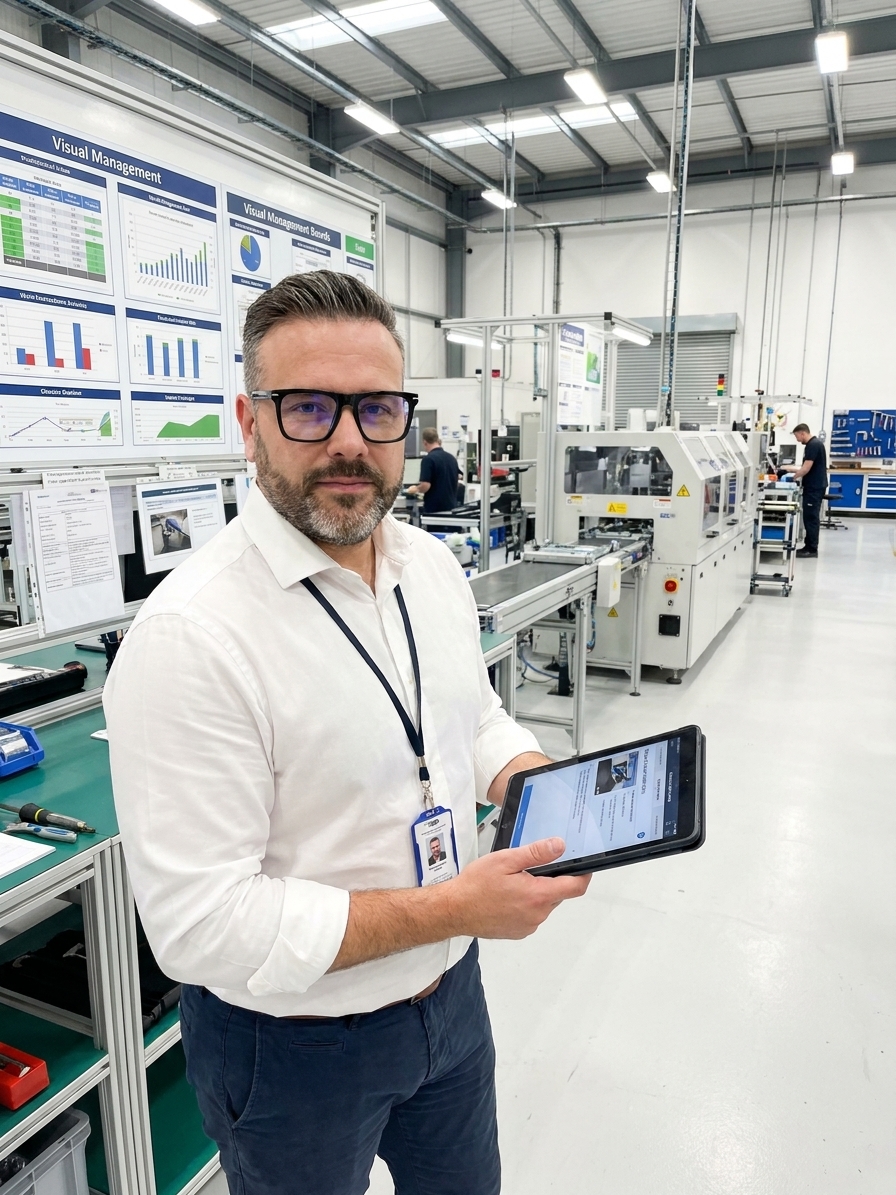
Finally, there is visual management. Standard work that sits in a binder on a supervisor's desk is dead documentation. It must be visible at the point of use, posted directly at the workstation. If an AS9100 or VDA 6.3 auditor walks up and the operator cannot show you the current standard for their job within thirty seconds, you have documentation theatre, not standard work.
These five elements transform abstract procedures into physical reality. They remove the guesswork that leads to shift-to-shift variation. When these elements are fully integrated into daily operations, they establish a predictable baseline that supports reliable production scheduling and accurate capacity planning across the entire value stream.
Why Engineering and Management Resist Compliance
Standard work faces resistance from exactly the people who should champion it. Engineers often believe that good product design should be self-evident. If a work instruction requires extreme detail, engineers argue the design itself is flawed. But the factory floor includes new operators, fatigue, and distraction. Detailed standard work is the safety net that catches what self-evident design misses in the real world.
Veteran operators resist because standardisation feels like an insult to their expertise. A machinist with fifteen years of experience does not want to be told how to tighten a bolt. Standard work is not about insulting the expert. It is about building a system that produces expert-level results when the expert is on holiday, sick, or retired.
Managers resist standard work because it exposes variation they prefer to ignore. If three shifts use three different methods and the scrap averages out to 1.2%, leadership can claim the process is under control. Standard work tears that comfortable average apart. It exposes the 3.4% scrap rate hiding behind the mean, forcing management to allocate resources to fix the underlying process.
Attitudes Toward Standard Work
The common resistance
- Engineers believe procedures should be self-evident
- Veterans feel their expertise is being undermined
- Managers tolerate variation if averages look acceptable
- Organisations fear documenting what actually happens
The operational reality
- Detailed work catches real-world distraction and fatigue
- Systems must produce quality even when experts are absent
- Averages mask costly defect spikes on specific shifts
- Honest documentation is the prerequisite for improvement
Creating Verified Standard Work at the Gemba
Creating effective standard work requires rigorous observation. You must go to the gemba and watch the actual work being performed. Ignore what the ISO 9001 procedure states. Record every step, every motion, and every hesitation across all shifts. The variation you observe between operators doing the 'same' job will immediately highlight the flaws in your current documentation.
Next, identify the best performers. Do not look for the fastest operator or the most senior employee. Find the operator who most consistently produces conforming product with the least waste. Study their technique. Document the specific key points and micro-adjustments they make that are absent from the official training materials. This undocumented expertise is your new baseline.
Document this best method visually. Photograph the correct alignments and record short videos of the optimal motions. Include the key points and the reasons behind them. A ten-page text document will never be read on the shop floor. A single-page visual standard, anchored by photographs and critical torque values, gets referenced daily.
Without standard work, there can be no improvement. A shifting baseline makes progress impossible to measure.Taiichi Ohno
Testing, Training, and the Digital Dimension
You must test the documented standard before rolling it out. Have your newest qualified operator perform the task using only the newly written standard. If they produce nonconforming output, your standard lacks specificity. Refine the instructions, test again, and repeat until a novice can achieve the expected result reliably without verbal intervention.
Once verified, train everyone using hands-on methods at the workstation. The trainer demonstrates, the trainee performs, and the trainer verifies competency. This directly supports your PFMEA and control plan requirements. Once deployed, audit compliance regularly. When an operator discovers a better method, validate it through your MSA and process validation steps, then update the standard immediately.
Digital work instructions and IoT monitoring are valuable Industry 4.0 tools, but digitising a bad standard only creates expensive mediocrity. Digital systems are only effective if they make updating the standard frictionless. If changing a work instruction requires a complex change request and multiple signatures, your organisation will simply stop improving the document.
Standard Work Creation Cycle
- 01Observe RealityWatch actual operations across all shifts to identify hidden variation.
- 02Capture Best MethodDocument the specific techniques of the most consistent, lowest-waste operator.
- 03Validate with NovicesTest the written standard on newly qualified operators to ensure clarity.
- 04Train and AuditDeploy at the workstation and audit regularly to drive continuous updates.
Measuring Standard Work Maturity
The ultimate test of standard work maturity is how leadership responds to deviation. When an operator deviates from the standard and produces a good result, do you congratulate their initiative, or do you investigate? If you congratulate them, you do not have a standard. The correct response is to analyse the deviation, test if it is genuinely better, and make it the new global standard.
When an operator deviates and creates a defect, punitive discipline destroys the system. The correct systemic response is to acknowledge that the standard was unclear, or the conditions made it impossible to follow. You fix the standard, or you fix the conditions. Standard work must function as a platform for improvement, never a tool for enforcement.
You can track compliance rates, count 8D findings, and measure OEE, but the single metric that proves standard work is alive is operator-driven improvement. How often does a frontline worker suggest a change to the standard work document? If the answer is never, your standard work is a bureaucratic wall imposed on the workforce.
Indicators of a Live Standard Work System
The Systemic Impact on Quality Performance
Implementing true standard work accelerates problem-solving dramatically. When a defect appears and every shift is performing the task identically, you know the problem lies in the method, the material, or the machine. If every operator works differently, every investigation starts with a debate about technique. Standardisation eliminates human variation as a variable, narrowing your 8D scope.
Training time also drops significantly. New operators reach competence faster because they learn the best-known method from day one. They do not inherit the bad habits of experienced colleagues through osmosis. This consistency protects your organisation during periods of high turnover or rapid scaling, ensuring quality remains stable regardless of workforce fluctuations.
Ultimately, standard work preserves institutional knowledge. It forces organisations to be honest about what actually happens on the shop floor, capturing undocumented expertise and converting it into organisational property. When your best operators retire, the expertise stays. The shared commitment to the best-known method today is what allows you to find a better one tomorrow.