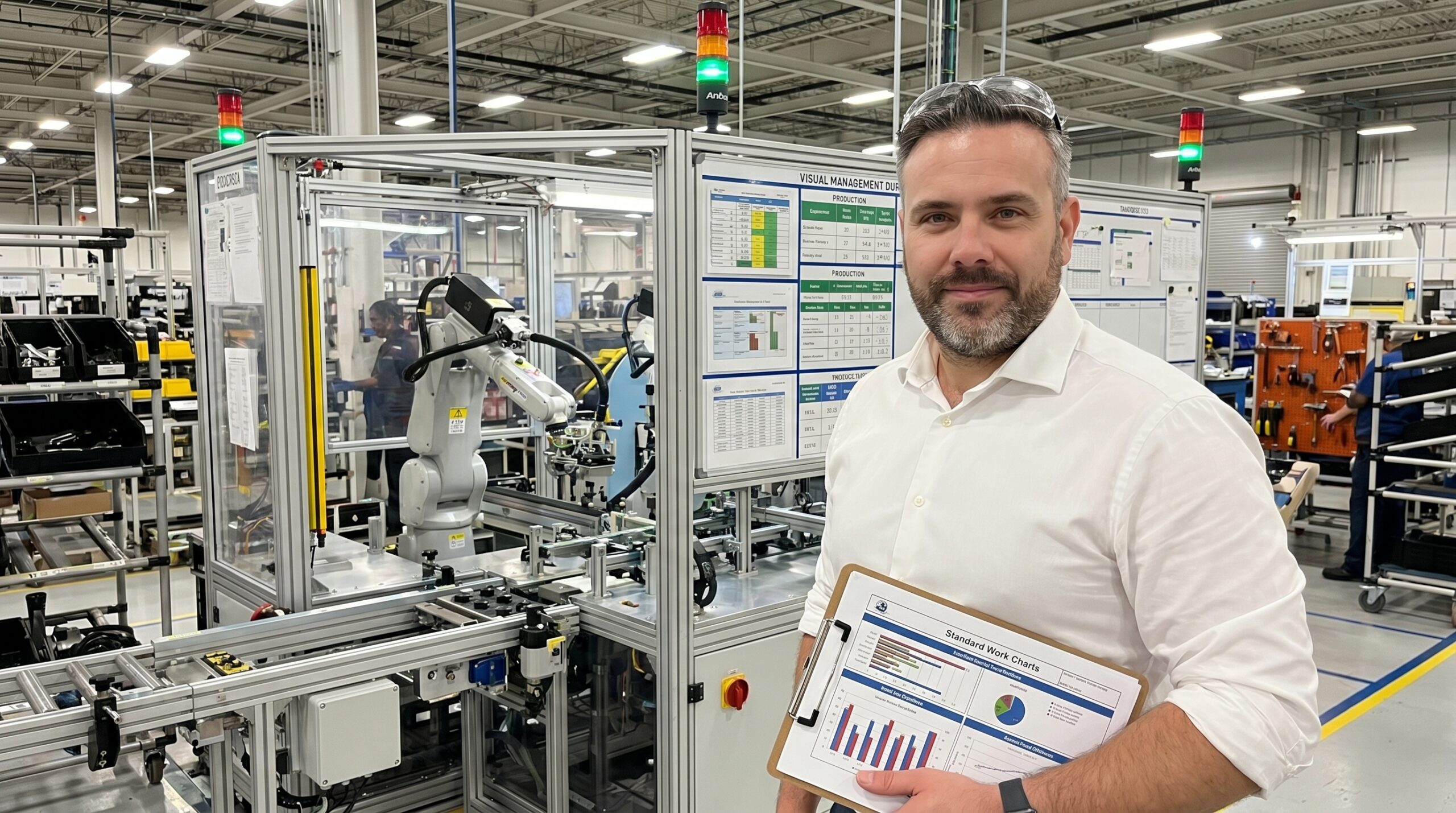
Three times in one month, the same defect appears on Line 3: a misaligned sealing ring on a hydraulic piston. It is not a recall-level crisis, but the trend is clear. You go to the gemba to watch the work.
Four operators run the station. One of them—call him Milan—works without hesitation. He seats the ring in one fluid motion, checks it with his fingers, and moves on. His cycle takes 23 seconds. His three colleagues take 31, 34, and 38 seconds. They also occasionally produce the defect. Milan does not.
When you ask Milan what he does differently, he pauses and says: "Nothing special. I just do it normally."
What Standard Work Actually Is
Standard Work is one of the most misunderstood concepts in lean manufacturing. Many plants reduce it to a work instruction—a thick document hanging on a wall, written by an engineer who has never stood at the line, which no operator reads.
That is not Standard Work. That is paper paralysis.
Real Standard Work is the documented best-known method for performing a task. It is built with the operators, it captures the hidden know-how of experienced people, and it serves as the baseline for continuous improvement. Taiichi Ohno was blunt about this: without a standard, there can be no improvement.
Genuine Standard Work rests on three elements. Without them, you have a manual, not a standard.
- Takt time — the pace at which you must produce to meet customer demand.
- Work sequence — the precise order in which the operator executes the task.
- Standard in-process stock — the defined quantity of work-in-progress between operations.
Surfacing the Tacit Knowledge
Milan's problem was not secrecy or unwillingness to help. His knowledge was automatic. He had performed the task for eight years. His hands knew what to do before his brain could formulate a sentence to explain it.
In knowledge management, this is called tacit knowledge—the implicit, hard-to-articulate expertise built through years of repetition. A veteran welder knows by sound when the arc length is wrong. Milan knew by touch when a ring would seat correctly. He could not put it into a PowerPoint because he was not consciously aware he was doing it.
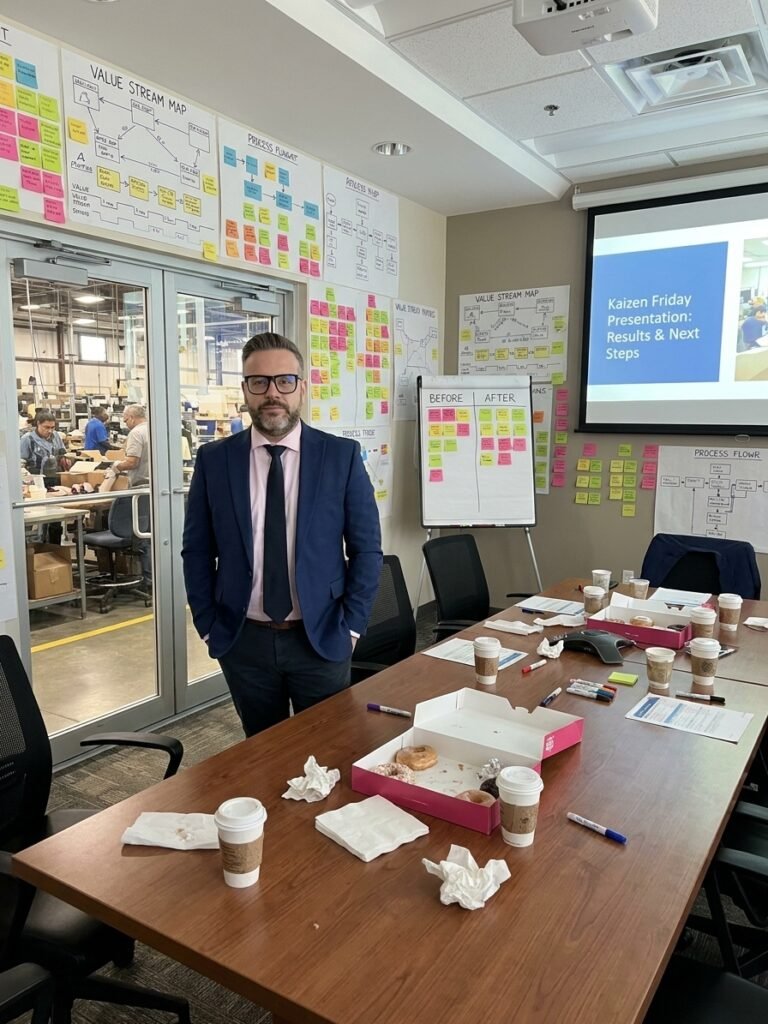
To capture it, we brought a camera. We filmed Milan working, then played the video back with him and his three colleagues. That is where the implicit became explicit.
"Look," Milan said, pointing at a paused frame. "I roll the ring slightly between my fingers first. I feel if the surface is smooth. If it's dry, I lightly lubricate it. Then I install it." A 1.2-second action that saved eight seconds of rework and eliminated the defect risk. Thirteen seconds of total cycle-time difference. All hidden in a motion Milan considered trivial.
The Three Forms of Standard Work Documentation
Documenting Standard Work is not a single act. It produces three distinct deliverables, each serving a different analytical purpose in IATF 16949 and VDA 6.3 environments.
| Document | Function | What it revealed on Line 3 |
|---|---|---|
| Standard Work Combination Sheet | Maps the time sequence: which steps are manual, which are automated, where the operator waits or moves. | Showed that Milan's 1.2-second ring check eliminated 8 seconds of rework downstream. |
| Standard Work Layout | Visual map of the workstation showing operator movement, material placement, and tooling. | Revealed Milan kept his parts bin 15 cm closer than standard, reducing wrist fatigue. |
| Job Breakdown Sheet | Step-by-step breakdown capturing WHAT is done, HOW it is done (key details), and WHY. | Documented the ring inspection technique that Milan could not previously articulate. |
The Standard Is the Floor, Not the Ceiling
The most damaging misconception about standards is treating them as an upper limit. A team hits the standard, declares victory, and stops looking for improvements. This is how processes stagnate.
The standard is the baseline. It is the floor you stand on to reach higher. At Toyota, if an operator proposes an improvement that changes the method, the standard updates immediately. Not during the next ISO 9001 surveillance audit. Not at the annual management review. The next day.
This creates a culture where operators are not afraid to bring ideas forward, because they know their improvement will become the new method—and their name will be on the revision. I have audited plants where this loop functions and plants where it does not. The difference in OEE and internal scrap rates is not incremental. It is structural.
Deploying Standard Work on the Floor
Implementing Standard Work is a sequence. Skipping the first step and jumping straight to documentation is the most common failure mode.
Standard Work Deployment Sequence
- 01Observe and MeasureRecord the best operators with cameras and stopwatches. Map movement and ask 'why' at every step.
- 02Identify Best PracticeCompare operators. Find the consistent differences. Do not chase perfection—capture the best current method.
- 03Document SimplyPhotos, short sentences, visual cues. An operator must understand the document in 30 seconds at the station.
- 04Train PracticallyUse TWI Job Instruction at the machine. Demonstrate, explain, let them try, give feedback, repeat.
- 05Audit and ImproveVerify the standard is current and being followed. Audit is dialogue, not punishment.
Shifting from Blame to System
When a defect surfaces on the line, the first question in most plants is: "Who made the error?" This is the wrong question. It triggers defensiveness and suppresses information.
The Standard Work approach changes the question to: "Was the standard followed?" If the answer is yes and the defect still occurred, the standard is insufficient and must be improved. If the answer is no, the question becomes why it was not followed—and how the workstation design forced a deviation.
A standard is not a tool for enforcing compliance. It is a diagnostic baseline for isolating where your system failed.
This eliminates the blame culture and replaces it with a solution culture. The operator shifts from being the person who caused the defect to being the primary source of information about where the process broke down.
Where to Start
If you have not started with Standard Work, the approach is pragmatic. Pick one operation—not a whole line. Choose the station with the highest defect rate or the widest variance between operators. Sit with the operators, let them show you what they do, and be humble about your role. They are the experts; you are the facilitator.
Do not delegate this to a function that never stands at the line. Standard Work is an operations responsibility. If it is written by someone who has never run the process, it is a dead document on arrival. Use photographs and diagrams before text. If a standard has not been revised in twelve months, either the process is perfect or nobody is using it.
Line 3 After Standard Work Implementation
On Line 3, codifying Milan's technique dropped the sealing-ring defect rate from 2.3% to 0.4%. Cycle time stabilised at 24 seconds for all four operators. Milan became the trainer—and while teaching his colleagues, he identified three further micro-improvements he had not previously noticed.
That is the real function of Standard Work. Documenting the best known method does not lock the door on innovation. It opens it. You can only improve a process when you know exactly where it stands today. Your factory will feel the difference—not in a presentation, but in every part that leaves the line without a defect.