The Beautiful Lie of the
Bell Curve
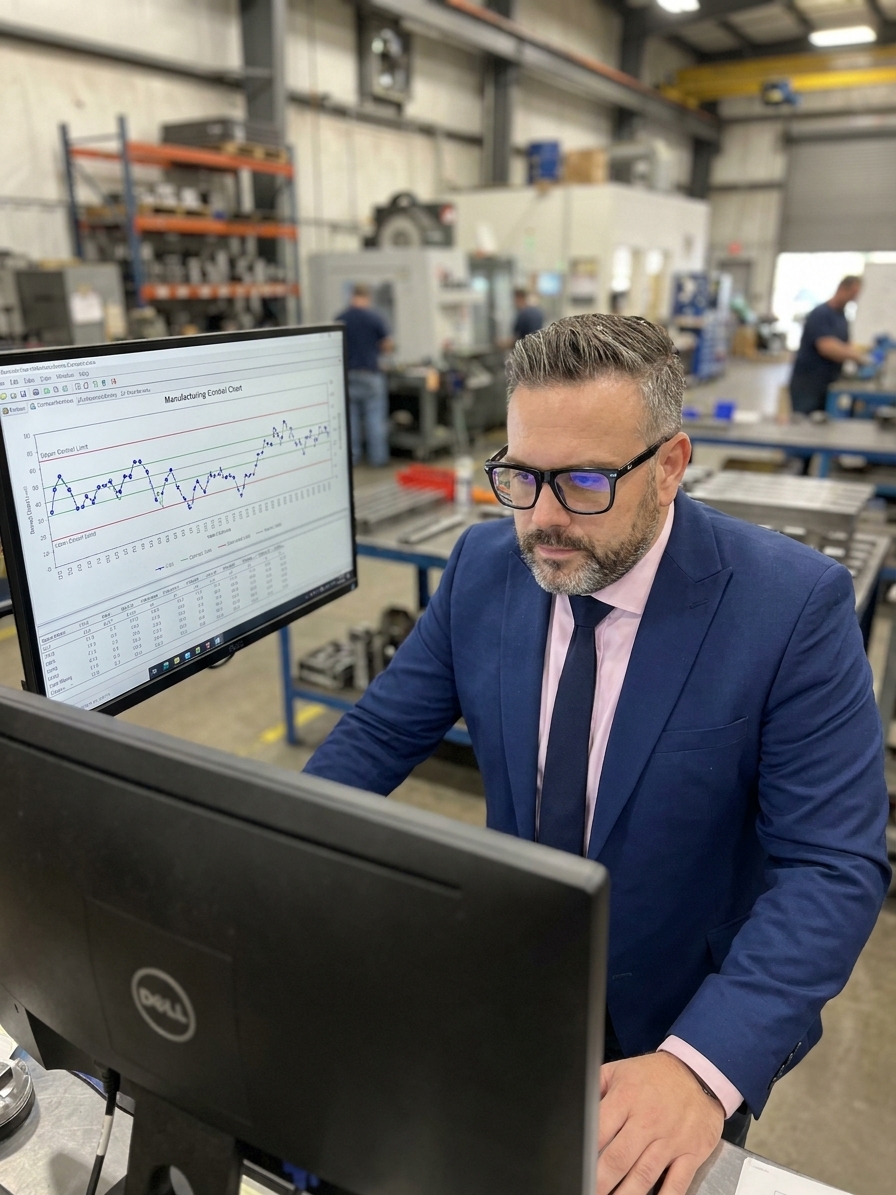
You’ve seen it a hundred times. The conference room projector hums,
and up goes the control chart — a serene landscape of dots dancing
between upper and lower control limits, the occasional spike dismissed
as “special cause, already investigated.” The quality manager beams. The
auditor nods. Everyone agrees the process is in control.
Meanwhile, on the production floor, parts are drifting. Not
dramatically — that would be visible. Slowly. Quietly. The kind of drift
that hides inside the control limits like a fox in a henhouse, waiting
until the monthly capability study reveals that your Cpk has dropped
from 1.67 to 1.12 and nobody can explain why.
This is the dirty secret of Statistical Process Control in
manufacturing: the tool that was supposed to give you x-ray vision into
your process has become the lullaby that puts your vigilance to
sleep.
What SPC Was Supposed to Be
Walter Shewhart invented the control chart at Bell Labs in the 1920s
for a simple and powerful reason: to distinguish between common cause
variation (the natural noise inherent in any process) and special cause
variation (the signals that something has changed and needs attention).
It was, and remains, one of the most elegant quality tools ever
devised.
When implemented properly, SPC tells you exactly when to act and —
equally important — when not to. It prevents overreaction to natural
variation (tampering, which Deming demonstrated always makes things
worse) while ensuring you catch real shifts before they produce
defective product.
The logic is beautiful: calculate control limits from process data
(typically ±3 sigma from the mean), plot your measurements, and react
only when a point falls outside the limits or when a non-random pattern
emerges. Simple. Scientific. Effective.
What SPC Actually Became
Here’s what happens in most manufacturing organizations, and it
probably sounds familiar:
Phase 1: Enthusiasm. The company invests in SPC
training. Software is purchased. Control charts are set up for every
critical dimension. Operators learn to plot points. There’s genuine
excitement about “data-driven quality.”
Phase 2: Compliance. The charts become a
requirement. Customers demand them. Auditors check them. So operators
plot points, but the plotting becomes ritual rather than analysis. The
data gets entered, the chart gets generated, and nobody looks at it
until the auditor walks through the door.
Phase 3: Theater. Someone notices a point outside
the control limit. The operator is asked to “explain” it. The
explanation goes into a form: “Material variation — no corrective action
needed.” The form gets filed. The chart goes back to looking normal.
Nothing changes. Nothing was ever going to change.
Phase 4: Irrelevance. The control charts hang on the
wall like paintings in a museum — occasionally admired, rarely studied,
and completely disconnected from actual process management decisions.
When a real quality crisis hits, nobody reaches for the control chart.
They reach for the phone and call an emergency meeting.
The Seven Deadly
Sins of SPC Implementation
After 25 years in quality management across dozens of manufacturing
facilities, I’ve watched organizations make the same mistakes with SPC
over and over again. Here are the seven that cause the most damage:
Sin 1: Measuring the Wrong
Variables
The most sophisticated control chart in the world is worthless if
it’s tracking a characteristic that doesn’t correlate to product
performance or customer satisfaction. I’ve visited plants where every
critical dimension per the print had a control chart, but the actual
failure modes driving customer complaints were related to surface finish
— which nobody was charting because it wasn’t a “dimension.”
The discipline isn’t in charting everything. It’s in charting the
right things. And “right” means the variables that most directly affect
function, fit, and customer experience — not the ones that are easiest
to measure.
Sin 2: Control
Limits That Never Get Recalculated
Control limits are supposed to be living things. They’re calculated
from your process data, and when your process fundamentally changes —
new tooling, new material lot, adjusted machine parameters — the limits
should be recalculated to reflect the new reality.
Instead, what I see repeatedly is control limits calculated once,
during the initial study, and then frozen like a photograph. The process
evolves. Tooling wears. Materials shift. But the limits stay the same,
and eventually the chart shows either everything “in control” (because
the limits are so wide they’re meaningless) or everything “out of
control” (because the process center has moved and the limits haven’t
followed).
Both scenarios are equally useless.
Sin 3: Ignoring
the Patterns Between the Limits
The rules of SPC aren’t just about points outside control limits.
Western Electric rules, Nelson rules, and similar frameworks identify
non-random patterns that signal process shifts even when every point is
technically “in control”: runs of 7 points above the mean, trends of 6
consecutive increasing or decreasing points, 2 out of 3 points beyond 2
sigma, and so on.
These patterns are where the real predictive power of SPC lives. A
gradual upward trend within the control limits is an early warning that
something is changing — tool wear, material drift, environmental shift.
Catch it early and you adjust before defects occur. Ignore it, and by
the time a point goes outside the limit, you’ve already produced
hundreds of suspect parts.
Most organizations ignore every pattern that doesn’t produce an
out-of-control point. They are, in effect, using only 10% of SPC’s
capability.
Sin 4: Sampling Plans
That Hide the Truth
Your control chart is only as good as your sampling plan. And your
sampling plan is only as good as your understanding of variation
sources.
A common trap: sampling at the same time every shift, from the same
machine position, with the same operator. Your chart shows beautiful,
tight control — because you’re measuring a system that’s been
standardized by your sampling methodology. Meanwhile, the first parts
after shift change, the parts from the cavity at the end of the mold,
and the parts produced during the hottest part of the afternoon are all
different, and you never see it because you never sample those
conditions.
Randomization and stratified sampling aren’t statistical niceties.
They’re the difference between a control chart that tells the truth and
one that tells you what you want to hear.
Sin 5: Tampering in
the Name of “Adjustment”
Deming’s funnel experiment demonstrated definitively that adjusting a
process in response to random variation always increases total
variation. Always. Yet I’ve watched operators do exactly this, dozens of
times: a point drifts toward the control limit (but is still within it),
and they “nudge” the machine setting to bring the next point closer to
center.
The result is a process that oscillates more widely than it would
have if they’d simply left it alone. The control chart shows a tighter
cluster around the mean, which looks like improvement, but the actual
part-to-part variation has increased. It’s a statistical illusion — and
it’s one of the most common self-inflicted wounds in manufacturing
quality.
Sin 6: Disconnected Response
Plans
A control chart without a clear, documented, and practiced response
plan is just a graph. When a point goes out of control, what happens?
Who gets notified? What’s the containment action? How do you verify the
corrective action worked?
In most organizations, the answer to “what happens when the chart
goes out of control?” is some version of “we tell the supervisor.” What
the supervisor does next is entirely up to the supervisor, their mood,
and how busy they are. There’s no standard response. There’s no
escalation protocol. There’s no verification loop.
The control chart detected the signal. The organization lost it at
reception.
Sin 7: SPC Without
Process Understanding
This is the fundamental sin that underlies all the others. Control
charts are a diagnostic tool, not a therapeutic one. They tell you when
something has changed, but they don’t tell you what changed or why. For
that, you need process knowledge — deep, experiential understanding of
how your equipment, materials, environment, and methods interact to
produce the output you’re measuring.
Too many organizations implement SPC as a substitute for process
understanding rather than a complement to it. They chart everything and
understand nothing. When the chart signals, they have no hypothesis
about the cause, no structured approach to investigation, and no
framework for verifying the fix. The chart becomes an alarm without a
fire department to respond to it.
The
Capability Trap: When Cpk Becomes a Number Without Context
SPC and process capability analysis are deeply intertwined, and both
suffer from the same degradation pattern. Your customer requires a Cpk
of 1.67. You run a study and get 1.73. Everyone is happy.
But what was the study based on? Fifty consecutive parts from a
single setup, run in the middle of a Tuesday shift, with a fresh tool
and material from a single lot? That Cpk of 1.73 is the capability of
your process under ideal conditions — conditions that represent maybe
20% of your actual production time.
Real capability — the Cpk your customer actually experiences —
includes the Monday morning startup parts, the Friday afternoon rush,
the material from the alternate supplier, the worn tool that should have
been changed two hours ago, and the operator who started last week and
hasn’t been fully trained yet.
The gap between reported capability and actual capability is one of
the largest unacknowledged risks in manufacturing quality. And SPC, when
implemented as a compliance exercise rather than a learning tool,
doesn’t close that gap — it disguises it.
What Effective SPC Looks
Like
I’ve seen SPC work. Not often, but enough to know it’s possible. The
organizations that get it right share several characteristics:
They chart the vital few, not the trivial many. Five
well-chosen characteristics with real-time monitoring and genuine
response plans are worth more than fifty charts that nobody looks
at.
They recalculate limits when the process changes.
They have a defined protocol: when tooling is changed, when material
source changes, when a significant maintenance event occurs, the control
limits are recalculated from new data.
They train for patterns, not just limits. Operators
don’t just know to react to out-of-control points. They’re trained to
recognize runs, trends, cycles, and shifts — and they have the authority
and the protocol to investigate early, before defects occur.
They connect SPC to action. Every out-of-control
signal triggers a documented response: containment, investigation (using
structured tools like 5 Whys or fishbone diagrams), corrective action,
and verification that the action worked by watching the chart return to
a stable state.
They use SPC to learn, not just to comply. The
control chart is treated as a process conversation — the process is
speaking, and the chart is the microphone. The question isn’t “are we in
control?” but “what is our process telling us today?”
They integrate SPC with maintenance, engineering, and
procurement. When the control chart shows a shift, the
investigation doesn’t stay in the quality department. It pulls in the
maintenance records (was there a machine event?), engineering (did we
change the program?), and procurement (did the material cert change?).
SPC becomes a cross-functional diagnostic tool, not a quality department
scoreboard.
The Real Cost of SPC Theater
Here’s the calculation most organizations never do: add up what you
spend on SPC — the software licenses, the measurement equipment, the
operator time spent recording data, the engineer time spent generating
reports, the management time spent reviewing charts in meetings. For a
mid-size manufacturing facility, this easily runs into hundreds of
thousands of dollars annually.
Now ask: how many process improvements were directly triggered by SPC
signals in the last year? How many corrective actions were initiated
because a control chart pattern was recognized and acted upon before
defects occurred? How many times did SPC actually prevent a quality
escape?
If the answer is a number much smaller than your investment, you’re
not doing SPC. You’re doing performance art.
The tragedy isn’t that SPC doesn’t work. It works brilliantly — when
it’s implemented as a living, breathing process management system rather
than a compliance checkbox. The tragedy is that so many organizations
have invested in the infrastructure of SPC without investing in the
culture, training, and discipline that make it effective.
A Path Forward
If your SPC program has become one of the seven deadly sins described
above, the fix isn’t to abandon it. The fix is to shrink it down to what
you can actually do well and grow from there.
Pick your three most critical process characteristics — the ones that
drive the majority of your quality issues. Set up control charts with
properly calculated limits. Train the operators on pattern recognition,
not just limit violations. Write response plans for every type of
signal. And then — this is the hard part — actually follow them. Every
time. For six months.
If you can do that with three characteristics, you’ll learn more
about your process than five years of passive charting ever taught you.
And you’ll have built the foundation to expand SPC the right way — as a
tool for understanding, not a shield for compliance.
Shewhart deserved better than what most of us have done with his
invention. So do your products. So do your customers.
Peter Stasko is a Quality Architect with over 25
years of experience in manufacturing quality management across
automotive, aerospace, and industrial sectors. He specializes in
transforming compliance-driven quality systems into genuine process
improvement engines. His work focuses on bridging the gap between
statistical theory and shop-floor reality — because the best quality
tool is the one people actually use correctly.