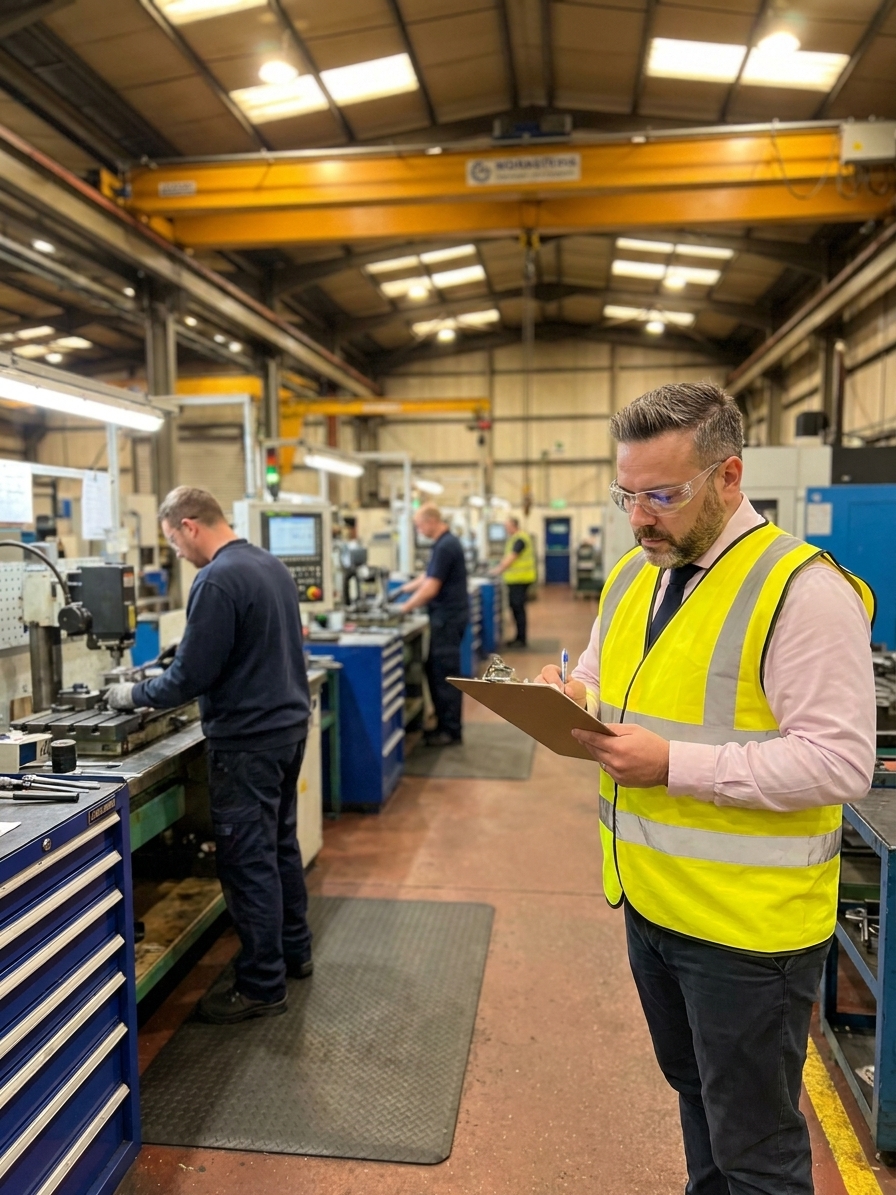
Every Tuesday morning, managers gather at the production floor entrance. They walk the line, nodding at operators, pausing to ask questions that sound suspiciously like 'is everything going okay?' Two hours later, they are back in the conference room, satisfied they have 'been to the gemba.' Nothing changes. This ritual produces zero insight, zero improvement, and zero trust.
The gap between lean philosophy and shop-floor practice is a structural failure that undermines your quality management system. When decision-makers rely on assumptions instead of actual conditions, they approve corrective actions that fail to address root causes. A tier-1 automotive supplier I worked with consistently missed Cpk targets because their leadership reviewed Pareto charts in conference rooms rather than watching the process drift on the floor.
Gemba means the actual place where value is created and problems reveal themselves. The concept is powerful, but execution in most organisations is not. If your walks are structured as casual tours, your quality system is operating on blind spots. Every observation must bridge the gap between what your procedures say happens and what physically occurs.
The Structural Failure of Unstructured Walks
Most gemba walks suffer from a fundamental design flaw: they have no operational target. A team shows up with a vague intention to 'observe' and 'engage' but without specific questions or focus areas. The result is a walk that covers physical distance without covering any intellectual ground. Operators can tell the difference between targeted observation and management tourism instantly.
I have audited plants where managers walk up to an operator, ask a question, and immediately start talking about what should be done based on what worked at their previous employer. The operator, who has run that machine for over a decade, barely gets a sentence out before the manager formulates a solution. This is not engagement; it is a monologue disguised as a conversation.
The premise of a gemba walk is that the people closest to the work know things you do not. If you are not creating structured space for them to tell you, you are wasting everyone's time. You must build observation frameworks that prevent managers from dispensing solutions before they have gathered sufficient context.
Defining the Observation Lens
Every effective gemba walk requires a specific lens. Generic themes like 'quality' or 'safety' are useless because your brain filters out abnormalities that have become normalised. You need a precise target: investigating why Line 3's first-pass yield drops during shift changes, or observing how operators handle a new torque specification at Station 7.

The theme must come from data, not gut feeling. Pull your last week's 8D reports, OEE trends, maintenance logs, and customer complaints. Identify the gaps where a single answer would unlock the most improvement. When you walk the floor looking for a specific pattern, you will notice failure modes you have walked past a hundred times.
A focused theme changes what you see. If you are investigating why a specific machining cell generates high scrap rates during the first hour of production, you will watch machine warm-up cycles, tool changes, and material handling. Without that focus, you would simply nod at the operator and walk past, missing the critical data.
Seeing Without Solving
The hardest part of a gemba walk is resisting the urge to solve problems on the spot. You will see an operator reaching above shoulder height, a bin overflowing with nonconforming parts, or a gauge reading outside the expected range. Your instinct will be to correct it immediately. Do not. Immediate fixes bypass the root cause analysis required for lasting quality improvement.
Instead, ask targeted questions. Notice an operator struggling with a fixture and ask: 'Is there a reason it is positioned that high?' You might learn they submitted a maintenance request six months ago that was never actioned. You might learn the reaching is the safest option given an underlying constraint. You will learn what you could never figure out by simply looking.
Observation means gathering information, not dispensing solutions. The time for solutions comes after you have walked the entire floor, talked to multiple operators across shifts, and cross-referenced your observations with the Cpk data and PFMEA you brought with you. Premature solutions destroy the trust required for honest floor-level feedback.
| Category | What to Look For | What to Ask |
|---|---|---|
| Safety | Awkward motions, bypassed guards, ergonomic strain | Have you reported this? What happened when you did? |
| Quality | Rework stations active, visual nonconformities, sort bins | How often does this happen? What triggers it? |
| Delivery | WIP accumulation, idle operators, expedited material | Is this the normal flow, or is today unusual? |
| Cost | Excess inventory, redundant handling, unnecessary steps | If you could change one thing about this process, what would it be? |
Integrating Walks Into Quality Systems
A gemba walk is not a standalone activity. It is an input into your quality management system. Observations from the floor must feed directly back into your PFMEA reviews. If you are seeing failure modes during walks that are not documented in your risk analysis, your IATF 16949 or AS9100 system has a dangerous blind spot.
When you identify an issue during a walk, it must enter your CAPA system with the same rigor as a customer complaint or third-party audit finding. Internal findings often receive lower priority because there is no external pressure driving them. This double standard guarantees that internal defects persist until they eventually escape to the customer.
Layered Process Audits and gemba walks share DNA but serve different purposes. LPA verifies compliance with established standards. Gemba walks question whether the standards themselves are correct. Both are required for a robust quality system, but substituting one for the other leaves you either rigid or unstructured.
If your walk does not result in at least one tangible CAPA per week, it has become bureaucratic theater.
Measuring Walk Effectiveness
Leadership teams invest significant hours in floor walks, yet few can answer a basic question: what changed because of our gemba walks? Without measurable outcomes, the activity defaults to performative management. You must track leading and lagging indicators to determine whether your walks generate real operational value.
Identification without resolution breeds cynicism faster than no identification at all. If operators report the same constraint week after week without seeing corrective action, they stop engaging. Track repeat findings rigorously. If the same issue appears on consecutive walks, you have a systemic failure in your action system, not your observation system.
Time to resolution is the most telling metric. Compare the cycle time from floor observation to implemented change against your standard customer complaint resolution time. If internal findings take significantly longer to close, your organisation is signalling that internal quality is a lower priority than external compliance.
Gemba Walk Performance Indicators
Building Floor-Level Trust
Operators have a finely calibrated detector for performative management. They know when a leader is walking the floor because they genuinely want to understand the process, and when they are there because their boss told them to be more visible. You cannot fake engagement, and attempting to do so is worse than not showing up at all because it actively erodes trust.
Trust is built through consistency and follow-through. If an operator tells you about a constraint on Tuesday's walk and you follow up on Thursday—not with a solution, but with targeted questions about what they reported—you create more engagement value than a year of suggestion boxes. Operators need to know that speaking up leads to investigation, not blame.
The worst pattern is showing up once a quarter, acting alarmed at conditions operators have reported for months, making promises you do not keep, and disappearing. This teaches the floor that leadership engagement is temporary. It poisons the well for future data collection. Without operator trust, your PFMEA is based on theory, and your quality planning is built on assumptions.
The goal is a culture where going to the source is instinctive rather than a scheduled event. A quality engineer who hears about a defect should walk to the station before opening a spreadsheet. A production manager facing a delivery risk should go to the cell and observe the bottleneck. When this becomes reflexive, the gemba walk ceases to be a calendar appointment and becomes the core mechanism of your quality system.