
Every quality director has heard the transformation pitch. A consultant presents a 24-month roadmap to reinvent the quality culture, complete with Gantt charts and a six-figure budget. These programmes promise a clean before-and-after narrative. They rarely deliver lasting change. I have spent over twenty years implementing ISO 9001 and IATF 16949 systems across automotive and aerospace, and the plants that achieve lasting excellence almost never underwent a dramatic transformation.
The organizations that win make thousands of small, unglamorous improvements. They refine one process at a time, one operator at a time, one defect at a time. The accumulation of these changes becomes extraordinary. The Japanese call this kaizen, meaning 'change for better'. It is the most powerful quality philosophy that most manufacturers completely misunderstand.
Kaizen is not a kaizen event. The intense three-to-five-day workshop where a cross-functional team tears down and rebuilds a production line is a useful tool, but it is an expression of the philosophy, not the philosophy itself. A workshop is a sprint; kaizen is physical fitness. It is the belief that every process can be improved, and that the people closest to the work are best equipped to improve it.
Most organizations treat kaizen the way people treat gym memberships in February. They start with enthusiasm, lose momentum within weeks, and return to firefighting the same defects with the same 8D tools. Kaizen demands daily discipline. It requires managers to relinquish control, measure what matters instead of what is easy, and tolerate unspectacular progress in a business culture that worships dramatic wins.
The Anatomy of a Kaizen Culture
I once worked with a tier-one automotive supplier manufacturing precision fuel injection components. The plant had 340 operators and a defect rate that was, by industry standards, acceptable. Their PPM hovered around 850. Management wanted it below 200 and had commissioned a consulting firm to design a transformation programme.
I asked to walk the floor first. No clipboard, no entourage. I wanted to see how people actually worked. What I found was a plant full of frustrated experts. Every operator I spoke to had actionable ideas for improving their workstation. One operator on Line 7 had been asking for six months to redesign a fixture. The current design required a lateral wrist movement causing repetitive strain and a burr defect on 3% of parts.
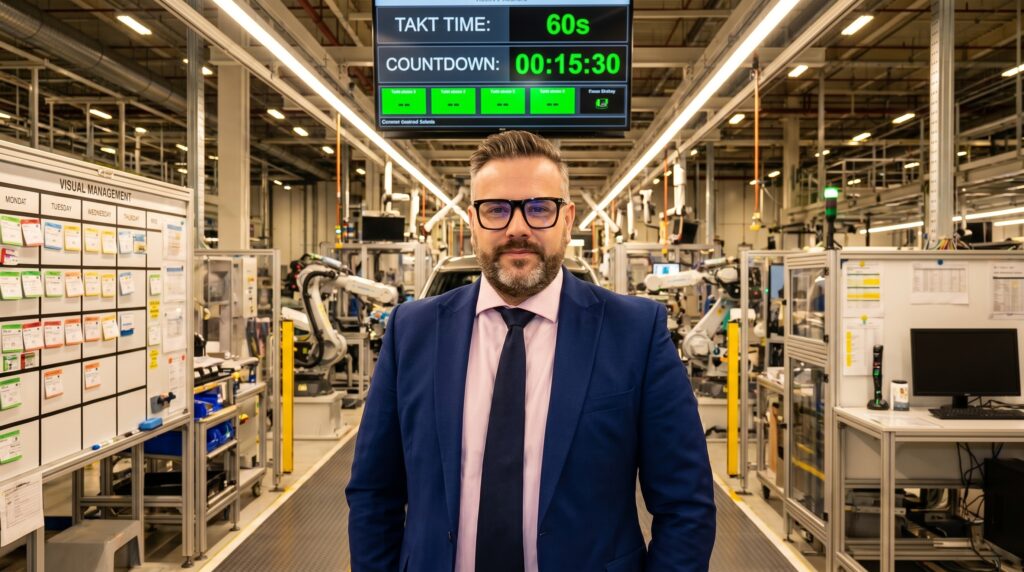
A quality technician had noticed that temperature fluctuations in the grinding cell between shifts correlated perfectly with dimension drift on the nozzle bore. He had no mechanism to escalate this observation into a formal investigation. These were not high-tech insights requiring digital twins or artificial intelligence. They required someone to listen and a mechanism to act.
That is the anatomy of a kaizen culture. It is not a programme. It is the organizational infrastructure that converts human observation into process improvement reliably and at scale. Without that infrastructure, the daily insights of your operators evaporate.
Suggestion Systems and Daily Rhythm
Most suggestion systems fail because of the gap between intention and follow-through. A typical digital portal collects ideas that disappear into a void. The operator hears nothing for weeks, then receives a generic acknowledgment. A functioning kaizen suggestion system must be fast, transparent, and celebratory. Every suggestion receives an owner within 48 hours.
At the automotive plant, we replaced their digital portal with a physical board at each line. It was a whiteboard divided into 'Idea', 'In Progress', and 'Implemented'. Each idea received a sticky note with the submitter's name. Within the first month, we received 127 suggestions. Within six months, we implemented 89 of them. The total cost was under €4,000; the annual savings exceeded €180,000.
Kaizen lives and dies at the team level during a daily stand-up meeting at the production line. This is not a status update for management. It is a conversation among the people who do the work, facilitated by their team leader, focused on three questions. What went well yesterday? Where did we struggle? What one thing can we improve today?
The discipline of this practice normalizes the act of looking for improvements. It makes the gap between current and ideal performance visible in real time, at the point of production. It is not a monthly report. It is a daily operational habit.
Closing the Loop: PDCA and Standard Work
Every kaizen improvement, no matter how small, follows the Plan-Do-Check-Act cycle. This is not bureaucratic overhead. It is the minimum viable structure that distinguishes disciplined improvement from random tinkering. You plan the change, do it on a small scale, check the result against expectation, and act by either standardizing or abandoning it.
Most organizations are reasonably good at Plan and Do. Many are terrible at Check. They implement a change, assume it worked, and move on. Without verifying your MSA and Cpk data, improvement is just change. Change without measurement is gambling. At its best, a kaizen PDCA cycle takes hours. An operator tries a countermeasure on the next ten parts and adopts or abandons it before lunch.
The PDCA Cycle in Daily Kaizen
- 01PlanDefine the specific change and the expected outcome based on operator observation.
- 02DoImplement the countermeasure on a small scale at the production line.
- 03CheckMeasure the result against the expected outcome using actual part data.
- 04ActStandardize if successful, or discard and learn if the change fails.
This speed makes kaizen powerful. The cycle time of improvement becomes shorter than the cycle time of production. But speed requires a baseline. You cannot improve a process that is performed differently every time. Standard work is the documented, agreed-upon current best method. It is the baseline against which improvement is measured.
Without standard work, kaizen becomes chaos. Every operator develops their own method, improvements cannot be shared across shifts, and you cannot distinguish between genuine process improvement and random variation. The sequence is absolute: standardize, improve, re-standardize.
Leadership and the Authority to Act
The hardest pillar for managers is resisting the urge to solve problems directly. Kaizen culture requires leaders who develop the habit of asking the people closest to the work how they would solve them. This is not abdication. The operator who has performed a task ten thousand times understands it at a level of granularity no engineer ever will.
When a supervisor walks the floor and sees a defect, their first question should never be 'Why did this happen?' directed at the operator as an accusation. The question must be: 'What would it take to make it impossible for this defect to occur?' directed at the operator as a collaborator.
The leader's job in a kaizen culture is to create the conditions where the right answers emerge from the floor.
A kaizen culture requires that the authority to make small improvements sits as close to the point of production as possible. When every idea must be approved by a manager, an engineer, and a quality reviewer, the cycle time stretches from hours to weeks. By the time approval arrives, the operator has moved on and the momentum is gone.
Managerial bottlenecks kill shop-floor initiative. If the approval process for a simple fixture modification takes a month, the operator will simply stop submitting ideas. They will adapt to the broken process on their own, hiding the defect rather than fixing the root cause.
The Mathematics of Incremental Excellence
After twelve months of disciplined kaizen culture at the Slovak fuel injection plant, their defect rate dropped from 850 PPM to 210 PPM. This did not happen through a single dramatic improvement. It happened through 347 individual changes, each one small enough that no one would have predicted a measurable difference.
Among those changes: a redesigned fixture on Line 7, a temperature monitoring protocol for the grinding cell, a new visual standard for surface finish inspection, and a reorganized tool layout that reduced changeover time by ninety seconds. The total investment in all 347 improvements was approximately €22,000. The annual cost avoidance was over €900,000.
Kaizen Impact at the Automotive Plant
Not a single one of those improvements required a consultant or a transformation roadmap. A 1% improvement every day, compounded, makes you 3,778% better over a year. That is not motivational mathematics. That is the arithmetic that separates world-class manufacturers from the rest of the field.
Building the Moat That Cannot Be Bought
Toyota's production system has been studied, documented, and taught for forty years. Yet no organization has successfully replicated it through imitation alone. The Toyota Production System is not a set of tools. It is the accumulated result of seventy years of daily kaizen — millions of small improvements, each building on the last, performed by operators expected to improve their work daily.
You cannot copy that with a consulting engagement or a digital platform. You can only build it, one improvement at a time, with the patience to let compound interest work. In an industry where competitors can buy identical equipment, hire the same consultants, and copy the same VDA 6.3 standards, kaizen culture is the competitive moat that cannot be purchased.
Organizations fail when they fall into the kaizen event trap, mistaking intense workshops for daily discipline. They fail when suggestion systems become graveyards, and when successful pilots become visitor showcases rather than plant-wide templates. The point of kaizen is that it applies everywhere, always.
This approach will not produce a slide deck that impresses the board. But in my experience building greenfield QA departments and introducing Routing Verification KPIs, the organizations that deliver consistent quality decade after decade are the ones that stopped waiting for the big transformation. They started making small improvements a daily habit. The best time to start was twenty years ago. The second-best time is at tomorrow morning's stand-up.