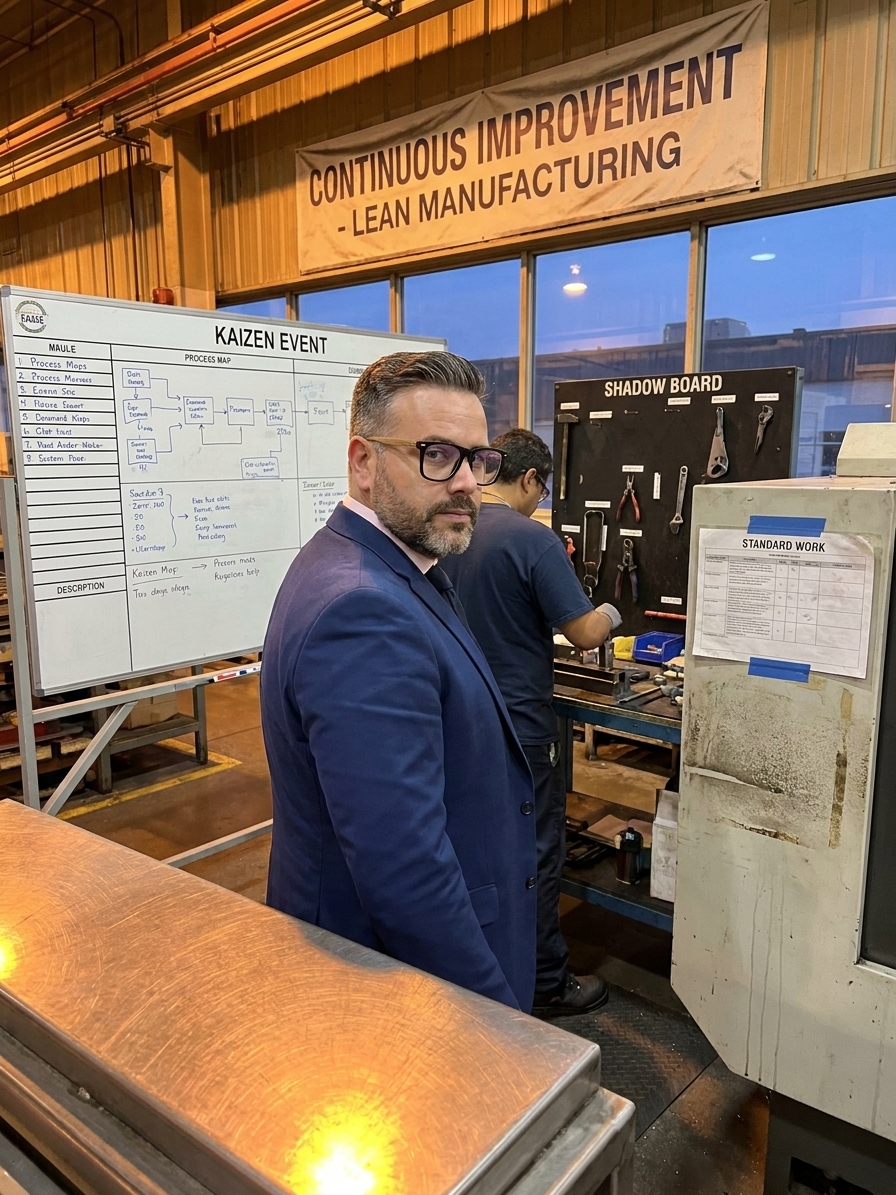
The kaizen event finishes on Friday. The team presents results to management, the before-and-after comparison looks dramatic, and everyone agrees this is what continuous improvement looks like. Then you walk through that same area six weeks later. The standardised work document is pinned to a board nobody reads. The cycle-time reduction has crept back to its original number, and nobody is alarmed because nobody is tracking it anymore. The improvement did not survive contact with Monday morning.
This is not a failure of kaizen as a methodology. The philosophy — that improvement should be continuous, incremental, and driven by the people who do the work — has transformed industries. Toyota's production system, still the gold standard of manufacturing excellence, is built on this foundation. Small improvements, every day, by every person, accumulating over time into capabilities that competitors cannot replicate.
The breakdown happens between the philosophy and the practice. Organisations adopt the language of continuous improvement without building the discipline to sustain it. They run kaizen events as projects with start dates and end dates rather than as expressions of an ongoing culture. They measure success by the magnitude of the initial impact rather than by durability over time. The result is a continuous improvement programme that produces improvements which are anything but continuous.
The Event Trap
The most common distortion of kaizen is the transformation of a continuous process into a discrete event. Kaizen events — structured workshops where a cross-functional team focuses intensely on a specific process over three to five days — can be extraordinarily effective. The intensity creates focus. The compressed timeline forces decisions that endless analysis would postpone indefinitely. The problem is not the event itself. The problem is that the event becomes the entire programme.
When an organisation equates continuous improvement with kaizen events, improvement becomes episodic. It happens in bursts separated by long periods of stasis, like cardiac arrhythmia rather than a steady pulse. The gains from each event decay during the intervals between events. The organisation must then spend a portion of each subsequent event recovering ground it has already gained rather than advancing into new territory. Net improvement over time approaches zero.
Improvement also becomes the responsibility of a specialised team rather than the daily practice of every person on the floor. The kaizen event team becomes the improvement team, and everyone else becomes an audience. Operators learn that improvement is something that happens to them, not something they do. They wait for the next event instead of making improvements themselves. The organisation's improvement capacity concentrates in a small group of people, and that group becomes a bottleneck.
The focus on events creates a bias toward improvements that are visible within the event's timeframe. Teams gravitate toward changes that produce immediate, measurable results because those results validate the event's existence and justify its cost. Improvements that are more subtle, systemic, or long-term — the kind that compound over months into transformative capabilities — receive less attention because they cannot be demonstrated in a Friday afternoon presentation. The organisation optimises for the spectacle of improvement rather than the substance.
The Sustainability Gap
Every improvement has a half-life. The new standard work degrades as operators take shortcuts. The visual management system fades as people stop updating it. The redesigned layout slowly reverts as equipment drifts back to positions of convenience rather than positions of efficiency. The statistical process control chart that was the centrepiece of the kaizen event becomes just another piece of paper on the wall, unconnected to daily decisions.
This is not because people are lazy or resistant to change. It is because sustainability requires a system, and most kaizen events produce improvements without producing the system needed to sustain them. A sustainable improvement requires ongoing measurement — not just a before-and-after snapshot, but a continuous stream of data showing whether the gain is holding or decaying. It requires accountability: someone whose explicit responsibility is to monitor the improvement and intervene when it slips.
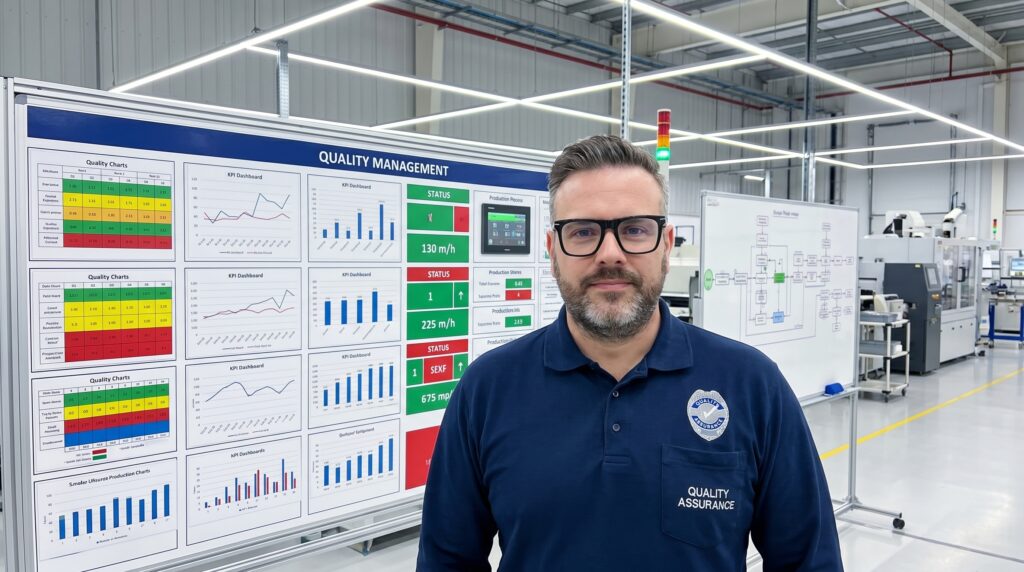
It also requires integration into the management system. The improvement must become part of the daily routine, part of the standard work, part of what supervisors check during their gemba walks. And it requires adaptation — the conditions that made the improvement effective will change, and the improvement must change with them. Most kaizen events address none of these requirements. They end with a presentation, a celebration, and a handoff that is more theoretical than actual.
The mathematics of decay are brutal. If an organisation runs twelve kaizen events per year and each improvement decays by thirty percent within three months, the net improvement over time approaches zero. The programme reports impressive activity metrics — events completed, people trained, dollars saved on paper — but the production floor sees no lasting change. I have audited plants where the gap between reported savings and actual floor-level cost reduction was wider than the plant's operating margin. The programme had become performative.
| Requirement | What Events Deliver | What Sustainability Demands |
|---|---|---|
| Measurement | Before-and-after snapshot | Weekly tracking with control limits |
| Accountability | Handoff to area supervisor | Named owner with KPI tied to holding the gain |
| Integration | Updated standard work document | Built into daily gemba walk checklist |
| Adaptation | Fixed solution to a fixed problem | Review trigger when process conditions change |
The Suggestion System That Isn't
The kaizen philosophy depends on one critical assumption: the people closest to the work have the best insight into how to improve it. This is why Toyota's production system emphasises every worker's authority and responsibility to identify problems and propose solutions. The suggestion system is not a bonus programme. It is the nervous system of the organisation, transmitting information from the point of execution to the point of decision.
Most organisations that adopt kaizen miss this entirely. They create suggestion systems that are bureaucratic, slow, and unrewarding. An operator submits a suggestion and waits weeks for a response. The suggestion is evaluated by a committee that has never stood at the workstation in question. The criteria for approval prioritise cost savings over safety, ergonomics, or quality improvements that are real but difficult to quantify on a spreadsheet.
The suggestions that are approved are often implemented by engineers who do not consult the person who submitted the idea. The feedback loop — the critical mechanism that tells the submitter their idea was heard, considered, and valued — is either absent or so delayed that it has no motivational impact. Suggestion rates drop to near zero within months of launch. The organisation concludes that its people do not have ideas, which is never true. What its people lack is a system that makes submitting ideas worth their time.
The improvement capacity of the frontline workforce remains untapped while the kaizen event team runs another workshop to solve a problem that an operator could have prevented months earlier with a simple fixture and five minutes of conversation. This is the most underutilised resource in manufacturing, and the programme designed to unlock it is what suppresses it.
The Metrics Illusion
Every continuous improvement programme measures itself. The metrics vary — number of events, ideas implemented, cost savings, cycle-time reductions, defect-rate improvements — but the practice is universal. Organisations track improvement activity because they need to justify the programme's existence, demonstrate return on investment, and identify areas for further work. The problem is that most improvement metrics measure activity rather than impact.
They count events held, suggestions submitted, and people trained without measuring whether the improvements from those events are still in place six months later. They do not measure whether the suggestions were genuinely good ideas or whether trained people are applying what they learned. The metrics create a picture of a thriving improvement programme that may bear little resemblance to the reality on the production floor.
An improvement that decays is worse than no improvement at all, because it teaches the organisation that improvement is temporary.
Cost savings are particularly vulnerable to distortion. Improvement teams are motivated to estimate savings aggressively because aggressive estimates justify the event's cost and demonstrate the programme's value. These estimates are rarely audited against actuals. A kaizen event that reportedly saved one hundred thousand dollars per year may produce actual savings of thirty thousand, or nothing at all if the improvement decays before generating meaningful returns. But the headline figure is what gets aggregated into the programme's annual total and presented to leadership as evidence of success.
Over time, the accumulated distortion creates a credibility gap. Finance begins to question the improvement programme's numbers. Production managers observe that their actual costs are not declining in proportion to reported savings. Operators notice that the improvements celebrated in reports do not match their daily experience. The improvement programme, rather than being a source of competitive advantage, becomes another corporate function whose primary product is its own reporting.
The Cadence Problem
True continuous improvement operates on a daily cadence. Every shift begins with a brief meeting where problems from the previous shift are communicated. Every workstation has a visual display showing current performance against target. Every supervisor walks the floor on a regular schedule, checking standard work adherence and asking operators what problems they are experiencing. Every problem triggers a structured response — an 8D or equivalent — that is tracked to completion.
This daily cadence is the engine of continuous improvement. It is unglamorous, repetitive, and relentless. It does not produce dramatic before-and-after presentations or justify banners and celebrations. But it is what keeps improvements alive and what surfaces new improvement opportunities before they become crises. It is the difference between an organisation that gets better every day and one that gets worse while reporting that it is improving.
Most organisations cannot sustain this cadence. It requires management discipline and floor presence that conflict with the firefighting mode most manufacturing managers operate in. The daily meeting gets shortened or skipped when production is behind — exactly when it is most needed. The supervisor's standard walk gets postponed because there is a more urgent problem elsewhere. The visual management display stops being updated because nobody has time.
This is a self-reinforcing failure mode. The organisation stops improving continuously because it is too busy dealing with problems. The problems become more frequent and more severe because the organisation stopped improving continuously. The cycle accelerates until the improvement programme exists in name only while the production floor operates in perpetual crisis mode. The cadence that was supposed to prevent the firefighting is the first thing sacrificed to it.
The Decay-to-Crisis Loop
- 01Cadence droppedDaily meeting or floor walk skipped to handle an urgent issue
- 02Early warnings missedWithout floor presence, small deviations go undetected
- 03Problems compoundSmall deviations escalate into production disruptions and rework
- 04Firefighting intensifiesMore crises leave even less time for structured improvement work
Building What Lasts
The alternative is straightforward in concept and demanding in execution. Start by measuring sustainability explicitly. For every improvement, define the metric that will indicate whether it is holding. Track that metric weekly for the first month, monthly for the first quarter, and quarterly thereafter. Make sustainability a visible part of the improvement programme's reporting. If an improvement decays, investigate why and address the root cause rather than simply re-running the event.
Distribute improvement capability across the organisation rather than concentrating it in a specialised team. Train supervisors to lead small improvements within their areas. Give operators the authority and the time to make changes within defined boundaries. Make improvement part of every role's performance evaluation, not just the kaizen team's. The goal is an organisation where improvement happens because it is expected, not because an event was scheduled.
Redesign the suggestion system for speed and responsiveness. Set a maximum response time of forty-eight hours for any submission. Give frontline supervisors the authority to implement improvements below a defined cost threshold without committee approval. Close the feedback loop every time, even when the answer is no — a prompt and respectful rejection builds more trust than a slow and bureaucratic approval.
Establish the daily cadence and protect it ruthlessly. The shift-start meeting is not optional. The supervisor's floor walk is not optional. The visual management display is not decorative. These are the mechanisms that sustain improvements and surface problems, and they must be treated with the same discipline as the production schedule. Stop measuring activity. Count improvements still in place at six months. Track the trend of key process metrics over time. Ask operators whether their work is actually improving.