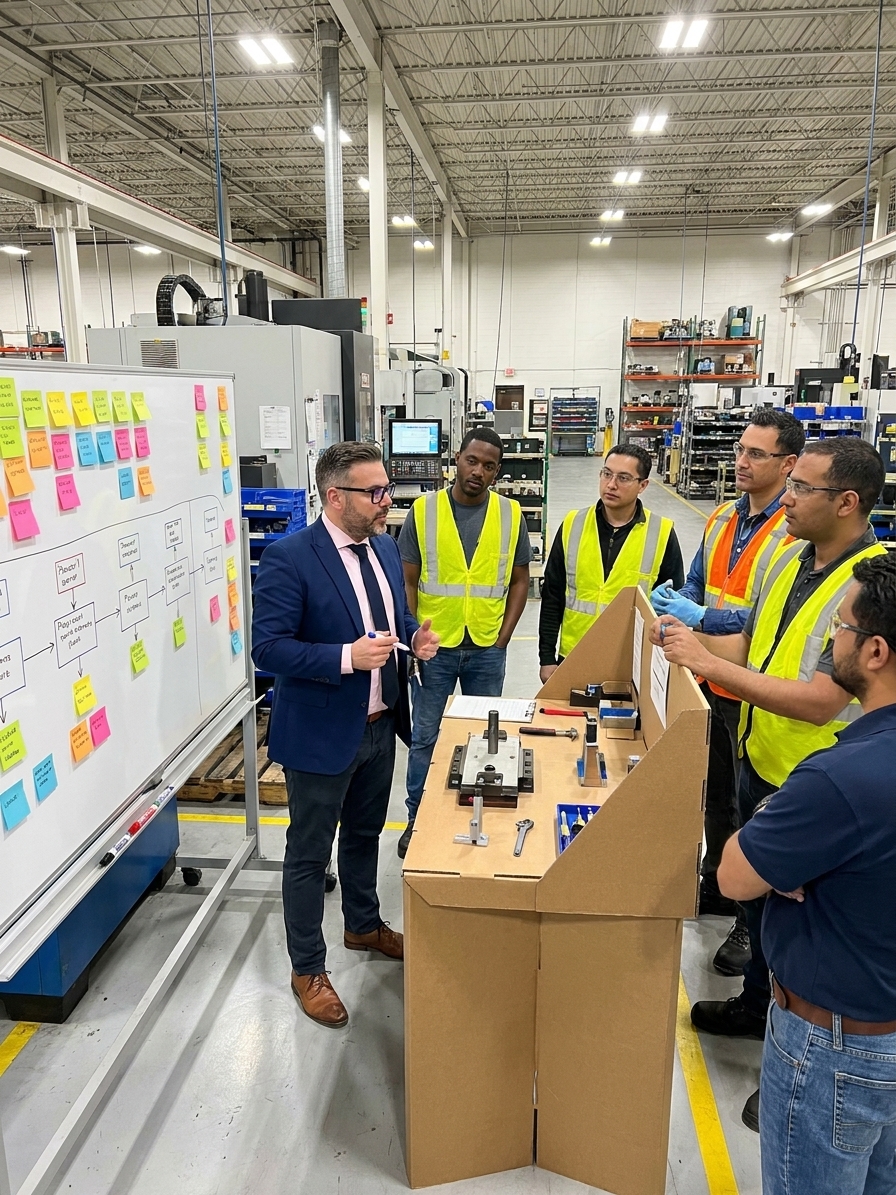
The kaizen event flyer goes up in the breakroom three weeks ahead. For five days, a cross-functional team tears apart a workstation, redesigns the flow, moves equipment, and by Friday afternoon they are celebrating. The before-and-after photos look excellent on the plant manager's slide deck. Then everyone goes back to their regular jobs.
Six weeks later, somebody walks past the line and notices the new flow has drifted back to the old flow. The shadow boards have missing tools. The standardized work documents posted at the station do not match what the operators are actually doing. The productivity improvement that was reported up the chain cannot be reproduced. The event produced a demo, not a transformation.
This is not an argument against kaizen events. Run properly, they are a powerful tool for breaking through inertia and demonstrating what is possible. But the way most organizations run them, they are a performance. A theatrical production with a run of five days and an audience of executives who clap at the finale and then leave. Having audited and implemented ISO 9001 and IATF 16949 systems across automotive plants, I have seen this exact pattern repeat at every tier of the supply chain.
The Root Cause: Skipping the Daily Foundation
A kaizen event is a structured, time-bounded activity in which a dedicated team focuses intensively on improving a specific process. Typically lasting three to five days, the event brings together operators, engineers, maintenance, and quality to analyze a process, identify waste, design improvements, implement them, and establish standards to sustain the new state.
The concept comes from the Toyota Production System, where kaizen means continuous, incremental improvements made by the people who do the work. The irony is that in most Western implementations, kaizen has come to mean the opposite: a large, episodic burst of improvement imposed on a process by a temporary team that then disperses. The foundation of daily improvement is skipped entirely.
In a genuine continuous improvement culture, kaizen is daily. It is an operator adjusting a tool location by two centimetres to reduce reach. It is a team leader noticing a recurring micro-stoppage and investigating on the spot using 8D methodology. The concentrated week-long event format exists in these cultures too, but it sits on top of a foundation of daily improvement habit.
Most companies skip that foundation and go straight to the event, expecting the event itself to create a culture of continuous improvement. It cannot. A fishing trip does not teach someone to fish. You end up with a calendar full of blitzes and a floor empty of ownership.
Selection and Staffing Failures
Many organizations select kaizen event targets based on visibility rather than value. A manager wants to show quick wins, so the team picks something easy like reorganizing a stockroom or labelling cabinets. These improvements are real but superficial. They do not touch the structural constraints that limit throughput, quality, or cost.
The countermeasure is to tie event selection to the value stream map and the site's strategic objectives. Where is the constraint? Where does the data show the most significant quality loss? These are uncomfortable targets because they are politically complicated and technically difficult. But they are the targets where a kaizen event can produce genuine, measurable impact on OEE and cost.
The staffing error is equally damaging. Organizations staff events with managers and engineers while pulling operators out for only an hour of input. This produces solutions that look elegant on paper and fail on the shop floor because the people who actually run the process were not designing the new state. Operators return to find their workstation rearranged and their routine disrupted.
Resistance here is not a personality flaw; it is a rational response to having changes done to you rather than with you. Operators from the target area must be full participants in the event. They know where the real friction lives, and their involvement is what creates the ownership required for sustainment.
The Implementation and Measurement Trap
Friday afternoon at 4:30 PM. The team has redesigned the cell, moved the equipment, written new standardized work, and trained the operators. Everyone is tired and proud. The event facilitator declares success, the plant manager shakes hands, and photos are taken. What happens Monday morning is drift.
The new standardized work was written under time pressure and contains assumptions that do not hold up under real production conditions. The equipment that was moved is not quite right, causing intermittent jams that were not there before. The support team that was supposed to follow up on open items gets pulled into an unrelated quality fire. Within two weeks, the process has reverted.
The measurement claims are equally unreliable. A productivity improvement announced at the Friday report-out is almost always based on a comparison between the worst-case baseline and the best-case post-event performance measured during a controlled demo run. Real productivity is measured over weeks of steady-state production, not minutes of observation.
Minimum Viable Measurement Timeline
Sustainment Through Leader Standard Work
The single biggest predictor of whether a kaizen event's gains will hold is what happens in the 90 days after the event, not the five days during it. The most important person might not be the facilitator or the team leader. It is the area supervisor who was not on the team but who will be responsible for sustaining the changes.
If that supervisor is not engaged before, during, and after the event, sustainment is in jeopardy. Practical sustainment mechanics require daily verification by the supervisor for the first two weeks using a simple checklist. Are the new standardized work documents being followed? Are the tools in the correct locations? Are the metrics being tracked and visible?
A kaizen event is a tool, not a strategy. When it is the only tool, every problem looks like it needs an event.
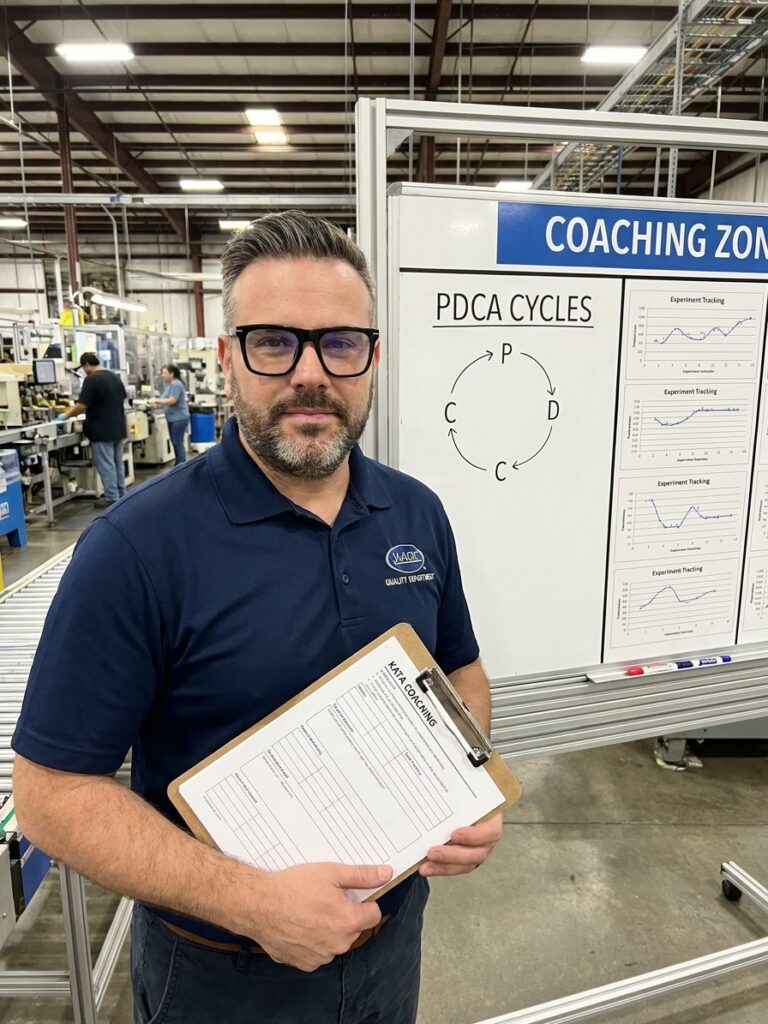
Weekly audits must follow for the first month, with findings addressed immediately rather than queued for the next event. Operator feedback channels are essential. A whiteboard at the workstation where operators note issues with the new process, with a commitment from the supervisor to review and respond within 24 hours, catches regression before it becomes reversion.
Leadership gemba walks must specifically visit the event area. The purpose is not to admire the improvements, but to verify they are still in place using VDA 6.3 or similar process audit discipline. If the standardized work has drifted, the walk exposes it immediately and forces a correction before the old habits fully return.
The 30-60-90 Day Follow-Up Discipline
At the Friday report-out, the team must present what was accomplished and what remains open. Open items get assigned owners and due dates before anyone leaves the room. A 30-day check is scheduled, a 60-day audit is planned, and a 90-day metrics review is calendared. The event is framed as the beginning of the improvement, not the completion.
The 30-60-90 Day Sustainment Cycle
- 0130-Day VerificationConfirm operators follow the new standardized work without deviation.
- 0260-Day Process AuditValidate that metrics hold and address any side-effect bottlenecks.
- 0390-Day Metrics ReviewLock in the baseline and establish the next target condition.
Implementation during the event itself should follow a strict rule: do not attempt more than you can stabilize. It is better to implement three changes thoroughly, with piloting, validation, training, and documentation, than to attempt ten changes and leave all of them half-done. The goal is to leave the area positioned to continue improving.
Try-storming accelerates this. Instead of debating whether a new layout will work, the team builds it with cardboard, tape, and temporary fixtures, then runs real product through it. This approach generates evidence rather than opinions and catches integration problems that a PowerPoint presentation would miss entirely.
Events as an Accelerator, Not a Substitute
Organizations that get the most value from kaizen events view them as an accelerator of a broader improvement culture, not as the culture itself. In these plants, operators make small improvements daily. Team leaders facilitate weekly improvement huddles. Supervisors coach on structured problem-solving methods.
Kaizen events are reserved for problems that require concentrated, cross-functional effort. These are the challenges that cannot be solved by daily incremental change. When the daily system handles routine problems, events are freed to tackle the genuinely complex constraints that warrant the investment of a full week.
If your organization is running thirty kaizen events a year and the floor still looks the same, the problem is not the events. The problem is what is happening, or not happening, on the 300 days when there is no event. The goal is fewer events, because the daily improvement system is doing its job.
Stop confusing activity with achievement. A charter tied to business value, operators in the room, a rigorous measurement plan, and a disciplined 90-day follow-up cycle will outperform a hundred blitzes every time. Build the foundation first.