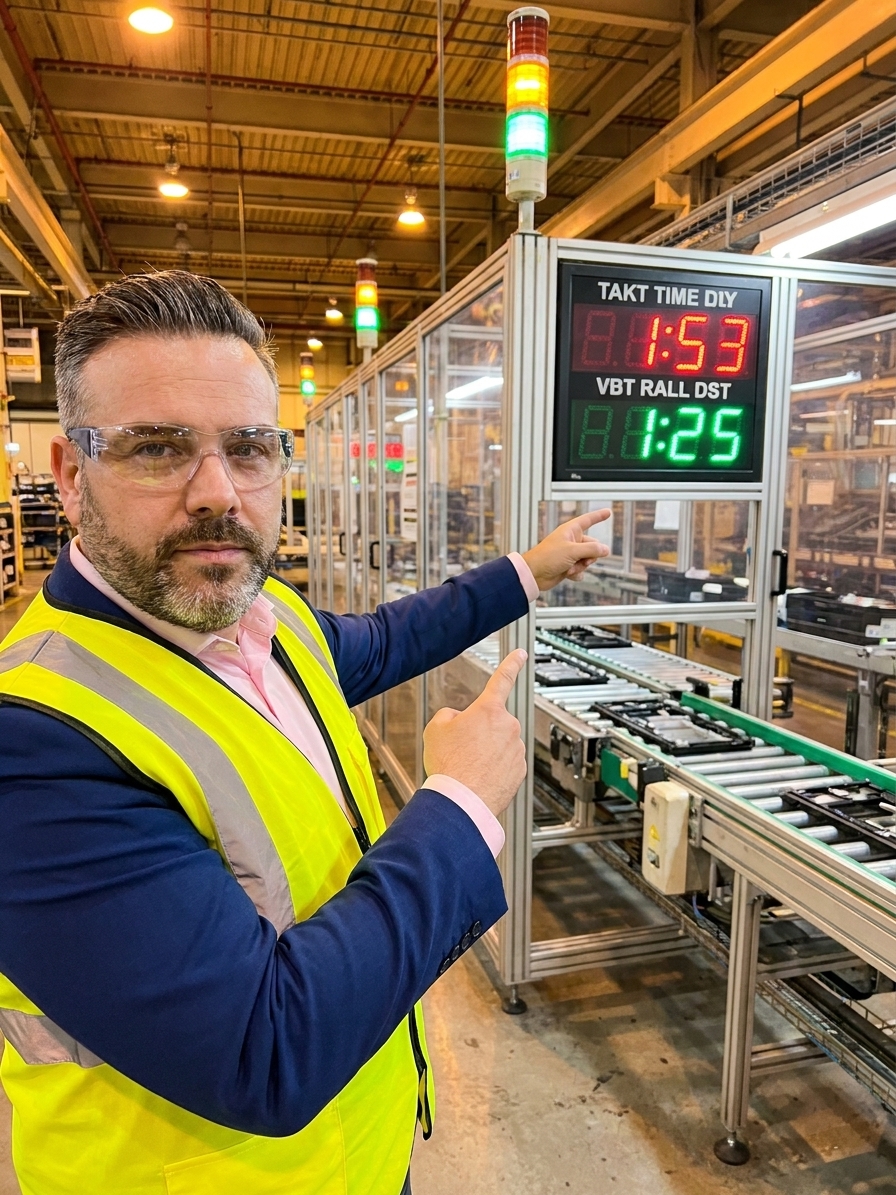
Walk into any factory practising lean manufacturing and you will soon hear the term takt time. Derived from the German Taktzeit, meaning rhythm or pulse, the concept is deceptively simple: divide your available production time by customer demand. The result is the rate at which you must complete a product to satisfy the market.
Yet across thousands of facilities, takt time has been reduced to a whiteboard calculation that impresses auditors but changes nothing on the shop floor. The number gets written on a board, perhaps translated into a digital andon display, and production continues exactly as it always has.
Factories run in batches, building ahead when there is nothing to do and scrambling when demand spikes. I have watched this pattern repeat for over twenty years. A team calculates takt time during a kaizen event, feels good about the math, and goes back to pushing parts out the door based on machine capacity rather than customer need.
What Takt Time Actually Is
Takt time is a synchronisation mechanism. It aligns your production pace with what the market is actually pulling. It is not a measure of efficiency or a target for how fast a machine can cycle.
The formula is elementary: Available Production Time ÷ Customer Demand. If you have 460 minutes of available time in a shift (after subtracting breaks, meetings, and planned maintenance) and your customer wants 230 units per shift, your takt time is 2 minutes. One unit must come off the end of the line every 120 seconds.
Not one unit every 90 seconds because your machine is capable of it. Not one unit every 4 minutes because that is how the operator prefers to work. Two minutes. The customer sets the pace.

Why the Calculation Is Easy and the Discipline Is Hard
Any engineer can compute takt time in under a minute. What is genuinely difficult is reorganising an entire production system — staffing, material flow, work balance, machine sequencing — to actually operate at that pace.
Manufacturing organisations are structurally biased toward overproduction. Machines are expensive, so managers want them running. Operators are measured on output, so they build ahead. Supervisors want buffer stock just in case. Every incentive in a traditional factory pushes production faster than takt time.
I worked with an automotive supplier that had calculated takt time for every cell. Beautiful charts, colour-coded displays, digital andon boards showing real-time cycle counts. During a Tuesday morning gemba, Cell 7 had already built 40 units beyond the shift's requirement — and it was only 10 AM. When I asked the team leader why, she shrugged: the machine was free, so they kept running. The system was perfectly calibrated to measure compliance and completely ineffective at enforcing it.
The Balance Problem: Where Implementations Stall
Knowing your takt time is one thing. Dividing work among operators so that each one finishes within that interval is an entirely different challenge. This is line balancing, and it is where most lean initiatives hit a wall.
Imagine a five-station assembly line with a takt time of 4 minutes and total work content of 17 minutes per unit. In theory, you distribute the work across five stations at roughly 3.4 minutes each. In practice, work does not divide evenly.
| Station | Work Content (min) | vs. Takt (4 min) | Status |
|---|---|---|---|
| 1 | 3.6 | Under | OK |
| 2 | 5.2 | Over | Bottleneck |
| 3 | 3.1 | Under | OK |
| 4 | 2.8 | Under | Wasted capacity |
| 5 | 2.3 | Under | Wasted capacity |
The natural response is to accept the imbalance. Station 2 becomes known as the slow one, and the rest of the line compensates by building small buffers around it. At that point, you have reintroduced inventory, broken one-piece flow, and lost the synchronisation takt time was supposed to deliver.
Proper line balancing requires breaking every task down to the element level, studying motion and sequence, then reassigning elements across stations. It is meticulous work that must be redone every time product mix or demand shifts. This is why so many organisations calculate takt time once, attempt a rough balancing, declare victory, and move on.
How Takt Time Drives Quality
Takt time is usually discussed as a lean manufacturing tool. Its impact on quality is profound and often overlooked.
When production runs faster than takt, excess inventory builds between processes. That inventory hides defects. A problem introduced at Station 2 might not be discovered until Station 5, by which point hundreds of defective units have been produced. The feedback loop between cause and detection stretches from minutes to hours or days. Root cause investigation becomes archaeology.
When production runs at proper takt with one-piece flow, a defect at Station 2 is caught at Station 3 almost immediately. The operator sees the problem while the conditions that caused it are still present. Adjustment happens in real time. The process stabilises.
Without takt time, every quality tool — SPC, FMEA, control plans — operates with a lag that reduces its effectiveness.
Common Failure Modes
Over two decades of quality engineering, I have catalogued the recurring ways takt time initiatives die. The patterns are predictable.
What Teams Do vs. What Works
What teams do
- Calculate takt annually and leave the static number on a digital board
- Set cycle time targets equal to takt and assume the system works
- Run ahead of takt to build buffer stock for forecasted demand spikes
- Accept line imbalances and let the slowest station dictate the pace
What works
- Recalculate takt monthly or whenever significant customer orders change
- Distinguish between actual cycle time and the required demand pace
- Apply heijunka (production leveling) to smooth demand without stockpiling
- Break tasks to element level and continuously rebalance the line
Making the System Work
After implementing takt-based production systems in facilities ranging from precision machining to high-volume electronics, I have found a handful of practices that separate working implementations from decorative ones.
Establishing a Working Takt Time System
- 01Calculate and ConnectDefine the pace and tie it directly to daily staffing and material needs.
- 02Balance to Element LevelRedistribute work content across stations to eliminate bottlenecks.
- 03Make it PhysicalUse chimes, moving conveyors, or visible signals to enforce the rhythm.
- 04Train to StopBuild a culture where operators halt the line when takt is missed.
- 05Continuous RebalancingReadjust work distribution weekly based on real-world performance data.
Takt time is a living number. If your figure has not changed in six months, either your demand is remarkably stable or — far more likely — nobody is updating it. Demand shifts, and available time shifts.
Digital displays are easy to ignore. A physical mechanism forces the rhythm into the operators' consciousness. Toyota's original andon system included a physical board that moved completed parts along at a set pace. The rhythm was tangible.
The most important behaviour in a takt-based system is the willingness to halt when something is wrong. If an operator cannot complete their work within the takt interval, the line should stop, the andon should signal, and support should arrive within seconds. This requires a culture where stopping the line is praised, not punished. Building that culture takes years.
What I Tell Leaders Starting Out
Pick one line — not your most complex, not your most visible, but one where management is willing to let the experiment run for at least 90 days without interference. Calculate takt. Balance the line as carefully as you can. Install a physical signal that makes the rhythm tangible. Train every operator on what to do when they cannot keep pace.
Then stand back. The first week will be chaotic. Problems you did not know existed will surface. Buffers you did not realise were there will drain. Supervisors will ask for just a small buffer to smooth things out. Resist that request. The chaos is what was always there, now made visible by the discipline of rhythm.
Within four to six weeks, if leadership holds firm, the line stabilises. Quality improves because defects are caught early. Lead time shrinks because inventory is not accumulating. Productivity rises because operators are not compensating for imbalanced work. And the takt time number on the board stops being decoration and starts being the heartbeat of a system finally synchronised with its purpose.