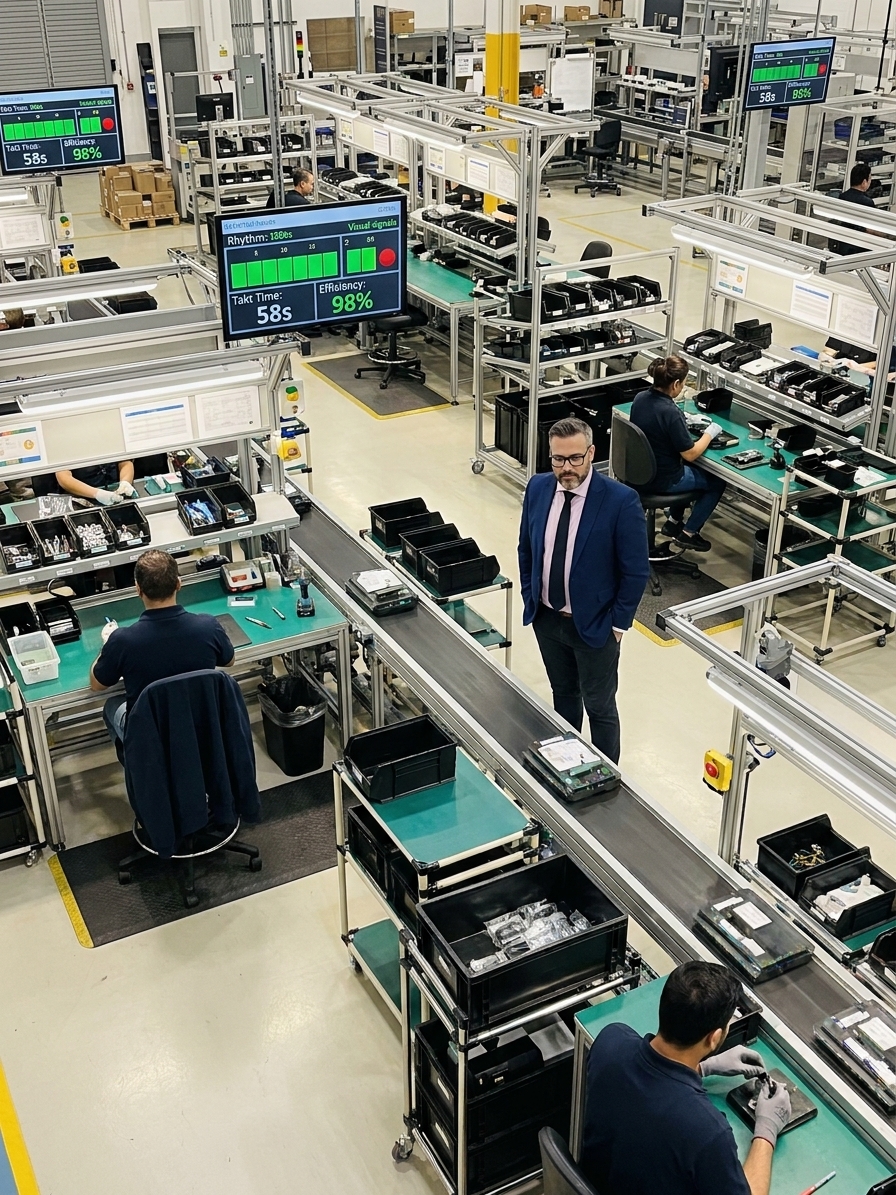
The calculation for takt time takes seconds: divide available production minutes by customer demand. The resulting number is the pulse rate at which finished units must leave the end of the line. In theory, this single metric aligns the entire value stream to actual consumption, synchronising labour, materials, and machine cycles into a predictable flow.
Across two decades in automotive and aerospace, I have audited plants that displayed perfectly calculated takt times on their Andon boards while their operations collapsed into push production. The arithmetic was correct, but the operational discipline was absent. Managers had taken a synchronisation tool and quietly converted it into a performance whip, stripping away the conditions required for the math to actually function.
When takt time degrades, the failure does not show up in the production report first. It manifests as physical symptoms on the shop floor: specific patterns of inventory accumulation, predictable defect types, and highly localised operator fatigue. Diagnosing a broken takt system requires reading these physical clues and tracing them back to the structural failures in implementation.
The arithmetic illusion and the hidden denominator
The first diagnostic failure happens before the shift even begins. Managers calculate available time by multiplying shift length by the number of operators. They routinely fail to deduct planned maintenance, shift handovers, mandatory breaks, and start-up meetings. A takt time built on an inflated denominator is structurally impossible to meet.
When the denominator is fabricated, the entire line runs at a permanent deficit. Operators are immediately behind the published pace, forcing them to skip in-process inspections to catch up. In aerospace manufacturing, where I have implemented and transitioned AS9100 systems, skipping verification steps to maintain a false rhythm directly generates latent defects that survive until final assembly.
The diagnostic signal here is a recurring pattern of 'start-up lag.' If the line falls behind in the first ninety minutes of a shift and never recovers, the takt denominator is inaccurate. The solution is not applying pressure to the operators; it is recalculating the time based on real, net working minutes. A takt target set at one hundred percent efficiency is a guarantee of systemic failure.
The weaponisation of pace and the quality collapse
The most destructive distortion occurs when management treats takt time as a minimum speed target rather than a precise synchronisation point. Supervisors see a takt of forty-five seconds and push the team to achieve forty. This is not lean manufacturing. It is a cycle-time reduction programme disguised with standard vocabulary.

When you arbitrarily shrink the interval to extract maximum labour output, you impose a pace that has nothing to do with actual customer demand. The immediate consequence is a spike in escape defects. Operators working beyond the designed process capacity do not have the seconds required to properly seat a clip, torque a fastener, or verify a weld.
I have seen this exact mechanism drive defect-related costs to unacceptable levels. When operators are pressured to beat the clock, they pass incomplete work downstream to avoid being flagged for missing takt. The metric looks green on the board, but the 8D corrective action queue fills up behind the scenes.
Diagnosing line imbalance through inventory signatures
Announcing a takt time without balancing the production line guarantees simultaneous bottlenecking and idle time. Takt dictates the average pace required across the value stream, but it says nothing about the distribution of work. If Station 4 requires twenty seconds and Station 7 requires seventy, the line will never sustain a steady rhythm.
You can diagnose this failure simply by walking the floor and observing the inventory signatures. Fast stations build small piles of work-in-process (WIP) because the downstream station cannot absorb the output. The operator at the overloaded station becomes the visible bottleneck, constantly playing catch-up while passing defects downstream because they lack the time to stop and fix anomalies.
The standard management response is to pressure the slowest operator. The correct response is to rebuild the line. Without using Yamazumi charts to stack and visualise work content, shift elements, and eliminate non-value-added steps, the imbalance remains. A single takt number applied to an unbalanced line simply guarantees chaos.
Diagnostic Responses to Takt Deviation
Symptom masking (push mentality)
- Pressure slowest operators to increase work speed
- Accept defects passed downstream as unavoidable
- Ignore idle time at fast stations as unfixable
- Blame the takt calculation for being inaccurate
Root cause analysis (synchronisation)
- Deploy Yamazumi charts to visualise work content
- Trigger standardised work review for rework loops
- Redistribute work elements to balance station times
- Ensure every station operates just below the takt
High-mix complexity and the fallacy of the single pulse
Takt time functions cleanly in repetitive automotive assembly where thousands of identical units flow down a line. A single, uniform pulse makes perfect sense. But in high-mix, low-volume environments—common in aerospace and custom fabrication—a single facility-wide takt number is entirely meaningless.
When Product A takes four minutes of assembly time and Product B takes forty, forcing a blunt metric onto the floor satisfies no one. The pace is physically impossible for complex orders and tediously slow for simple ones. Operators quickly learn to ignore the Andon board because the published rate has no connection to their actual work content.
The diagnostic indicator of this failure is widespread operator apathy toward the visual management system. If the production team treats the takt board as irrelevant decoration, the calculation methodology is likely flawed. The resolution requires analytical sophistication: weighted average takt times, product-family-specific rates, and intelligent order-based sequencing.
Volatile demand and the cost of static calculations
Takt time assumes a baseline of demand stability. When customer orders swing drastically from month to month, a takt calculation based on last quarter's volume bears no resemblance to current reality. The most common failure mode is setting the pace once during a launch and treating it as fixed forever.
When demand drops but the static takt pace remains high, the facility builds unneeded inventory. The floor continues pushing out units to hit local efficiency targets, consuming raw materials and occupying valuable floor space. This directly contradicts lean principles and ties up cash flow in finished goods that customers no longer want immediately.
Takt time was conceived to protect workers from unsustainably fast production; weaponised, it becomes the instrument of pressure it was designed to prevent.
When demand spikes but the static pace remains low, the facility misses shipments and initiates emergency escalation. To recover, they run unplanned overtime, which fatigues operators and degrades process capability. Recalculating takt on rolling demand data—monthly or even weekly depending on volatility—prevents both scenarios and keeps the system synchronised.
Corrective Sequence for Takt Integrity
- 01Verify net available timeDeduct planned maintenance, breaks, and shift handovers from gross shift minutes.
- 02Map work content distributionTime current operations to identify stations operating above and below the takt threshold.
- 03Execute structured line balancingRedistribute work elements until all station cycle times fall just below takt.
- 04Establish deviation triggersConfigure Andon systems and hourly boards to flag any station that misses the recalculated pace.
Treating deviations as diagnostic signals
Factories that succeed with takt time share a fundamental respect for the metric. They understand that the number exists to create calm, predictable flow, not to extract maximum labour output. Takt deviations—when a station consistently misses the pace—are treated as diagnostic signals, not disciplinary triggers.
When a station misses takt, the correct response is immediate investigation. Is the work content too high? Is the equipment unreliable, causing micro-stoppages? Are there upstream quality issues forcing rework? By treating the deviation as a symptom of a broken process, management can identify and eliminate the actual root cause.
Ultimately, a functional takt system requires respect for the customer, whose demand drives the pace, and respect for the process, whose capability defines reality. It also requires respect for the people on the line. Operators deserve a rhythm they can sustain for an entire shift without sacrificing quality or safety to satisfy a fabricated mathematical target.
The math behind takt time is elementary. The operational discipline required to make that math relevant is exceptionally rare. By recognising the diagnostic patterns of failure—inflated denominators, weaponised pace, imbalanced inventory, and static calculations—quality leaders can rebuild the system into what it was always meant to be: a tool for synchronisation.