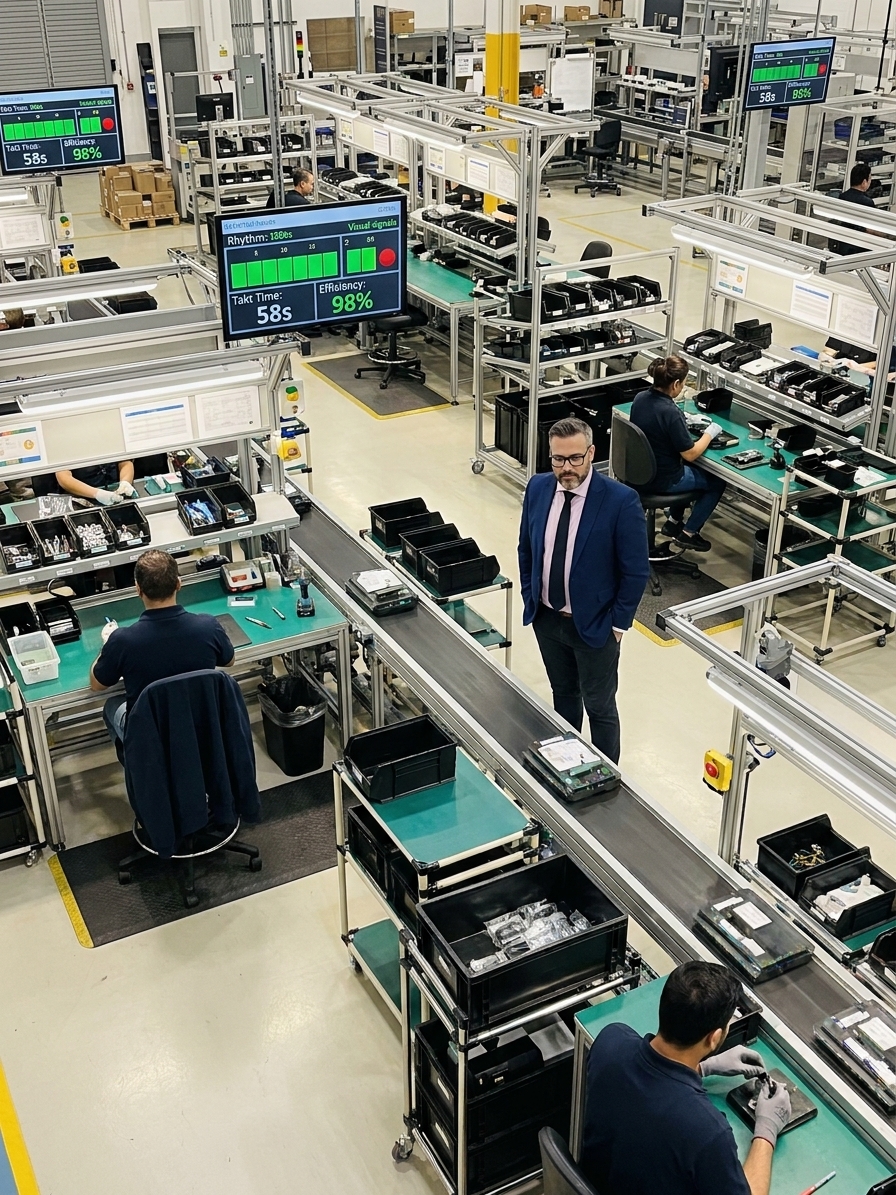
Takt time is the heartbeat of lean manufacturing. Derived from the German word Taktzeit, meaning rhythm, it represents the rate at which products must be completed to meet customer demand. If customers order 480 units per day and your facility runs one 8-hour shift with 480 available production minutes, your takt time is exactly one minute per unit. Every sixty seconds, a finished product must roll off the line.
In theory, this calculation is perfectly balanced. In practice, takt time is one of the most misunderstood and weaponised concepts in modern manufacturing. The math is elementary division, but the interpretation of what that math means in the daily life of a factory is where organisations consistently go astray.
I have audited plants that displayed a takt time on their Andon boards that had no connection to actual customer orders or available working minutes. When the number is calculated incorrectly, or applied as a performance whip rather than a synchronisation tool, the entire lean system degrades into push production with a misleading label. The consequences are predictable: quality collapses, lead times inflate, and operator morale evaporates.
The original intent: synchronisation, not speed
The original intent behind takt time is profound in its simplicity: synchronise production to actual customer-pulled demand. Not to forecast. Not to machine capacity. Not to what the sales team wishes they could sell. To real, verified demand. When implemented correctly, takt time creates a visible, measurable pulse across the entire value stream.
Operators know exactly how fast they need to work — not faster, not slower. Supervisors can immediately see when the line falls behind because the rhythm breaks. Bottlenecks become audible, visible, and impossible to ignore. The entire organisation aligns around a single, shared tempo that reflects the voice of the customer.
In organisations that understand this, takt time transforms chaos into flow. Cycle times stabilise and inventory shrinks. Quality improves because operators are neither rushed nor idle. They work at a sustainable, predictable pace that allows them to focus on doing each operation correctly. This ideal requires a level of operational discipline, systems thinking, and organisational honesty that most manufacturers have never actually achieved.
Distorting takt time into a speed target
The most damaging distortion of takt time is treating it as a minimum speed rather than a precise synchronisation point. Managers who do not understand the concept look at a takt time of forty-five seconds and see an opportunity. They push for forty seconds, then thirty-five. This is not takt time. It is a cycle time reduction programme disguised with lean vocabulary.
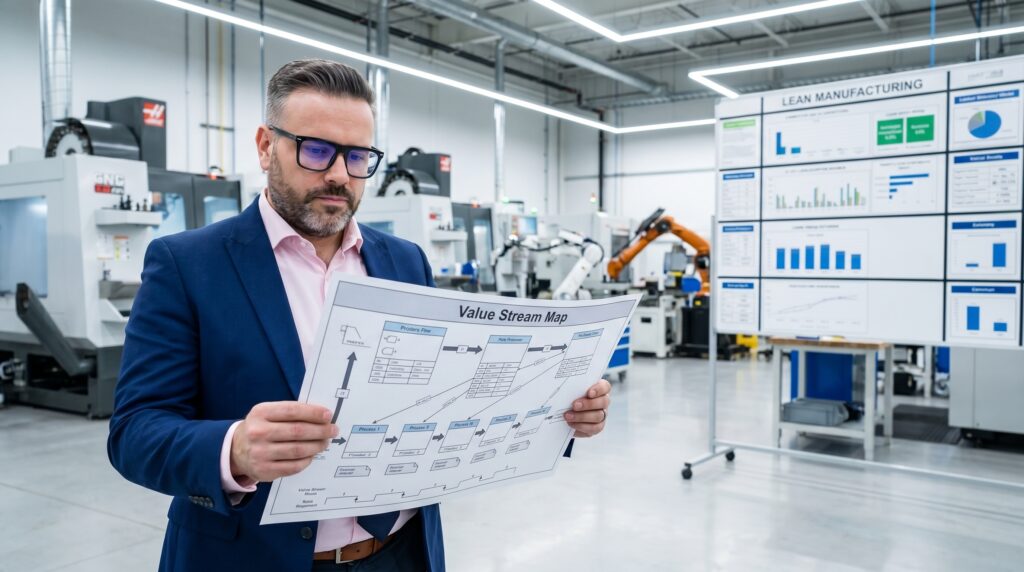
While reducing cycle time is a legitimate improvement goal, conflating it with takt time destroys the concept entirely. Takt time is customer-driven. When you arbitrarily shrink it to push more units through the system, you have reverted to push production. You have not synchronised with demand. You have imposed a target that has nothing to do with what customers actually want.
The consequences on the shop floor are predictable. Operators work faster than the process was designed to handle. Quality suffers because the time available for inspection, adjustment, and care is stripped away. Equipment is run beyond its rated capacity. The takt time that was supposed to create calm, predictable flow becomes a relentless treadmill that exhausts everyone on it.
The critical prerequisite of line balancing
Calculating takt time is the easy part. The hard part — where most organisations fail — is balancing the production line so that every workstation operates at or just below takt. Takt time tells you the average rate needed across the entire value stream. It says nothing about whether Station 4 takes twenty seconds while Station 7 takes seventy.
When takt time is announced but line balancing is not performed, you get the worst of both worlds. You establish a published rhythm that nobody can follow because the work distribution is wildly uneven. Some operators finish their portion in twenty seconds and stand idle for twenty-five more. Others are drowning, perpetually behind, passing defects downstream because they lack the time to stop and fix them.
Line balancing realities against takt
Unbalanced line response
- Pressure the slowest operators to work faster
- Accept defects passed downstream as inevitable
- Ignore idle time at fast stations as unfixable
- Blame the takt time calculation for being wrong
Structured line balancing
- Use Yamazumi charts to stack and visualise work content
- Eliminate non-value-added steps before redistributing
- Shift work elements to balance station cycle times
- Ensure every station operates just below takt
The line as a whole never meets takt, and management’s typical response is to pressure the slowest stations rather than rebalance the work. It is like setting a metronome for an orchestra where half the musicians are playing concertos and the other half are playing scales. The tempo exists on paper, but the music is chaos.
Applying takt in high-mix and volatile environments
Takt time works cleanly in repetitive, high-volume environments like automotive assembly. When you are making ten thousand identical units, a single, uniform pulse makes perfect sense. But many manufacturers operate in high-mix, low-volume environments. Job shops, custom fabricators, and make-to-order operations face different cycle times, routings, and constraints for every product.
A single takt time for the entire facility is meaningless when Product A takes four minutes and Product B takes forty. Organisations that force a blunt number onto a mixed-model environment end up with a metric that satisfies no one. It is too fast for complex products and too slow for simple ones. Operators learn to ignore it because it does not reflect their actual work.
The solution exists: weighted average takt times, product-family-specific rates, and order-based sequencing all work effectively. But they require analytical sophistication that many organisations lack. Applying a single, blunt number to a complex environment guarantees the lean implementation will fail to deliver results.
Demand instability compounds this problem. Takt time assumes relatively stable, predictable demand. When customer orders swing drastically from one month to the next, a takt time calculated on last month’s demand bears no resemblance to reality. Instead of recalculating based on rolling demand data, many facilities set the pace once and treat it as fixed, building unneeded inventory or scrambling to catch up.
The weaponisation of a synchronisation tool
Perhaps the most insidious misuse of takt time is when management uses it as a tool for extracting maximum labour output. The logic is straightforward and destructive. Management calculates a takt time of thirty seconds per unit, then mandates that every operator produce one unit every thirty seconds. If they cannot, they are labelled underperforming.
This framing transforms takt time from a synchronisation mechanism into a punitive performance standard. The consequences are entirely predictable. Operators game the system to meet the number. Quality is sacrificed for speed. Safety incidents rise as workers push themselves beyond safe limits. An adversarial relationship develops between management and labour.
Takt time was conceived to protect workers from unsustainably fast production. Weaponised, it becomes the instrument of pressure it was designed to prevent.
In the hands of managers who see workers as variables to be optimised, takt time becomes exactly the instrument of pressure it was designed to prevent. It serves customer demand selectively, ignores process capability entirely, and treats operators as interchangeable units of output. The lean implementation that results is lean in name only.
A framework for honest takt implementation
Organisations that get takt time right share several specific habits. They calculate it honestly, basing available production time on real shift minutes minus breaks, meetings, and planned maintenance. They base demand on actual orders, not aspirational forecasts. If demand varies, the takt time varies, and everyone understands why.
They balance before they pace. Before imposing a rhythm on the line, they distribute work evenly across stations using Yamazumi charts to visualise cycle times at each step. They eliminate waste, combine operations, and split tasks until every station can complete its work within takt. Only then does the takt time become meaningful.
They build in buffer and recovery time. Real processes are not perfect. Machines jam, parts do not fit, and operators need breaks. A takt time calculated at one hundred percent efficiency is a fantasy. Effective implementations build in planned downtime, buffer inventory at key points, and Kanban signals that allow the line to breathe without losing the overall rhythm.
Sequence for implementing takt on a selected line
- 01Isolate a product familySelect a high-volume, stable line to pilot the methodology before scaling.
- 02Calculate true available timeDeduct planned maintenance, breaks, and shift handovers from gross shift minutes.
- 03Map and time current operationsIdentify stations operating above and below takt to find the work content gaps.
- 04Execute line balancingRedistribute work elements until all stations operate just below the takt threshold.
- 05Establish deviation triggersConfigure Andon systems and hourly boards to flag any station that misses the pace.
- 06Recalculate on rolling demandAdjust the takt calculation monthly or weekly depending on order volatility.
They use takt time as a diagnostic, not a whip. When a station consistently misses takt, the response is investigation, not discipline. Is the work content too high? Is the equipment unreliable? Are there quality issues upstream forcing rework? Takt deviations are signals to fix the process, not punish the person operating it.
Ultimately, takt time is about respect. Respect for the customer, whose demand should drive the pace. Respect for the process, whose capabilities define what is realistic. And respect for the people on the line, who deserve a rhythm they can sustain for eight hours. Factories where takt time creates calm rather than chaos understand that the concept is not about speed. It is about balance.