Plants that run every machine at maximum speed rarely synchronise with actual customer consumption. They generate staggering amounts of work-in-progress, overwhelm final assembly with semi-finished goods, and rely heavily on unplanned overtime to recover from artificial bottlenecks. Quality suffers because operators compensate for scheduling chaos by rushing critical steps, which drives up scrap and rework rates across the line.
Takt Time—the German word for rhythm or beat—resolves this by acting as the manufacturing metronome. It dictates exactly how fast a unit must exit the end of your line to satisfy actual customer demand. In automotive and aerospace environments governed by IATF 16949 and AS9100, failing to establish this rhythm leads to rigid, capacity-driven push systems that cannot absorb upstream variation or downstream demand spikes.
The calculation is deliberately simple. Divide your available production time by customer demand. The resulting figure defines the maximum allowable Cycle Time for any operation on the floor. This metric shifts the focus from what your equipment can produce to what the customer actually requires, exposing hidden waste and forcing deliberate line balancing.
Calculating the Rhythm: Moving Beyond Machine Capacity
Most manufacturers plan production around historical run rates or nameplate machine capacity. This guarantees overproduction. If an injection moulding machine can cycle every 20 seconds, operations run it at 20 seconds regardless of whether the downstream assembly or the end customer actually needs parts that fast, flooding the floor with inventory.
Takt Time strips away internal capabilities and looks entirely outward. Consider a plant running three shifts across five days, yielding 432,000 available seconds per week. If the OEM orders 12,000 units weekly, the Takt Time is 36 seconds per unit. Every 36 seconds, one finished part must leave the line—not 35, not 37. This precision prevents both stockouts and the accumulation of excess buffer stock.
When the OEM increases demand to 15,000 units per week and shifts to twice-daily deliveries, the available time remains constant but the Takt Time drops to 28.8 seconds. Management accustomed to capacity thinking will immediately demand a new line or additional headcount. However, the actual problem is rarely a lack of resources; it is unbalanced work content relative to the new, stricter rhythm.
Takt Time vs. Cycle Time: The Critical Distinction
Confusing Takt Time with Cycle Time is the most common failure I see during plant audits. Takt Time is the voice of the customer—an external demand you cannot control. Cycle Time is your actual performance, representing the time your line physically requires to complete one unit. The relationship between the two dictates the operational health of your facility.
If your Cycle Time is strictly less than your Takt Time, you have buffer capacity. If they are equal, any micro-stoppage will immediately put you behind schedule. If Cycle Time exceeds Takt Time, you are systematically losing ground and will inevitably miss deliveries. Operators must understand this gap without abstract engineering terminology.
Cycle Time vs. Takt Time Thresholds
Line Balancing: Eliminating the Bottleneck
Operators know exactly where their processes fail. The bottleneck is rarely a mystery. In one automotive supplier scenario, the injection moulding operation took 42 seconds, while subsequent steps like assembly and packaging took under 30 seconds. Because the first station exceeded the Takt Time of 36 seconds, the entire line cascaded into delay, and managers aggressively pushed downstream stations to compensate, which only added stress.
The solution is not to add a parallel injection moulding machine or throw extra operators at the problem. The solution is line balancing. By breaking down the 42-second operation into smaller elements, standardising operator motions, and redistributing fractional tasks to downstream stations with excess capacity, the peak cycle time drops.
In this scenario, redistributing the work content brought the longest operation down to exactly 29 seconds. The new Takt Time for the increased OEM demand was 28.8 seconds. The line met the higher volume with zero capital expenditure and no new headcount, simply by realigning standardised work to match the customer's pulse.
| Operation | Before Balancing (s) | After Balancing (s) |
|---|---|---|
| Shell Injection | 42 (Bottleneck) | 29.0 |
| Surface Check & Pre-Assembly | 18 | 27.0 |
| Clip Mounting | 28 | 28.0 |
| Final Inspection & Packing | 22 | 26.0 |
Visualisation and the Andon Response
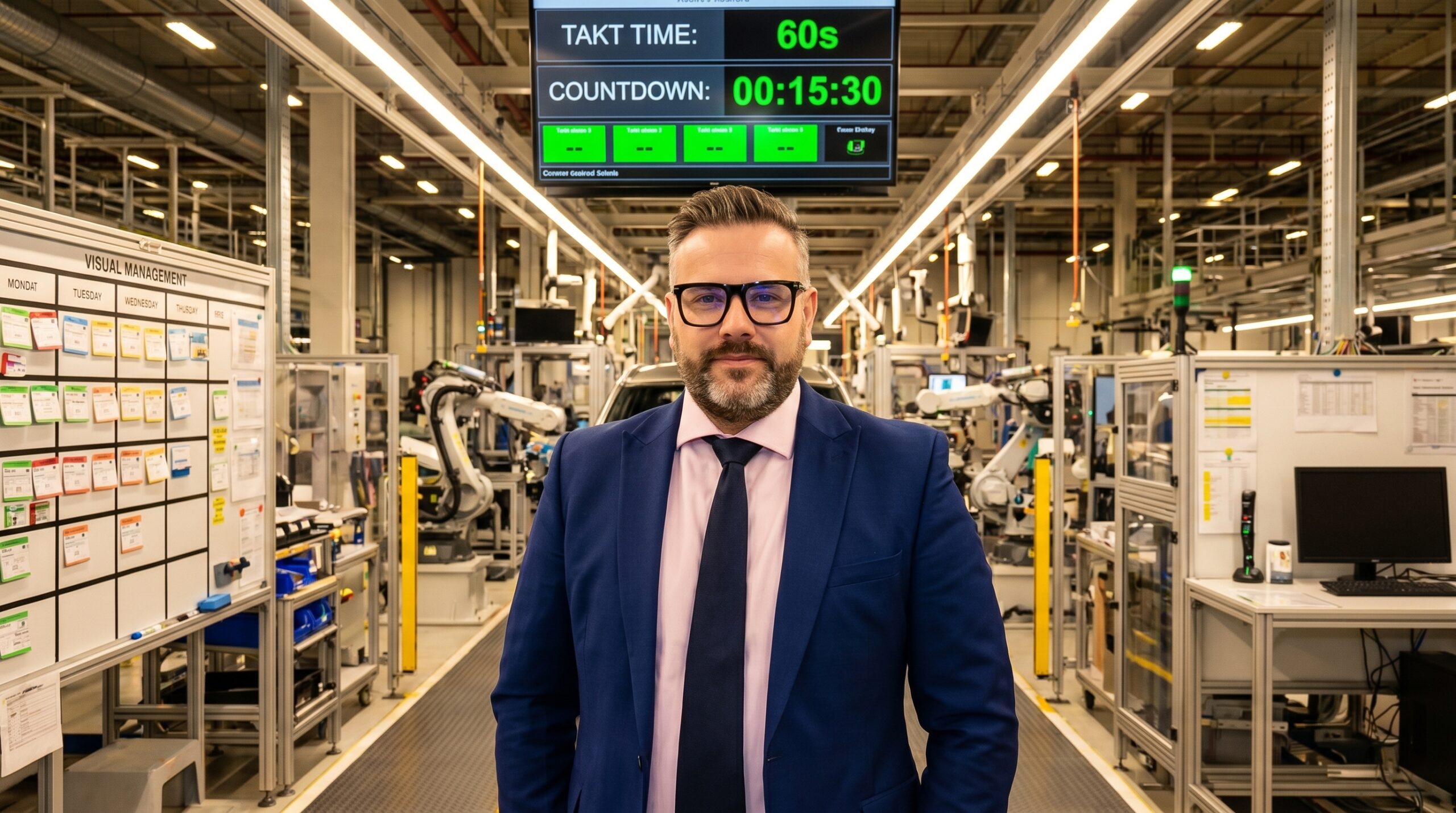
Operators cannot pace themselves to a rhythm they cannot see. Displaying the Takt Time prominently—using digital countdowns at the end of the line or simple hourly tracking boards—transforms abstract timing into physical action. When operators visually register the remaining time before the next cycle begins, they self-correct minor delays before they compound into shift-level losses.
Visualisation must pair with a robust escalation protocol. When a station falls behind Takt Time, the board turns red. The immediate supervisor response cannot be disciplinary. It must trigger an Andon-based support system where engineering or maintenance intervenes instantly to resolve the technical constraint. The red status is a signal for help, not an accusation of poor performance.
When a station falls behind takt, the system must respond with support, not punishment.
This cultural shift builds trust. Operators stop hiding minor stoppages because they know reporting a problem brings immediate assistance rather than reprimand. Standardised work, supported by visible Takt boards and responsive escalation, removes the daily chaos. The focus shifts from surviving the shift to continuous, rhythmic output.
Lean Integration: Kanban, Heijunka, and Standardised Work
Takt Time does not exist in isolation; it is the foundation of Lean manufacturing. Kanban systems fail when teams guess container sizes or replenishment triggers without anchoring them to Takt Time. Heijunka, or production levelling, requires accurate Takt inputs to smooth out demand spikes and prevent the line from starving or flooding.
Standardised work documents must explicitly state the Takt Time for every operation. If a Standard Operating Procedure lacks the required cycle time relative to Takt, operators have no baseline for improvement. Kaizen events should specifically target operations where Cycle Time bleeds past Takt Time, using time studies, video analysis, and motion efficiency to close the gap.
A Lean system without Takt Time is just a collection of isolated efficiency projects. I have audited plants that aggressively implemented 5S and SMED but ignored demand pacing. They achieved high OEE on individual machines while missing customer deliveries, because the local optimisations never synchronised with the global rhythm of the value stream.
Sustaining the Pulse: Recalibration and Digital Maturity
Takt Time is not a static number set during a facility's launch. Customer demand fluctuates based on seasonality, supply chain disruptions, and OEM scheduling changes. If you calculate Takt Time once during Year-End volume planning and never revisit it, your line balancing will slowly degrade until the rhythm is lost.
Quarterly Takt Time Recalibration
- 01Verify Available TimeSubtract planned maintenance, breaks, and changeover windows from gross shift hours.
- 02Confirm Customer DemandAnalyse the latest OEM release or delivery schedule for the upcoming period.
- 03Calculate New TaktDivide available time by the confirmed demand to set the new target pulse.
- 04Assess Cycle Time GapTime-study critical operations to identify bottlenecks against the new Takt.
- 05Execute Line BalancingRedistribute work content and update Standard Operating Procedures.
In mature Industry 4.0 environments, IoT sensors on the line measure Cycle Time in real time, feeding data directly into Manufacturing Execution Systems (MES). When a station consistently approaches or exceeds Takt Time, digital Andon systems push alerts directly to team leaders. This immediate visibility allows for intervention before a backlog impacts downstream operations.
Digital tools amplify the philosophy, but they do not replace it. The fundamental requirement remains the same: listen to the customer, measure the rhythm, and align the process. Plants that sustain high delivery performance use technology to enforce the Takt, while plants that struggle use technology to generate after-the-fact reports explaining why they missed it.