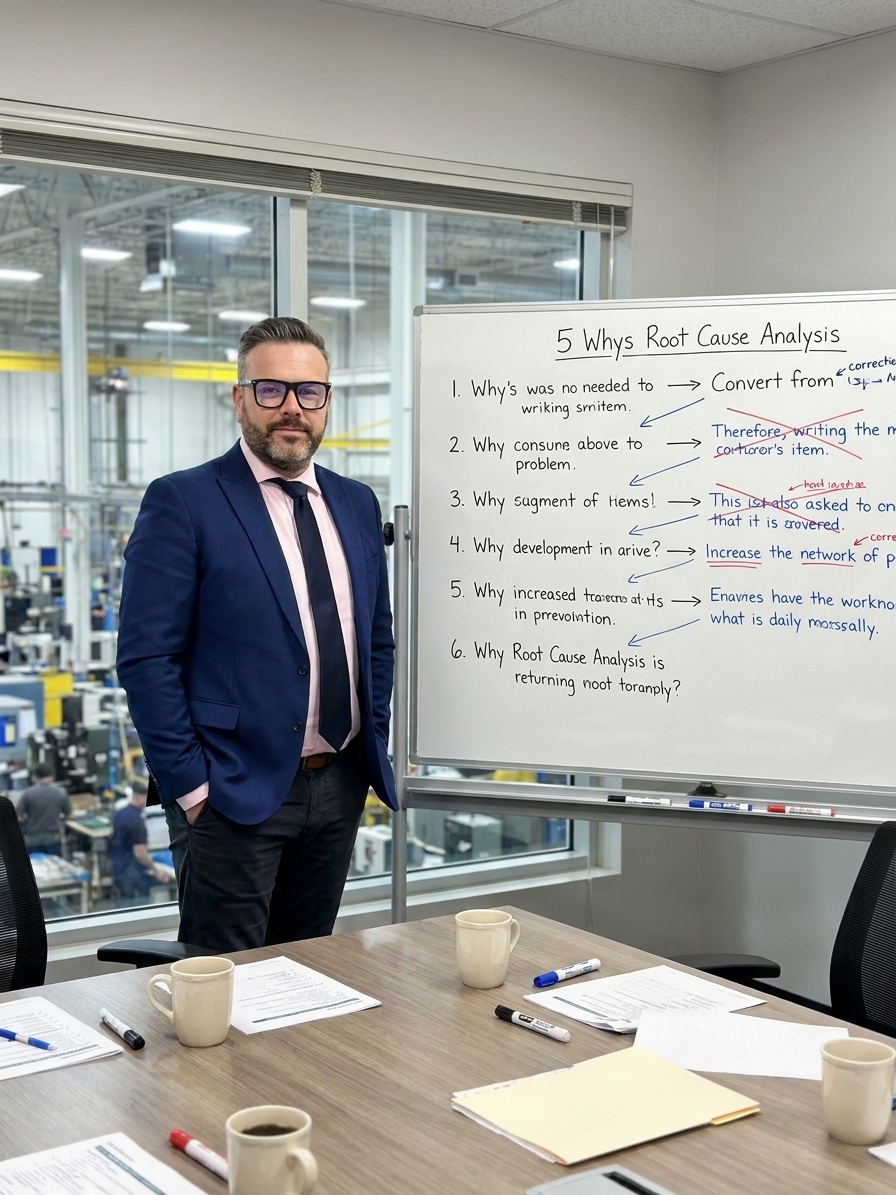
You know the exercise. Someone writes a problem statement on a
whiteboard, and the facilitator asks “Why?” five times. The team works
its way down, each answer leading to another “Why,” until someone
declares they’ve found the root cause. Everyone nods, action items are
assigned, the whiteboard is photographed for the deck, and the team
disperses with the comfortable feeling that they’ve solved
something.
Except they haven’t. They’ve performed a ritual that looks like
investigation but produces the conclusions they already suspected. The 5
Whys, perhaps the most widely taught root cause analysis tool in modern
manufacturing, has become one of its most systematically misused. And
the misuse isn’t a bug — it’s a structural feature of how the technique
is deployed in real organizations.
The Tool That Was
Never Meant to Be Simple
Taiichi Ohno, the Toyota executive who pioneered the approach, never
intended “5 Whys” to be a formulaic five-question drill. He used it as a
teaching method to demonstrate the depth of thinking required to move
beyond symptoms. The number five was illustrative, not prescriptive.
Sometimes the root cause emerged after three questions. Sometimes it
took seven or nine. Ohno’s point was that most organizations stop at the
first or second layer — the symptom layer — and never reach the systemic
layer where the real causes live.
The technique worked at Toyota because it was embedded in a culture
where asking “Why?” was an act of genuine curiosity, not a procedural
step. Engineers were expected to go to the gemba, observe the actual
process, and base each “Why” on evidence they could see and verify. The
questioning was iterative with investigation — each answer was tested
before the next question was asked. It was rigorous, evidence-based, and
deeply uncomfortable for the people whose decisions were being
examined.
That’s not what happens in your factory.
How the 5 Whys Actually Plays
Out
Here’s a scenario. A CNC machine produces parts with excessive
burring on a batch of aluminum components. The quality team gathers for
a root cause analysis session. The facilitator writes on the
whiteboard:
Problem: Excessive burring on aluminum housing parts
(Batch A-4471).
Why 1: Why are the parts burred? Answer:
The cutting tool is dull.
Why 2: Why is the cutting tool dull?
Answer: It wasn’t replaced at the scheduled interval.
Why 3: Why wasn’t it replaced? Answer: The
operator didn’t follow the tool change schedule.
Why 4: Why didn’t the operator follow the schedule?
Answer: Lack of training and awareness.
Why 5: Why is there lack of training?
Answer: The training program needs improvement.
Root Cause: Inadequate training program.
Action: Review and update operator training.
The team feels good. They’ve drilled down five levels. They’ve
identified “training” as the root cause — a suitably systemic-sounding
answer that implies organizational maturity. The action item is safe,
non-controversial, and will generate documentation that looks like
progress.
But let’s examine what actually happened. At Why 1, the team accepted
“the cutting tool is dull” without verifying it. Did anyone inspect the
tool? Did anyone check the tool wear logs? Did anyone examine whether
the burring pattern was consistent with tool wear versus, say, a spindle
alignment issue, a coolant flow problem, or a material hardness
variation in that specific aluminum batch? No. The team started with an
assumption and then built four more layers of speculation on top of
it.
By Why 3, the analysis had already shifted from technical
investigation to human blame. “The operator didn’t follow the schedule”
is a conclusion that deserves interrogation, not acceptance. Did the
schedule exist in a form the operator could access? Was the tool change
interval appropriate for this specific material and operation? Was there
pressure to keep the machine running to meet production targets? Was the
tool wear monitoring system — if one exists — actually functional?
None of these questions were asked. Instead, the team sailed past the
technical possibilities and landed on “training,” which is where most 5
Whys exercises end up because it’s the safest root cause to declare.
Nobody has to defend a machine specification. Nobody has to question a
production scheduling decision. Nobody has to admit that the preventive
maintenance system has gaps. Training is the root cause that everyone
can agree on because it offends no one and requires no immediate
technical investment.
The Five Structural Failures
The 5 Whys technique, as practiced in most organizations, suffers
from five structural failures that compound at each level of
questioning.
1. Assumption Stacking
Each “Why” in the chain depends on the answer before it. If Why 1 is
wrong — if the tool isn’t actually dull, or if dullness is a secondary
condition rather than the primary cause — then every subsequent answer
is built on a false foundation. The technique has no built-in mechanism
for validating each step. In practice, teams rarely pause to verify
because the momentum of the exercise pushes them forward. By the time
they reach Why 5, they’ve constructed an entire causal narrative that
may have been derailed at the first question.
This is particularly dangerous because the narrative feels coherent.
A five-step causal chain has the appearance of logical rigor. It has
depth. It has progression. It has a satisfying conclusion. And none of
that means it’s correct.
2. Single-Path Reduction
Real-world manufacturing problems rarely have single linear causes.
The burring problem might involve tool wear AND coolant concentration
AND feed rate AND material variation simultaneously. The 5 Whys forces a
single path: one answer per question, one direction of inquiry. It
cannot capture interacting variables, feedback loops, or conditions that
must coincide for the failure to manifest.
When you force a branching causal reality into a linear chain, you
don’t simplify the problem — you distort it. You pick one thread and
follow it while ignoring the others, and the thread you pick is usually
the one that’s easiest to investigate, not the one that’s most
important.
Organizations that exclusively use 5 Whys for root cause analysis
develop a institutional habit of monocausal thinking — the belief that
every problem has one root cause if you dig deep enough. This belief is
false, and it leads to corrective actions that address one factor while
leaving the other contributing factors intact. The problem recurs, and
everyone is confused because they “found the root cause.”
3. Confirmation Bias in
Question Design
The way you frame “Why?” determines the answer you get. A facilitator
who suspects the problem is maintenance-related will unconsciously steer
the questioning toward maintenance. A facilitator who suspects operator
behavior will steer toward training and procedures. The technique
provides no guardrails against this bias because the questions are
generated by the same people who have pre-existing theories about the
cause.
In one case I witnessed, two different teams conducted separate 5
Whys analyses on the same defect — a recurring dimensional inconsistency
in an injection-molded part. The first team, led by the process
engineer, traced the root cause to mold temperature variation. The
second team, led by the quality supervisor, traced it to incoming
material specification drift. Both chains were internally logical. Both
reached five levels. Both produced confident root cause declarations.
And both were partially right — the actual cause was the interaction
between material viscosity variation and mold temperature control, which
neither linear analysis could capture.
4. Stopping at Comfortable
Causes
There’s a well-documented phenomenon in root cause analysis called
the “stops at human error” problem. When a causal chain reaches “the
operator made a mistake,” teams almost always stop. They’ve found their
root cause. The action item is retraining, or a procedure update, or a
sign on the machine.
But “the operator made a mistake” is almost never a root cause. It’s
an event. The actual root causes are upstream: Why was the procedure
ambiguous? Why was the operator fatigued? Why was the machine interface
confusing? Why was production pressure creating incentives to skip
steps? Why was there no poka-yoke device to prevent the mistake?
The 5 Whys, as practiced, tends to terminate at whatever cause the
team finds first that they’re willing to accept. And what teams accept
is determined by organizational politics, not by causal depth. Blaming a
supplier is acceptable. Blaming a machine specification is debatable.
Blaming a management decision about staffing levels is career-limiting.
So the root causes that get documented are the ones that fall within the
organization’s zone of acceptable blame — and that zone is almost always
drawn to exclude the causes that matter most.
5. No Validation of the Root
Cause
After the 5 Whys exercise produces a root cause and a corrective
action, there is rarely a validation step. Nobody asks: “If we implement
this corrective action, are we confident this specific failure mode will
not recur?” Nobody designs an experiment to test the hypothesis. Nobody
collects data to confirm that the causal relationship actually
holds.
This is the critical missing element that Toyota’s original practice
included and most implementations omit. Ohno expected engineers to
verify — to go back to the floor, test the hypothesis, and confirm that
addressing the identified cause actually eliminated the problem. The 5
Whys was the beginning of investigation, not the end. In most
organizations, it’s the end. The whiteboard photo goes in the CAPA file,
and everyone moves on.
When 5 Whys Does Work
— and Why That’s Rare
The technique can work under specific conditions: when the problem is
genuinely simple and monocausal, when the facilitator is skilled and
independent, when each step is verified with evidence, when the
organization has a culture that tolerates uncomfortable answers, and
when the analysis includes validation.
Those conditions exist at Toyota and at a small number of
organizations that have invested years in building that culture. They do
not exist at the average manufacturing plant where the quality manager
pulls out the 5 Whys template because the customer requires a CAPA
report within 48 hours.
The irony is that the 5 Whys became popular precisely because it
appears simple. “Just ask Why five times” is a message that fits on a
slide, in a training module, in a procedure document. It doesn’t require
statistical training, specialized software, or cross-functional
expertise. It democratized root cause analysis — and in doing so, it
stripped root cause analysis of the rigor that made it effective.
What to Do Instead
— or at Least in Addition
If your organization relies on 5 Whys as its primary root cause
analysis tool, you’re not getting the depth your problems require.
Here’s what a more robust approach looks like.
Start with evidence, not questions. Before gathering
the team for a 5 Whys session, gather data. Inspect the failed part.
Review the process parameters at the time of the failure. Check the
maintenance logs. Look at the batch records. Talk to the operator. The
causal investigation should begin with what the evidence tells you, not
with what the team assumes.
Use multiple analytical tools in combination. The 5
Whys is one tool. Fishbone diagrams (Ishikawa) help map multiple
potential cause categories. Fault tree analysis captures branching
causality. FMEA identifies failure modes you might not have observed
yet. Each tool has limitations; using them in combination compensates
for individual weaknesses. A 5 Whys that is informed by a fishbone
diagram and validated against process data is far more powerful than a 5
Whys conducted in a conference room with a whiteboard.
Branch when the evidence branches. If at Why 3 you
discover that two factors could independently cause the observed
problem, split the analysis. Follow both paths. A problem with two
contributing causes requires two corrective actions. Forcing yourself to
pick one path means you’ll fix half the problem.
Never accept “human error” as a root cause. If your
analysis lands on “the operator made a mistake,” you haven’t found the
root cause — you’ve found a symptom of a system that allowed a human
mistake to result in a defect. Keep asking why the system failed to
prevent, detect, or correct the error. If the system couldn’t prevent
it, that’s the root cause. If the system could have but didn’t, that’s
the root cause. “Human error” is the beginning of the interesting part
of the investigation, not the end.
Validate the corrective action. After you’ve
identified a root cause and implemented a corrective action, track the
data. Does the failure mode disappear? Does it decrease? Does it recur
at a lower frequency? If the problem recurs, your root cause analysis
was wrong — regardless of how logical the 5 Whys chain appeared. Go back
and investigate again, this time with the humility that your first
analysis was incomplete.
The Deeper Problem:
Analysis as Theater
The fundamental issue with how the 5 Whys is practiced isn’t the
technique itself — it’s what the practice reveals about organizational
intent. When an organization’s root cause analysis consistently produces
safe, comfortable answers that never challenge existing systems, the
analysis isn’t investigation. It’s theater. It exists to satisfy a
requirement — a CAPA closure, an audit finding, a customer complaint
response — not to solve a problem.
The 5 Whys, in this context, becomes a tool for closure rather than
understanding. It provides a structured format that looks rigorous,
produces a documented answer that looks definitive, and generates action
items that look like commitment. The CAPA file gets closed. The audit
passes. The customer receives a response. And the underlying problem
persists, waiting for the next batch, the next shift, the next
inevitable recurrence.
If your organization has conducted hundreds of 5 Whys analyses and
the same types of defects keep appearing, the 5 Whys isn’t the problem.
Your organization’s relationship with the truth is the problem. No
analytical technique can compensate for an institutional unwillingness
to follow evidence wherever it leads — even when it leads to decisions
that are expensive, uncomfortable, or politically difficult.
The 5 Whys was designed to be a starting point for genuine
investigation. In most organizations, it has become a substitute for it.
And the five questions you ask in your conference room, stripped of
evidence, verification, and intellectual honesty, have become the five
excuses you tell yourself so you never have to ask the questions that
actually matter.
About the Author: Peter Stasko is a Quality
Architect with over 25 years of experience in manufacturing quality
management, process improvement, and systemic problem-solving across
automotive, electronics, and industrial sectors. He writes about quality
systems at the intersection of theory and real-world implementation —
focusing on where established methodologies break down and what
organizations can do differently.