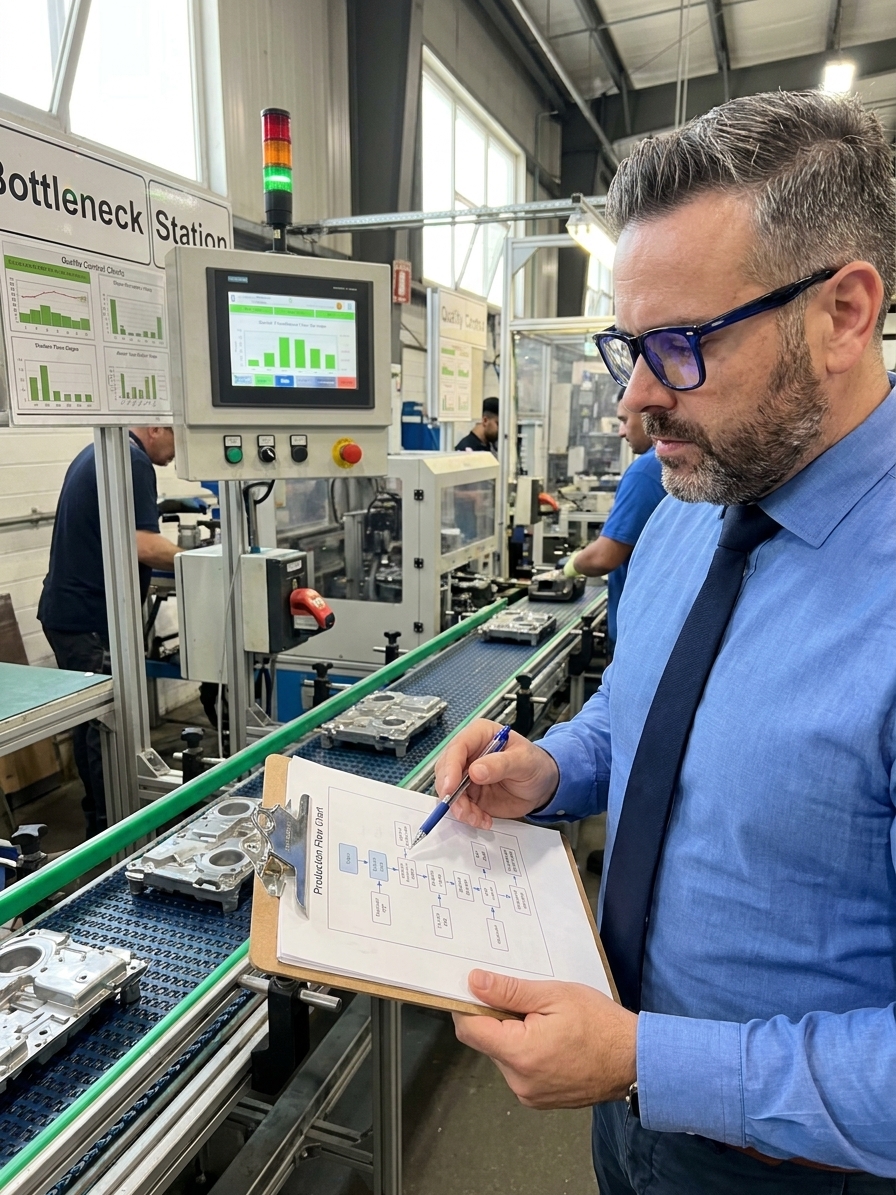
Improving a single process step by thirty percent feels like progress, but the overall defect rate often remains static. Organizations pour resources into inspection, rework, and training, only to find the numbers barely shift. The fundamental issue is not a lack of effort; it is a misallocation of improvement resources across a system governed by a single limiting factor.
Eliyahu Goldratt introduced the Theory of Constraints in his 1984 book The Goal. While originally framed as a production management philosophy, its principles apply directly to quality engineering. Most organizations treat quality as a distributed problem, assuming defects must be reduced everywhere simultaneously. The Theory of Constraints argues the opposite: quality, like throughput, is governed by the weakest point in the system.
Improving any process except the primary quality constraint creates an illusion of progress. The constraint dictates the maximum quality level of the entire system. Until you identify, exploit, and subordinate your operations to this specific bottleneck, your quality improvement efforts will circulate without generating system-wide gains.
Defining the Quality Constraint
In manufacturing, a constraint typically manifests as a bottleneck limiting the flow of good product. However, quality constraints function differently than throughput constraints. A throughput constraint limits how much you can produce. A quality constraint limits how well you can produce by generating defects, variation, and nonconformance at a rate that no downstream process can fully compensate for.
Consider a stamping operation where a specific die produces parts with excessive burr formation. The downstream deburring operation removes the burrs but introduces its own dimensional variation. Final inspection catches the remaining outliers, yet some escape to assembly. Assembly struggles with fit-up because the parts carry the signature of the original stamping variation through every subsequent step. The constraint is the stamping die, not the remediation steps.
The quality constraint is the point in the process where defects originate and variation is injected. Everything downstream is purely remediation. Everything upstream is irrelevant if it feeds the constraint at a rate or quality level the constraint cannot handle. I have audited plants where millions were spent on automated inspection, completely ignoring the upstream machining center generating the initial nonconformance.

Goldratt's Five Focusing Steps Applied
Goldratt's five focusing steps provide a systematic methodology for managing constraints. Applied to quality engineering, they take on a specific character that directs resources toward system-wide capability improvements rather than localized optimization.
Step One is to identify the constraint. Find the process step contributing the most variation to the final product. Pareto analysis helps identify which station has the highest scrap rate, but you must look beyond raw defect numbers to systemic impact. A process step producing a small number of critical defects may be a more severe quality constraint than one producing many minor cosmetic issues.
Step Two is to exploit the constraint. Squeeze every fraction of capability out of that step without adding resources. Ensure the constraint is never starved for conforming inputs, never rushed, and never asked to process compromised material. If the constraint is a heat treatment process, schedule it strictly at optimal capacity and feed it material held to tighter tolerances.
Step Three is to subordinate everything else to the constraint. Upstream processes may need to hold tolerances tighter than their own specifications dictate simply to feed the constraint optimal input. Downstream processes must accept pacing that matches the constraint. Slowing down a fast downstream process prevents the buildup of inventory buffers that mask quality problems and delay root cause feedback.
Step Four is to elevate the constraint. If exploitation and subordination fail to achieve the required capability, invest capital. Purchase new equipment, upgrade tooling, or redesign the process. Step Five is to repeat. When a constraint is resolved, the system changes, and a new constraint emerges. This is a continuous operational discipline.
The Five Focusing Steps for Quality Constraints
- 01IdentifyLocate the exact process step generating the most critical variation and nonconformance.
- 02ExploitMaximize the constraint's existing capability through strict scheduling and optimal inputs.
- 03SubordinateForce all upstream and downstream processes to match the constraint's pace and quality needs.
- 04ElevateInvest capital in new tooling or equipment only after exhausting operational improvements.
- 05RepeatAddress the newly exposed constraint as the previous bottleneck is eliminated.
Drum-Buffer-Rope in Quality Engineering
Goldratt's Drum-Buffer-Rope scheduling methodology translates directly into quality management. The drum is the constraint, setting the pace of defect generation for the entire system. If the constraint produces defects at a two percent rate, the system's minimum defect rate is two percent, regardless of how perfect every other step might be.
The buffer in throughput management protects the constraint from starvation. In quality management, buffers serve dual purposes. A quality buffer before the constraint protects it from receiving out-of-spec input. A quality buffer after the constraint protects the customer from escaping defects. However, excessive buffers delay feedback, making root cause analysis harder and corrective action significantly slower.
The rope is the signaling mechanism that releases work into the system at a pace the constraint can handle. In quality terms, the rope ensures upstream processes do not flood the constraint with work that exceeds its capacity to process with quality intact. Releasing work based solely on production scheduling, rather than constraint capacity, forces overloading and generates the exact defects you are trying to prevent.
Common Failure Modes in Constraint Management
The most common failure mode is the tyranny of local optimization. Improving a non-constraint process by fifty percent feels successful but leaves the overall defect rate unchanged. The improved step gains excess capacity that goes unused. Resources were spent, effort was invested, and the system's quality output remains identical to the baseline.
A second failure mode is misidentifying the constraint by confusing symptoms with causes. High scrap at final inspection is routinely attributed to the inspection process rather than the upstream operation feeding it marginal material. I have seen entire Six Sigma projects launched at the wrong work center because defect data was analyzed without mapping the system's actual production flow.
Ignoring interaction effects is a third failure mode. Fixing one constraint shifts system dynamics and exposes hidden bottlenecks. Processes previously stable because they operated at a comfortable pace are suddenly pushed harder to match the newly elevated constraint throughput. Quality degrades at these stressed points, and management is confused because they just successfully resolved a bottleneck.
Local Optimization vs. Constraint Management
Local Optimization Approach
- Spreads improvement resources evenly across all operations
- Maximizes individual process speeds regardless of system flow
- Focuses on final inspection data to drive corrective actions
- Purchases new equipment when a target metric is missed
Constraint-Based Quality
- Concentrates engineering resources on the primary bottleneck
- Subordinates upstream and downstream speeds to the constraint
- Traces defect data upstream to the point of origin
- Exploits existing capability thoroughly before adding capacity
Integrating Statistical Process Control
Statistical Process Control (SPC) and the Theory of Constraints share a natural synergy that most organizations fail to exploit. SPC indicates when a process is statistically out of control. The Theory of Constraints indicates which process actually matters. Combining them means applying the most rigorous SPC monitoring directly at the constraint, because variation at this point has system-wide consequences.
A control chart at a non-constraint process step is useful for local management but has limited system impact.
An out-of-control signal at the constraint demands immediate response because the system's quality output is actively degrading. Furthermore, the capability analysis performed at the constraint must be more rigorous than at any other point. A Cpk of 1.33 might be acceptable at a non-constraint step but insufficient at the constraint, where every fraction of additional capability translates directly into system-wide yield improvements.
This requires tightening internal specifications at the constraint well beyond what baseline customer requirements dictate. This practice often feels wasteful to operators and managers until they realize the constraint's capability represents the absolute ceiling of the system's overall quality output.
SPC Allocation by Process Type
Implementation in Manufacturing and Services
Implementation begins with mapping the process flow and collecting defect origin data at every step, not just final inspection data. You need to know exactly where defects are first introduced. Which step, if improved, would have the largest impact on overall quality? Answering this requires tracing nonconformance reports upstream to the actual point of creation.
The Theory of Constraints is not limited to physical manufacturing. In transactional and service quality systems, the constraint is often a decision point, an approval process, or a single overloaded individual. If all nonconformance reports must pass through one quality engineer for review before corrective action begins, that engineer is the constraint. A delayed review queue means the production floor continues generating identical defects.
In software development, a small security review team reviewing all code before deployment acts as a constraint. Developers continue writing code without feedback, propagating systemic issues. The solution is not immediately hiring more reviewers, which is elevation. The solution is to exploit the constraint: streamline the review process, handle simple cases via automated checklists, and improve upstream coding practices.
Constraint-based quality improvement replaces a scattered portfolio of projects with a focused sequence. Identify the constraint, improve it until it is no longer the limiting factor, and identify the new constraint. This rhythm creates visible, measurable system-wide gains and builds the operational momentum required to sustain long-term manufacturing excellence.