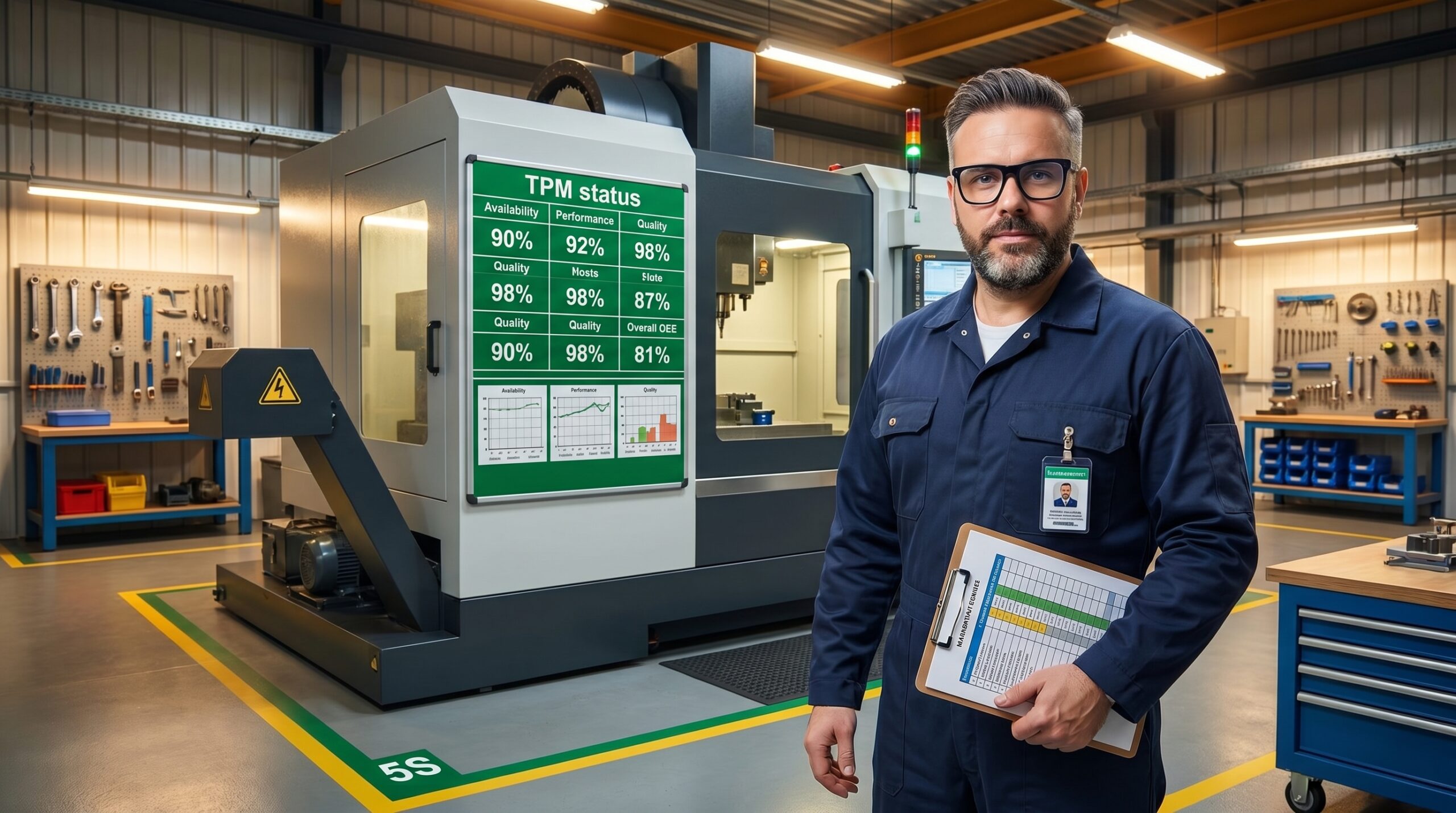
A three-euro bearing seal failed on a critical moulding machine, shutting down automotive sensor production for six hours. The total cost of that single failure reached 14,000 euros in lost output, delayed customer shipments, and emergency recovery logistics. This is the reality of reactive maintenance.
Total Productive Maintenance (TPM) was developed in the Japanese automotive industry to eliminate exactly this scenario. It shifts the operational paradigm from running machines until they break to proactively maintaining them at their optimal condition. Operators stop being passive users; they become the first line of equipment defence.
Having implemented quality systems across automotive and aerospace plants, I have seen how TPM dictates whether a facility survives or thrives. TPM is not a maintenance checklist. It is a rigorous operational discipline that integrates prevention, operator involvement, and continuous improvement into a single framework aimed at zero unplanned downtime.
The Architecture of Autonomous Maintenance
Jishu Hozen, or autonomous maintenance, is the core of TPM. It pushes routine equipment care directly onto the production floor. The operator becomes responsible for cleaning, lubricating, inspecting, and tightening components. This does not replace maintenance technicians; it frees them to focus on predictive and preventive interventions.
Operators know the baseline behaviour of their equipment. They hear when a hydraulic pump changes pitch. They see when a cutting tool starts vibrating outside its normal pattern. TPM builds a structured mechanism to capture and act on this tacit knowledge before it escalates into an engineering failure.
The deployment follows strict phases. It starts with initial cleaning and inspection, where operators physically wash the machine to uncover hidden defects. Subsequent steps eliminate contamination sources, establish lubrication and inspection standards, and finally transfer routine checks entirely to the production team.
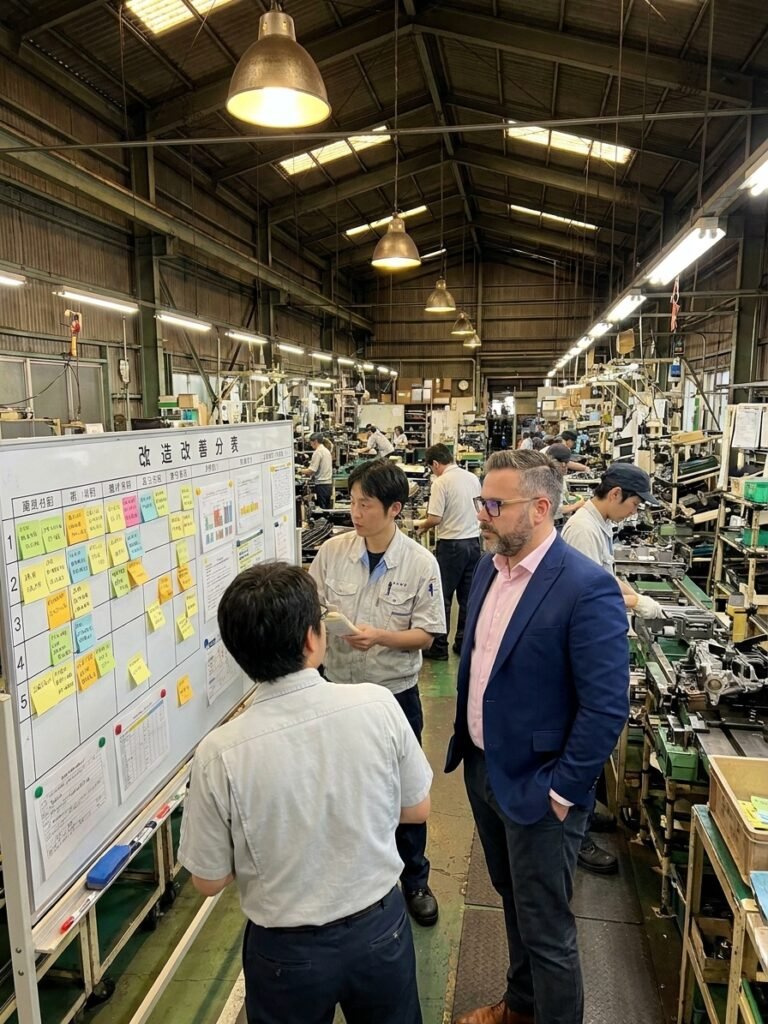
Planned Maintenance and the Predictive Shift
While operators handle routine care, the maintenance department must undergo its own transformation. It must shift from a reactive fire-fighting function to a predictive engineering unit. This means scheduling interventions based on actual equipment condition and operating data, rather than arbitrary calendar dates.
Planned maintenance evolves in four distinct stages. First, reactive or corrective repair addresses what breaks. Second, preventive maintenance schedules part replacement based on time or cycles. Third, predictive maintenance monitors actual component degradation. Fourth, proactive maintenance eliminates root causes through design changes.
A successful TPM implementation targets a 90/10 ratio of planned to unplanned interventions. I have audited plants that were stuck at 80 percent unplanned downtime. By analysing failure history and deploying vibration analysis and thermography, they systematically identified the five failure modes causing 60 percent of their breakdowns and eliminated them.
Planned Maintenance Evolution
- 01CorrectiveEmergency repairs executed only after functional failure has already occurred.
- 02PreventiveTime-based or cycle-based part replacement scheduled at fixed intervals.
- 03PredictiveCondition-based monitoring that tracks actual component degradation trends.
- 04ProactiveRoot cause elimination through equipment design and process modification.
Measuring Reality Through OEE
TPM measures its success through Overall Equipment Effectiveness (OEE). OEE is the multiplication of Availability, Performance, and Quality. It exposes the hidden capacity lost to micro-stops, speed reductions, and start-up scrap that traditional accounting ignores.
World-class manufacturing defines an OEE target of 85 percent. The reality in most operations sits between 40 and 60 percent. This means nearly half of the installed manufacturing capacity is consumed by manageable losses. Without an OEE baseline, management cannot allocate capital or engineering resources effectively.
OEE only functions if the underlying data is trusted. Hand-written downtime logs are notoriously inaccurate. Automated data capture via the programmable logic controller (PLC) is mandatory. When a machine registers a micro-stop, the system must log it automatically, forcing the team to categorise and eliminate that specific loss.
OEE is a compass, not a target. Measuring it without executing structured countermeasures changes nothing.
Categorising the Sixteen Big Losses
TPM systematically categorises operational waste into sixteen specific losses. These span availability, performance, quality, and management factors. The goal is not merely to track these losses, but to structure engineering and operational responses against each category.
Availability losses include breakdowns, set-up and changeover times, and start-up dropouts. Performance losses are driven by micro-stops and reduced cycle speeds. Quality losses account for start-up defects and production scrap. Management losses track logistical delays, missing tools, and poor planning.
Categorisation often reveals counter-intuitive data. Teams frequently assume machine breakdowns are their primary bottleneck. However, loss tracking routinely exposes that waiting for quality approval between operations consumes more available time than mechanical failures. This shifts the improvement focus from maintenance to quality engineering.
| Loss Category | Primary Driver | Primary Countermeasure |
|---|---|---|
| Breakdowns | Component wear and degradation | Autonomous and planned maintenance |
| Micro-stops | Sensor faults or minor jams | Root cause analysis and Poka-Yoke |
| Speed reductions | Machine age or deliberate operator throttle | Restore ideal cycle time |
| Start-up scrap | Process stabilisation variance | Standardised work and SPC limits |
Integrating TPM with IATF 16949 and Lean
TPM does not exist in a vacuum. In an IATF 16949 environment, it is a foundational requirement for predicting machine downtime and ensuring process stability. Just-in-Time (JIT) production completely fails without reliable equipment, making TPM a prerequisite for any Lean manufacturing system.
Integrating TPM with existing Lean tools generates compounding operational gains. SMED (Single-Minute Exchange of Die) directly targets set-up losses identified in OEE tracking. Statistical Process Control (SPC) identifies when a machine begins drifting out of tolerance, signalling mechanical degradation long before a functional breakdown occurs.
Early equipment management is a critical TPM pillar in this context. New machinery must be designed for maintainability. If technicians must dismantle half of a machine guard to reach a lubrication point, the design has failed. Lessons learned from the factory floor must feed back into equipment specifications and supplier standards.
Reactive vs TPM Manufacturing Culture
Reactive Maintenance Model
- Maintenance is treated as a fixed overhead cost.
- Breakdowns dictate the daily production schedule.
- Operators leave equipment issues for the next shift.
- OEE is unknown or estimated without hard data.
TPM Operational Model
- Maintenance is managed as a strategic investment.
- Production runs against a stable, planned schedule.
- Operators own daily cleaning, inspection, and lubrication.
- OEE is tracked via automated PLC data in real time.
Avoiding Implementation Failure
The most common reason TPM implementations fail is delegation. Management assigns TPM exclusively to the maintenance department. If operators are not actively involved, the system loses 80 percent of its effectiveness. TPM requires a daily commitment from the production team, led directly by shift supervisors and production managers.
Pilot selection is critical. Do not launch TPM across every machine simultaneously. Select a single, mid-performance production line where the potential for improvement is visible. Baseline the OEE, execute the autonomous and planned maintenance steps, and standardise the results before scaling the methodology to adjacent lines.
Finally, digitalisation in Industry 4.0 does not replace shop-floor culture. IoT sensors, vibration analysis, and machine learning algorithms provide unprecedented visibility into equipment health. But technology cannot execute a countermeasure. Only trained, empowered operators and engineers who understand the data can eliminate the root cause.