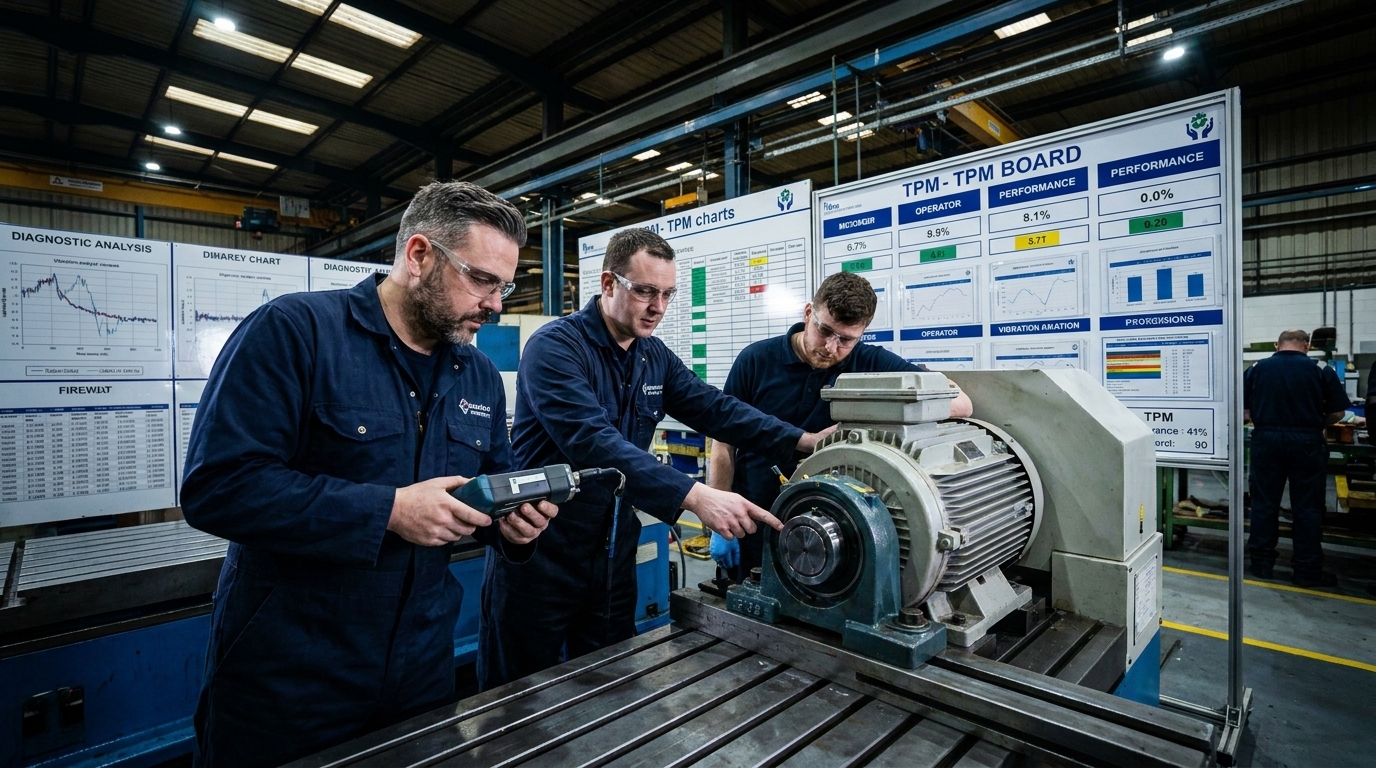
Total Productive Maintenance (TPM) is one of the most rigorously defined reliability frameworks in manufacturing, yet it fails in practice with staggering consistency. The literature promises dramatic Overall Equipment Effectiveness (OEE) gains and near-zero breakdown rates. The reality in most plants is a pile of abandoned lubrication checklists and a maintenance budget that never shrinks.
I have audited plants that launched ambitious TPM initiatives, printed the posters, and formed steering committees, only to see their breakdown frequency remain identical eighteen months later. The failure is rarely a lack of effort. The failure is systematic substitution of activity for engineering discipline.
Organizations adopt the visible rituals of TPM without building the analytical and structural foundations that make those rituals effective. They implement autonomous maintenance as janitorial work, confuse planned maintenance with a relabelled calendar, and track activity metrics instead of equipment outcomes. Here are the specific mechanisms that derail these programmes.
The Reduction of Autonomous Maintenance
Autonomous maintenance is the most visible TPM pillar, which makes it the most commonly corrupted. It is designed as a structured, seven-step progression where operators learn to identify abnormalities, eliminate sources of contamination, establish inspection standards, and eventually conduct autonomous inspections. The end goal is an operator who understands the machine's failure modes.
What actually happens in most facilities is a catastrophic truncation of this sequence. Management tells operators to wipe down their machines at the start of the shift, tapes a lubrication chart to the guard, and declares the pillar implemented. Steps two through seven are silently abandoned. The contamination sources, such as chronic hydraulic leaks and unsealed dust ingress points, remain unaddressed.
The consequence is predictable. You achieve clean-looking machines that fail at the exact same rate as dirty ones. You also generate organizational friction: operators resent being asked to do janitorial work, and maintenance technicians feel their technical expertise is being undermined by untrained personnel.

The Illusion of Planned Maintenance
TPM requires a transformation of your maintenance strategy from reactive firefighting to a structured combination of preventive, predictive, and corrective actions. Most plants already have a mediocre, time-based preventive maintenance (PM) schedule before TPM launches. It is typically based on generic manufacturer recommendations, rarely updated, and frequently skipped when production pressures mount.
When TPM is introduced, this existing PM schedule is rarely overhauled. It is simply relabeled. The same inadequate intervals and incomplete task lists remain. The predictive maintenance elements, which require investment in vibration analysis, oil analysis, and thermography, are discussed during the kickoff and quietly shelved when the capital request is denied.
You cannot achieve zero breakdowns with a reactive maintenance culture wearing a preventive label. The underlying strategy never changed, so the machines will continue to fail according to their established wear patterns, entirely independent of your new TPM branding.
Attacking the Wrong Equipment Losses
Focused improvement, or Kobetsu Kaizen, is where TPM is supposed to deliver visible short-term wins. Cross-functional teams analyze a specific machine's losses, identify the biggest contributors, and systematically eliminate them. The trap lies in the quality of the loss data. Most plants do not accurately measure Nakajima's six big losses.
Their OEE calculation lumps everything into vague categories. Because the data is blind, the improvement team attacks what it can see. A team will spend three weeks optimizing a changeover that accounts for two percent of the total equipment loss, while a chronic minor stoppage problem that accounts for eighteen percent goes unaddressed.
Without rigorous loss accounting, focused improvement becomes a lottery. The team celebrates a successful Kaizen event, the engineering manager updates the dashboard, but the machine's overall effectiveness does not move. You must measure and categorize every minute of equipment time before you can prioritize your engineering effort.
The Truncated Autonomous Maintenance Progression
- 011. Initial CleaningIdentifying obvious abnormalities and restoring basic condition.
- 022. Eliminate ContaminationFixing the root sources of dirt and hard-to-access areas. (Usually skipped)
- 033. Establish StandardsCreating visual, actionable cleaning and lubrication baselines.
- 044. General Inspection TrainingTeaching operators to identify wear, drift, and failure signals. (Skipped)
- 055. Autonomous InspectionOperators taking ownership of predictive condition checks. (Skipped)
Confusing Quality Maintenance with Quality Control
Quality Maintenance (Hinshitsu Hozen) is the most intellectually demanding pillar and the one most commonly skipped entirely. Its premise is that equipment conditions directly determine product quality. Controlling those parameters, such as bearing wear tolerances and thermal variation, is a more effective strategy than relying on downstream product inspection.
This requires you to map every quality characteristic of your product back to the specific machine parameters that influence it. You must understand what hydraulic pressure drift causes surface defects, or what thermal variation in the injection barrel causes sink marks. This is hard, analytical engineering work that requires a deep understanding of process physics.
What happens instead is that plants conflate Quality Maintenance with their existing Statistical Process Control (SPC) program. They already have control charts on product characteristics, so they assume the requirement is met. SPC detects problems after they occur; Quality Maintenance is supposed to prevent them by controlling the equipment conditions that cause the variation in the first place. The difference is proactive prevention versus reactive detection.
The OEE Distortion Field
Since TPM uses OEE as its primary scorecard, it inherits all the measurement vulnerabilities of OEE. When OEE determines the success of the programme, the incentive structure distorts immediately. Teams learn to calculate OEE in ways that make the numbers look acceptable to management.
Minor stoppages under a certain threshold are excluded from the calculation. Changeover time is classified as planned and removed from availability. Reduced speed is accepted as the machine's normal operating rate rather than a loss. A plant can report seventy-five percent OEE using generous assumptions, while its true OEE, calculated against theoretical ideal cycle time with every loss included, sits closer to forty-five percent.
A TPM programme without cross-functional ownership is just a maintenance budget with better branding.
The dashboard looks successful while the equipment losses the programme was supposed to eliminate continue unabated. The numbers are comfortable, but the equipment is not. If your OEE calculation does not hurt, you are not measuring it rigorously.
Outcome Metrics vs. Activity Metrics
Designing for Unmaintainability
Early Equipment Management addresses a structural problem most plants do not realize they have. When a new machine is specified, the purchasing decision is driven by engineering process capability and finance driven by price. Maintainability is rarely a selection criterion. Access points are difficult to reach, lubrication points are hidden behind guards requiring special tools, and critical components require full disassembly to inspect.
Early Equipment Management dictates that maintenance and operations must be involved in the specification process. Maintainability requirements must be built into purchase specifications, and reliability testing must occur during commissioning. Almost no plant does this.
Instead, they keep buying machines that are maintenance nightmares, then launch TPM programmes to deal with the consequences. It is an expensive cycle of treating symptoms while ignoring the disease. You cannot TPM your way out of inherently poor equipment design.
Leadership Abandonment and the Final Audit
These systemic failures require sustained leadership commitment to correct. Not a kickoff speech, not a steering committee that meets quarterly. The plant manager must visit the gemba regularly, observe autonomous maintenance in practice, ask operators what they have learned about their equipment, and review OEE trends personally.
When leadership treats TPM as the maintenance department's programme, that is exactly what it becomes. It turns into an isolated initiative that operators do not support, production does not prioritize, and engineering does not contribute to.
If your TPM programme has been running for two years and your breakdown rate has not dropped significantly, your maintenance cost as a percentage of asset value has not decreased, and your honestly calculated OEE has not improved, you do not have a TPM programme. You have TPM-themed activities. Stop measuring whether you are doing TPM, and start measuring whether your equipment is genuinely getting better.