Every minute a machine runs out of tolerance or sits idle waiting for repair is a minute of lost value and escalating scrap. Total Productive Maintenance (TPM) is frequently dismissed as a maintenance department initiative. In my experience implementing quality systems at SNOP and WITTE Automotive, TPM functions as a core quality engineering discipline.
The objective of TPM is zero breakdowns and zero defects. It shifts the organisation from reactive firefighting to systematic prevention. When you align TPM with frameworks like IATF 16949 and VDA 6.3, equipment reliability stops being a cost centre and becomes the primary driver of process capability.
In practice, TPM means that quality is built into the equipment's operation rather than inspected at the end of the line. Maintenance tasks are distributed, scheduled, and measured with the same rigour we apply to Production Part Approval Process (PPAP) submissions. The ultimate metric is Overall Equipment Effectiveness (OEE), which directly correlates to your ability to hold dimensional and functional tolerances.
Autonomous Maintenance and Operator Ownership
Autonomous maintenance is the foundation of TPM. Operators take responsibility for cleaning, lubricating, and inspecting their equipment. This is not about offloading skilled maintenance work to untrained staff. It is about identifying deviations early. An operator who cleans a sensor daily will notice a water-oil emulsion leak before it causes a catastrophic bearing failure.
When I built the greenfield QA/QC department for a 900+ employee plant, we implemented standardised operator training for routine equipment care. Maintenance technicians were then freed to focus on predictive maintenance and root cause analysis. This split is critical. If your highly skilled technicians are changing filters and clearing chips, they are not analysing vibration data or optimising machine programs.
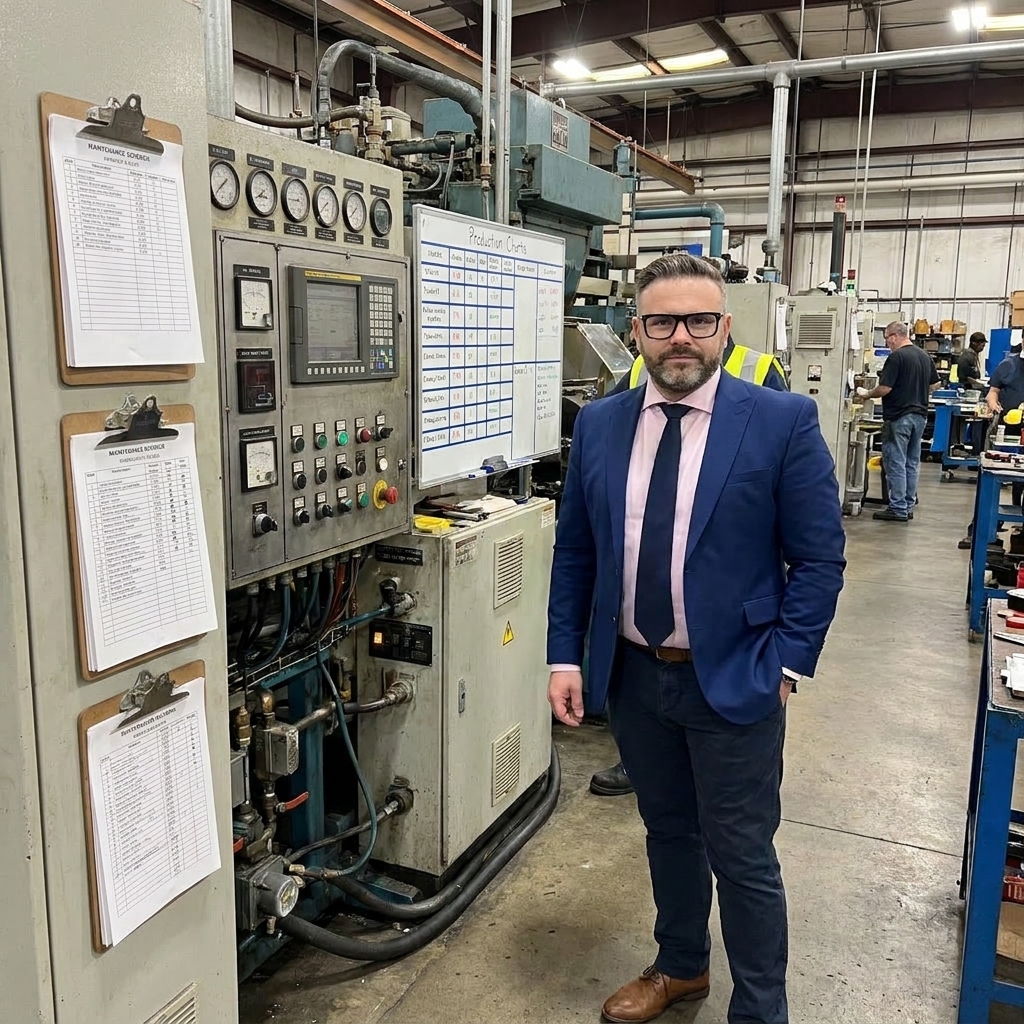
Handing over basic maintenance requires strict standardisation. We use visual management tools—lubrication tags, colour-coded gauges, and one-point lessons—to make abnormalities immediately visible. The operator becomes the first line of defence against process drift, catching mechanical wear before it results in a nonconforming product.
The consequence of skipping this pillar is predictable. Quality becomes reactive. You discover machine degradation only when a dimensional check fails, or worse, when a customer rejects a shipment. Autonomous maintenance closes the gap between machine condition and product quality.
Planned Maintenance: Data-Driven Prevention
Planned maintenance relies on historical failure data, Mean Time Between Failures (MTBF), and production schedules. You cannot wait for components to fail. Instead, you calculate the useful life of critical spares—bearings, seals, servo motors—and replace them during planned changeovers. This minimises unplanned downtime and stabilises the process.
In highly regulated environments like aerospace, planned maintenance is a non-negotiable requirement. Under EASA and AS9100, you must demonstrate that your tooling and machinery are maintained to strict specifications. If you cannot produce the maintenance logs and calibration records for a machine that produced a flight-critical part, the part is suspect.
Maintenance must also be measured for quality. A repaired machine that produces scrap for two shifts while the maintenance team troubleshoots is a failure. Effective maintenance requires standard work. When a technician completes a repair, the machine must return to its validated state, verified by First Article Inspection (FAI) or a short capability run.
Integrating the Eight Pillars into Quality Systems
Standard TPM frameworks deploy eight pillars. While autonomous and planned maintenance handle daily operations, the remaining pillars address systemic issues. Focused Improvement (Kaizen) uses cross-functional teams to eliminate the root causes of chronic losses. Safety, Health, and Environment (SHE) ensures that machine guarding and lockout-tagout procedures are absolute.
The Training pillar closes the skills gap. Maintenance without competence is a hazard. Quality maintenance means technicians understand mechanical, electrical, and software systems. They must also understand how their adjustments impact the product's Cpk. When a technician tightens a clamp, they must know how that force distribution affects the part geometry.
Early Equipment Management integrates TPM into the design phase. At WITTE Automotive, I saw the cost of ignoring this firsthand. Specifying machinery without maintainability in mind leads to inaccessible components and prolonged changeovers. When TPM principles dictate the design and installation of new lines, you achieve stable production faster, protecting your PPAP timelines.
| TPM Pillar | Primary Mechanism | Quality Metric Impacted |
|---|---|---|
| Autonomous Maintenance | Operator-led cleaning and inspection | First Pass Yield, Scrap Rate |
| Planned Maintenance | MTBF-based component replacement | OEE, Unplanned Downtime |
| Focused Improvement | Cross-functional Kaizen on chronic losses | Cpk, Cost of Poor Quality |
| Training & Skills | Standardised mechanical and quality training | Rework Rate, Safety Incidents |
Connecting OEE to Defect Reduction
OEE is the standard TPM metric, combining availability, performance, and quality. The quality component is straightforward: the percentage of good parts produced versus total parts. However, the availability and performance components also drive quality. A machine that stops constantly and runs at erratic speeds introduces process variation.
OEE Component Focus
Micro-stops are the silent killers of quality. An operator clears a jam and restarts the machine in ten seconds. Maintenance logs nothing because the line never officially went down. Yet, during those ten seconds, the injection moulding barrel cooled unevenly, resulting in internal voids in the next five parts produced. TPM forces the tracking of these micro-events.
When you map OEE data against your Process FMEA (PFMEA), the correlation becomes clear. The failure modes you identified—tool wear, sensor drift, thermal expansion—show up as availability losses or quality rejects before they trigger a formal 8D corrective action. TPM provides the data to prevent the failure mode entirely.
If your maintenance strategy relies on breakdowns to trigger work orders, your quality system is inherently defective.
Implementing TPM in Greenfield and Service Environments
TPM is most effective when built into a plant from day one. During the greenfield plant launch at WITTE Automotive, we embedded autonomous maintenance and 5S into the standard operating procedures before the first shift ran. The result was a 98% reduction in initial defect rates and a 75% reduction in unplanned downtime within the first year.
The discipline translates beyond automotive manufacturing. In cleanroom electronics production, precision cleaning protocols and environmental controls are essentially TPM applied to air quality and particulate contamination. The mechanism is identical: systematic prevention of conditions that cause defects.
The same principles apply to administrative and IT processes. Planned maintenance for server infrastructure and customer service systems ensures service availability. While you do not measure OEE on a database, you measure uptime and transaction quality. The mindset of preventing failure rather than reacting to it remains the core value driver.
Sustaining the System: Metrics and Leadership
Implementing TPM requires a fundamental shift in how management views maintenance. If the maintenance budget is the first thing cut during a financial squeeze, the organisation does not understand TPM. Equipment care is an investment in process stability and capability, directly impacting the Cost of Poor Quality (COPQ).
To sustain the system, leadership must review TPM metrics with the same frequency and intensity as safety incidents and customer complaints. Maintenance dashboards must be visible on the shop floor, showing current OEE, open corrective work orders, and PM compliance rates. When operators see leadership tracking this data, the behaviour changes.
At its core, TPM is about removing variation from the physical process. You cannot achieve stable Cpk on unstable equipment. By integrating maintenance data with quality metrics, engineering teams can predict when a process will drift out of control and intervene before scrap is generated. That is how maintenance becomes quality.