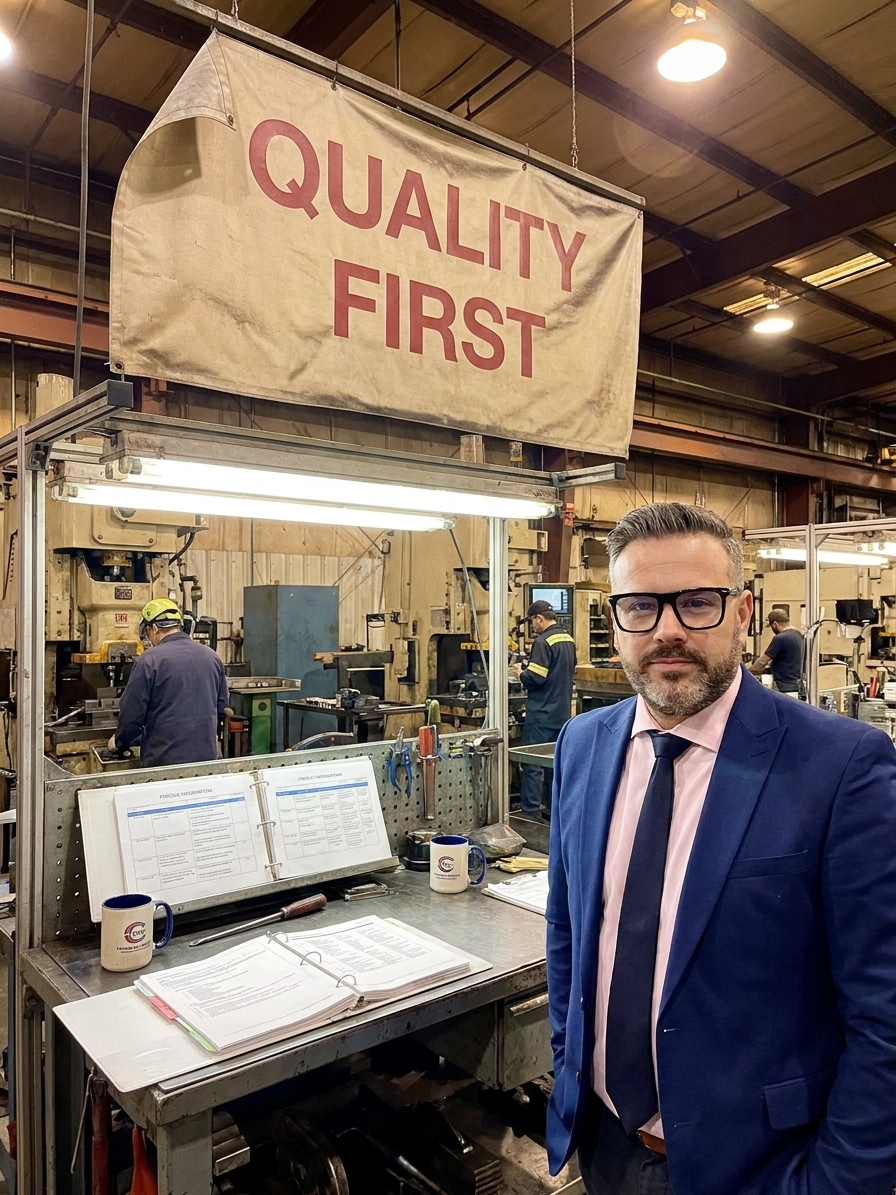
Total Quality Management fails long before the first operator is trained. The architecture of the initiative—how budget, authority, and escalation paths are drawn—determines whether the system survives contact with production pressure. Most organisations design TQM as a departmental overlay, layering new vocabulary over structural defects they have no intention of fixing.
Across two decades implementing ISO 9001, IATF 16949, and AS9100 systems in automotive and aerospace plants, I have seen the same pattern. A launch event introduces ambitious goals, followed by training, new metrics, and updated procedures. Within six months, the posters are faded and the defect rate has returned to baseline.
The failure is structural. TQM demands cross-functional authority, data-driven escalation, and operational discipline. When executives treat it as an awareness campaign rather than a redesign of how decisions are made, the system cannot hold. The gap between the documented framework and the actual decision-making architecture is where every initiative breaks.
Designing Authority Before Designing Training
The most common architectural failure is delegating TQM ownership to the Quality Manager while retaining operational decisions at the executive level. This structure guarantees the framework will lack enforcement power. The quality team becomes responsible for systemic defects without the authority to halt nonconforming shipments or mandate supplier design changes.
Operators read this structural reality faster than any trainer can speak. They watch whether the quality team gains the authority to stop a production line during a scheduling crunch, or merely absorbs additional administrative reporting. When production targets inevitably override containment, the workforce learns the initiative is rhetorical. Cynicism is the only rational response to a system that punishes awareness without granting control.
Real TQM requires structural authority distributed across every function. The plant director or CEO must personally own the cross-functional metrics and enforce the escalation paths. If the organisational chart places quality as a subordinate reporting function rather than a parallel authority with veto power, the framework is structurally disabled at launch.
I have built greenfield QA departments for plants employing over 900 people. In that environment, cutting defect-related costs by 70% required structurally embedding quality authority into the production chain—not bolting it on as an inspection function. The quality team had the explicit, documented power to halt processes, and plant leadership was contractually obligated to support that decision.
Structural Design Flaws in TRM Rollouts
The Departmental Overlay
- TQM owned by Quality Manager with no stop-line authority
- Training deployed before escalation paths are defined
- Metrics reviewed monthly in passive management meetings
- Production schedule overrides quality containment decisions
The Structural Redesign
- Cross-functional ownership with plant director accountability
- Escalation paths tested under simulated production pressure
- Tier meetings driven by real-time floor data, daily
- Quality containment authority codified in operating procedures
The PFMEA That No Operator Reads
Process documentation is where design intent goes to die. Plants spend months creating detailed PFMEA documents, control plans, and flowcharts to secure IATF 16949 or AS9100 certification. The documentation describes an idealised state that operators never follow, because the actual process relies on workarounds and tribal knowledge developed over years of production pressure.

This divergence is not a training problem—it is an engineering failure. If the PFMEA identifies a failure mode but the workstation lacks the fixturing, sensors, or poke-yoke to prevent it, the operator is expected to compensate for an inadequate process design. Documenting the standard does not control the process; engineering the workstation to the standard does.
Maintaining standardised work requires supervision to verify compliance during gemba walks and enforce the documented procedure. But enforcement is impossible if the engineering team has not built a process that can physically sustain the standard. A work instruction that asks an operator to hold a tolerance the tooling cannot maintain is a documentation defect, not a personnel defect.
Measurement Architecture: Lagging Indicators Hide Leading Causes
Standard TQM scorecards track lagging indicators: internal PPM, scrap value, rework hours, customer complaints, and audit findings. These metrics tell you what happened, not what is about to happen. By the time lagging data reaches a monthly management meeting, the defect has already escaped, the customer is already affected, and the root cause is already buried.
Effective measurement architecture tracks leading indicators that predict defects before they occur. Process capability indices, statistical control charts, and first-time-yield data measured at the operation level provide the real-time signal needed to act. The system must measure whether the process is in control, not just whether the output was acceptable.
Measurement must also drive daily tier meetings, not quarterly reviews. A daily shift review driven by floor data catches a drifting process within hours. A monthly summary reviewed in a boardroom catches it after thousands of defective parts have shipped. The cadence of measurement is as important as the metric itself.
Operational Thresholds That Precede a TQM Rollout
The Empowerment Vacuum After Root Cause Analysis
Training operators in 5 Whys, fishbone diagrams, and 8D methodology without providing the structural authority to implement corrective action is a guaranteed formula for cynicism. When a team identifies a root cause requiring a fixture redesign or a supplier change, they need budget, engineering support, and cross-functional sign-off. If the system provides none of these, the training has equipped them to see problems they are powerless to solve.
This is a structural design failure. The escalation path from problem identification to corrective action implementation must be engineered before training begins. If root cause analysis regularly produces action items that stall in an approval queue, the organisation has built a diagnostic system with no treatment capability.
I have audited plants where 8D reports documented the same root cause across three consecutive years. The analysis was technically correct each time. The corrective action was never funded. The system was designed to document defects, not eliminate them, and the workforce knew it.
Training people to identify defects they have no authority to fix is not empowerment. It is engineered frustration.
Leadership Behaviour Under Production Pressure
The ultimate structural test is what happens when a critical defect is detected during a peak production period. If leadership authorises the line stop and deploys resources to the root cause, the system holds. If leadership pressures the team to ship and address the defect later, the entire framework collapses in a single decision.
An executive who demands output acceleration when targets are behind, regardless of quality constraints, actively destroys the quality culture. The organisation learns instantly that the stated commitment is conditional. Every subsequent quality decision is filtered through the knowledge that throughput will always override containment.
If a supplier quality issue requires rejecting a shipment, leaders must focus on the cost of the defect downstream, not the cost of the delay. Passing known defects to the customer is never a scheduling decision—it is a systemic failure of the quality architecture. The cost of a field failure, a warranty claim, or a lost customer always exceeds the cost of a containment delay.
Leadership commitment is not a statement in a quality policy. It is a consistent, visible pattern of decisions made under operational stress. If that pattern prioritises short-term output over process integrity, no amount of training, documentation, or measurement will compensate.
Rebuilding From a Single Process, Not a Programme
If your organisation has experienced a failed initiative, abandon the terminology. The acronym carries structural baggage and workforce cynicism. Instead, select one specific defect mode causing field failures or heavy scrap, and assign your highest-performing cross-functional team exclusively to that target.
Execute disciplined 8D methodology on that single issue. Contain the defect physically within hours. Run root cause analysis with engineering and operations in the same room. Implement corrective actions that alter the process physically—new tooling, revised fixturing, updated programming. Stabilise the process to a Cpk of 1.33 or higher and verify statistical control over time.
Update the PFMEA and control plan to reflect the physical changes. Audit the new standard daily on the floor during gemba walks. Proving the methodology on one highly visible problem demonstrates that the system can actually solve issues, not just document them. That proof is the foundation for any broader transformation.
Proving the Methodology on a Single High-Impact Defect
- 01Target selectionSelect one defect mode causing field failure, customer escape, or heavy internal scrap
- 02Resource allocationAssign top engineering and production talent to solve the issue with dedicated time
- 03Containment and RCAIsolate the defect physically and execute root cause analysis using 5 Whys and 8D
- 04Process stabilisationImplement corrective actions and verify statistical process control over time to Cpk 1.33
- 05StandardisationUpdate work instructions, amend the PFMEA, and audit the new standard daily on the floor
Change one leadership behaviour immediately. If the procedure mandates that lines must be stopped for critical defects, leadership must fund the downtime and support the operators without exception. Measure the impact using operational data: internal PPM, scrap value, and rework hours. If these metrics do not improve within ninety days, the structural redesign has not taken hold.
The path forward is not another programme. It is the deliberate construction of an operating system where authority matches responsibility, measurement drives action, and leadership behaviour under pressure proves the commitment the quality policy only describes.