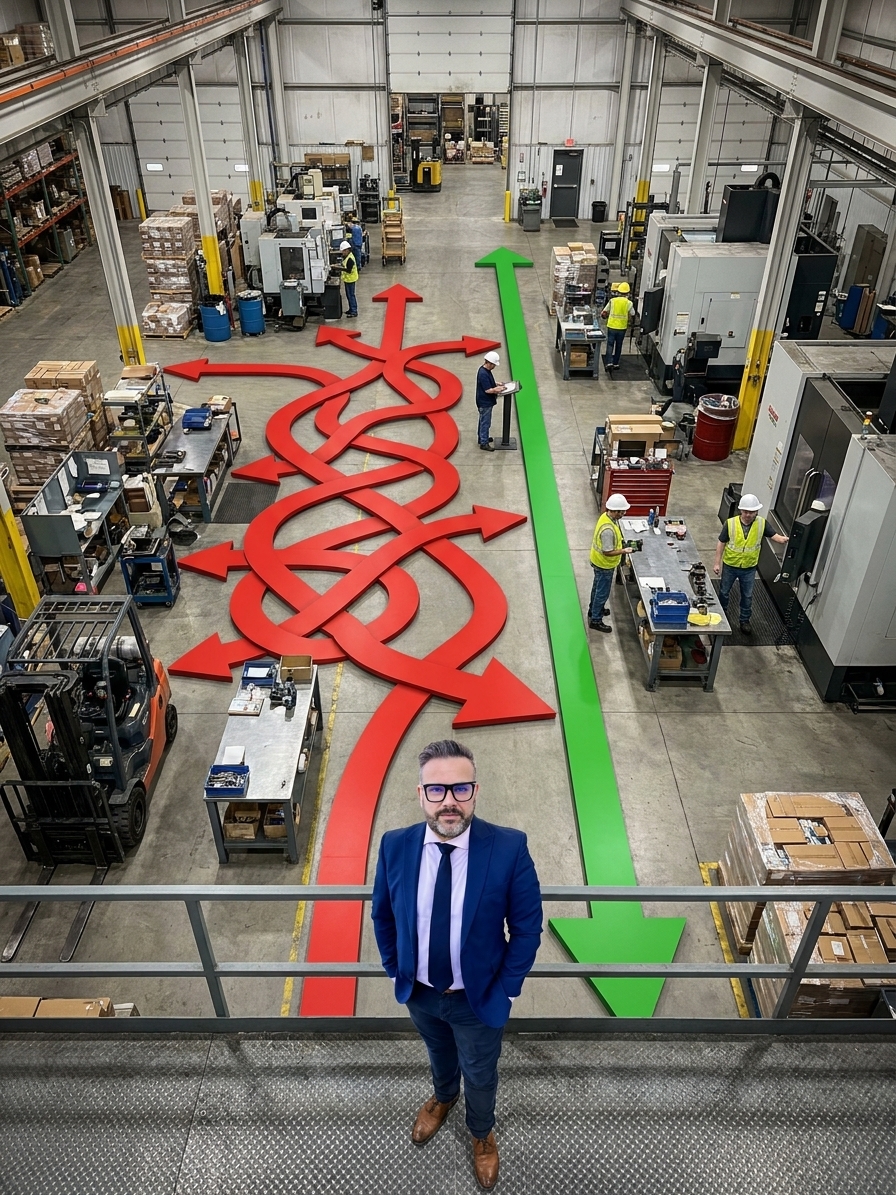
Value stream mapping entered mainstream manufacturing through Mike Rother and John Shook's "Learning to See" in 1999. The technique gave Western manufacturers a structured methodology for seeing processes as interconnected systems rather than isolated operations. Its premise is elegant: instead of optimizing individual workstations, you map the entire flow of value from supplier to customer.
I have walked into facilities where the current-state map hangs beside an expired ISO 9001 certificate. The future-state map exists in a shared drive under "Lean Initiatives — ARCHIVE." Nine months after the workshop, not one process step has changed, not one second of lead time has been removed, and the cross-functional team has dispersed back to their daily routines.
This is not unusual. The tool designed to reveal waste and guide transformation routinely becomes a documentation exercise that changes nothing. The map becomes the deliverable. The breakdown happens at a specific, predictable point — and once you recognise it, the fix is structural, not motivational.
Where Mapping Ends and Inaction Begins
The breakdown between mapping and improving happens the moment the future-state map is completed. The organisation faces a choice: treat the map as a plan requiring immediate execution, or treat it as an achievement worth celebrating. Most choose the latter, though they would never describe it that way.
The language sounds responsible. "Now we have a clear picture — let's socialise this with leadership and get alignment before making changes." This is the beginning of the end. Socialising the map means presenting it in a meeting. The meeting generates feedback, the feedback generates revisions, and the revisions require another meeting. Concerns about resource allocation surface. These concerns are acknowledged, deferred, and forgotten.
Meanwhile, daily production continues. Customer complaints arrive, expediters expedite, and the future-state map waits for a moment that never comes. The organisation is too busy managing the current state to build the future one. The mapping exercise consumed three weeks of cross-functional effort and produced an artifact indistinguishable from decoration.
This failure mode compounds because it teaches the organisation that improvement initiatives produce meetings, not results. The next time someone proposes mapping a value stream, the team remembers the last exercise and responds with scepticism. The methodology gets blamed for what is, at its core, an execution problem.

The Precision Trap and Scope Explosion
Some organisations become absorbed in the mapping process itself and never move beyond it. They refine the current-state map with increasing granularity — measuring process times to the second, documenting every material handler's walking path, cataloguing every signature in the information flow. The map grows more detailed, more precise, more impressive, and no more useful than it was at one-tenth the resolution.
This is the precision trap: the belief that a more accurate map will produce better improvements. Your VSM identified a forty-five-minute changeover as a bottleneck. Measuring it more precisely and discovering it is actually forty-three minutes and twenty-two seconds does not change the action required. The precision feels like progress, but it is procrastination dressed in data.
The scope explosion operates by a different mechanism. What begins as a value stream map of a single product family — the correct starting point — grows to encompass the entire facility, then the Tier 2 supply chain, then the distribution network. Each expansion is motivated by a legitimate insight: internal flow cannot improve without addressing supplier variability. These statements may be true, but they convert a manageable kaizen project into a multi-year transformation requiring capital investment and executive sponsorship nobody has secured.
How VSM Projects Derail
What teams do
- Measure changeover times to the second, seeking perfect data before acting
- Expand scope from one product family to the entire supply chain network
- Design a future state requiring zero inventory and single-piece flow everywhere
- Revise the map repeatedly based on leadership feedback and new constraints
What works
- Accept the 45-minute bottleneck estimate and start reducing it immediately
- Map one family, improve it, measure results, then expand to the next
- Set a future state achievable in 90 days, not a vision of manufacturing perfection
- Freeze the map, assign an owner, and begin executing the first action within one week
The Perfectionist Future State
Some teams design future-state maps so ambitious they paralyse the organisation. The future state eliminates all inventory, implements continuous flow in every segment, installs pull systems across every boundary, and achieves single-piece flow — all within a process that currently produces in batches of five thousand and warehouses three months of finished goods.
The gap between the current state and this idealised future state is so vast that no one knows where to begin. So no one begins. The future-state map joins the current-state map on the conference room wall, a vision of manufacturing perfection that exists in the same category as the organisation's mission statement: aspirational, inspirational, and entirely disconnected from daily operations.
An achievable future state targets one or two structural changes: implementing a supermarket pull system between two bottleneck operations, reducing a changeover from forty-five minutes to single-digit minutes using SMED, or establishing a FIFO lane to replace a chaotic batch queue. These are not visionary. They are operational changes that can be implemented, measured, and verified within a quarter.
Implementation Discipline: The Missing Ingredient
The difference between organisations that map their value streams and organisations that improve them is not analytical skill or workshop facilitation. It is implementation discipline — the organisational muscle that converts analysis into action. In the context of VSM, this discipline means several specific, non-negotiable commitments.
First, commit to a ninety-day implementation cycle. Not a planning cycle, not a study cycle — an implementation cycle. The team picks the highest-impact changes executable within ninety days and then executes them. Not perfectly, not completely, but measurably. Something on the shop floor must change within ninety days of completing the future-state map. If it does not, the mapping exercise has failed.
Second, assign a single responsible owner for the implementation. Not a committee, not a cross-functional steering team — one person who is accountable for making the changes happen and who has the authority to allocate resources and resolve conflicts. At SNOP, I built a greenfield QA/QC department for over 900 employees on exactly this principle: committees provide input, but owners drive execution.
Third, resist the temptation to map everything before improving anything. Map one product family, implement improvements, measure results, then expand. This builds organisational capability and produces something that detailed maps never will: evidence that the methodology works. The first future-state map will be wrong in places. That is not a failure — it is an inherent feature of complex systems. The map is a hypothesis. Implementation is the experiment that tests it.
The Normalisation Problem
There is a psychological dimension to VSM failure that is rarely discussed. When an organisation maps its value stream for the first time, the current-state map almost always reveals waste that is staggering in its magnitude. Lead times one hundred times longer than processing times. Inventory levels representing weeks of production. Material handling distances that would qualify as exercise.
This revelation should be motivating. In practice, it is often demoralising. The waste is so pervasive, so deeply embedded in the system, that it feels impossible to address. The organisation looks at the map and thinks: if this is how bad things are, where do we even start? The answer — start anywhere, but start — is unsatisfying to people who want a comprehensive plan addressing everything simultaneously.
During the workshop, the team sees the process with fresh eyes. Every inventory buffer is shocking, every unnecessary approval step is absurd, every batch-and-queue operation is obviously wasteful. Then the workshop ends. Within days, sometimes hours, the fresh eyes fade. The inventory buffers are just how things are. The approval steps are just the process. The batch production is just what the equipment was designed to do.
The map was supposed to prevent normalisation. Instead, the map itself became normalised.
The Measurement Disconnect
Many organisations that do implement changes based on their value stream maps then fail to measure the results correctly. They measure local improvements — this workstation is faster, that inventory buffer is smaller — without reconnecting to the system-level metrics that VSM is designed to improve.
The purpose of value stream mapping is not to make individual process steps more efficient. It is to improve the flow of value through the entire system. The relevant metrics are system-level: total lead time from order to delivery, inventory turns across the value stream, on-time delivery to the customer, and total cost of the value stream including all waste.
When organisations measure only local improvements, they discover that local gains have not improved the system. A faster workstation produces more, but the output goes into an inventory buffer because the downstream process has not changed. The lead time remains the same. The cost remains the same. The organisation has improved a step without improving the stream.
System-Level Metrics That Validate VSM
Building a Recurring Practice
The organisations that get lasting value from VSM share several characteristics. They time-box the mapping process: current-state and future-state maps are completed within one to two weeks, not months. A good-enough map that drives action is infinitely superior to a perfect map that drives discussion. The mapping is treated as a means to an end, not as an end in itself.
They build implementation into the mapping event itself. Rather than completing the future-state map and then planning implementation as a separate phase, they identify the first actions during the workshop and begin executing them the following week. This creates momentum and prevents the gap between mapping and doing. At a major aerospace manufacturer, I introduced routing verification KPIs that cut internal lead time by 97% — not by mapping more precisely, but by acting on what the data already showed.
They use the maps as working documents, updated regularly to reflect current reality and revised as improvements are implemented. They are reviewed in weekly execution meetings, not in quarterly reporting reviews. And they re-map periodically: value stream mapping becomes a recurring practice, not a one-time event, because there is always more waste to find and more flow to improve.
Your beautifully drawn value stream map is not an improvement. Your meticulously documented current state is not progress. Your ambitious future state is not a result. These are inputs. They become outputs only when something changes on the shop floor — when inventory is physically moved, when a process step is physically eliminated, when a batch size is physically reduced. If your maps are hanging on walls instead of driving weekly action, they are trophies. Trophies do not reduce lead time.