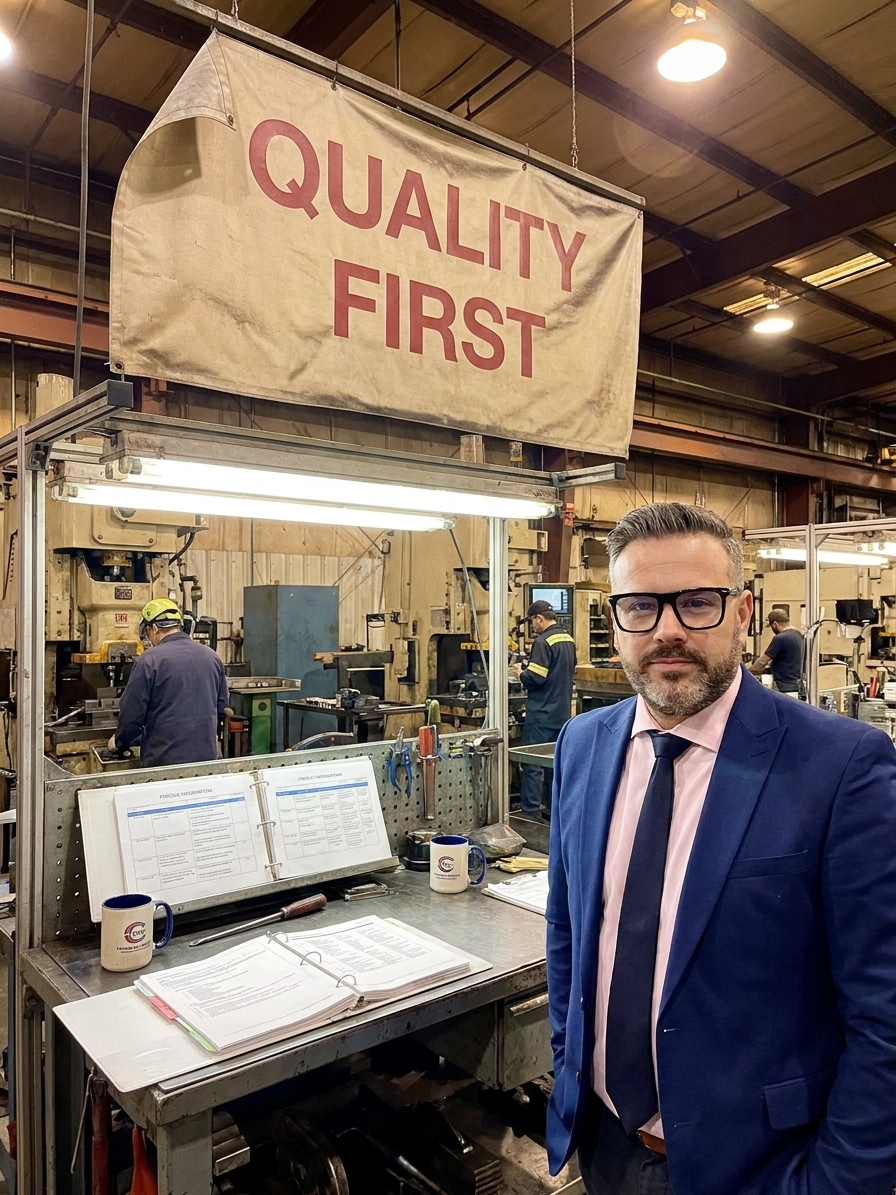
Total Quality Management should not be launched. It can only be built, slowly and deliberately, from the foundation up. Yet the standard implementation pattern relies on a grand kickoff, an external consultant, and a severe timeline that guarantees surface-level compliance.
I have audited plants that displayed massive TQM banners next to machinery actively producing nonconforming parts. The gap between the corporate messaging and the shop-floor reality is the exact point where quality systems collapse. When leadership treats TQM as a campaign with a start date, the workforce waits for the inevitable end date.
The methodology synthesised by Deming, Juran, and Ishikawa requires daily management behaviour, not posters. If the system lacks the patience to solve problems at their root, the organisation simply acquires a new vocabulary for its existing defects. True TQM demands structural authority distributed across every function, measured against precise operational data.
The Grand Launch Without Foundation
The most common failure mode is the executive launch. An executive visits a successful plant, returns inspired, and schedules an all-hands meeting to announce the company is becoming a quality organisation. The consultant arrives, delivers standardised training, and departs within weeks.
Nothing structural changes. TQM requires a foundation of operational trust. Operators must trust that highlighting a defect will not trigger punishment, and that leadership will genuinely prioritise quality over output during a scheduling crunch. This trust cannot be generated by a presentation; it must be established through consistent, visible decisions on the shop floor.
Following the launch, operators return to their workstations and wait. They observe whether the quality team gains actual authority to stop production lines, or merely absorbs additional administrative responsibility. When the production schedule inevitably overrides quality concerns, the workforce learns that the initiative is purely rhetorical. Cynicism becomes the default operational mode.

Delegation to the Quality Department
Delegating TQM implementation to the Quality Manager is the most lethal structural error. An executive who claims quality is everyone's responsibility, yet assigns the framework solely to the quality department, sends a contradictory signal. The organisational structure immediately exposes the reality of the priority.
When TQM is owned exclusively by quality managers, it becomes a localised department initiative. By definition, it loses the 'Total' component. Real TQM must be driven by the highest level of operational leadership. It requires the personal attention and metric-driven involvement of the plant director or CEO to enforce cross-functional compliance.
I have observed QA departments tasked with TQM implementation while lacking the authority to halt nonconforming shipments. They were given responsibility for systemic defects without the structural power to mandate design changes or alter supplier contracts. The initiative immediately degraded into an internal audit exercise.
Training, Measurement, and the Empowerment Gap
Training operators in problem-solving tools without changing the organisational structure breeds cynicism. When teams identify a root cause using 5 Whys or a fishbone diagram, they require budget, engineering support, and cross-functional authority to implement the corrective action. Without structural empowerment, the training guarantees frustration.
Organisations simultaneously obsess over massive TQM scorecards. These reports track dozens of metrics: defect rates, rework, customer complaints, audit scores, and open 8Ds. Because these metrics are generated monthly and reviewed exclusively in passive management meetings, they function as reporting exercises rather than operational management tools.
TQM Metric Architecture
Process Documentation Without Process Discipline
Most plants interpret process focus as documenting processes rather than improving them. Teams spend months creating detailed PFMEA documents, control plans, and flowcharts to secure IATF 16949 or ISO 9001 certification. Once the certificate is framed, the actual work on the floor remains entirely unchanged.
The documentation describes an ideal state that operators do not follow. The actual process relies on workarounds, tribal knowledge, and habit. This divergence between the documented standard and the physical reality becomes the source of every major systemic quality escape the plant cannot contain.
Process discipline requires leadership to enforce the documented standard. If the engineering team updates a work instruction to eliminate a defect mode, supervision must verify compliance during gemba walks. Maintaining the standardised work is tedious, but it is the only mechanism that locks in continuous improvement gains.
Leadership Commitment Requires Leadership Behaviour
The most fundamental TQM failure occurs when leaders allocate budget and sign the quality policy without changing their own behaviour. An executive who demands output acceleration when targets are behind, regardless of quality constraints, actively destroys the quality culture. The organisation immediately learns that the stated commitment is conditional.
When a supplier quality issue requires rejecting a shipment, leaders must focus on the cost of the defect, not the cost of the delay. If leadership prioritises immediate throughput over containment, they train the entire organisation to pass defects downstream. The stated quality metrics immediately become irrelevant.
Leadership commitment without leadership behaviour is worse than no commitment at all.
True commitment is proven under production pressure. If a line must be stopped to implement corrective action, the leadership response determines the success of the TQM initiative. Supporting the stop and deploying resources to solve the root cause is the only behaviour that builds the required operational trust.
Rebuilding TQM: An Operational Framework
If your organisation has experienced a failed TQM initiative, abandon the terminology. The acronym carries structural baggage. Instead, select one specific process generating defects or one problematic supplier, and focus your highest-performing cross-functional team exclusively on that target.
Solve the problem using established 8D methodology. Document the technical and operational lessons learned, update the PFMEA, and stabilise the process capability to a Cpk of 1.33 or higher. Proving the methodology on a single, highly visible issue builds the foundation for broader organisational change.
Operational TQM Restoration
- 01Target SelectionSelect one high-impact defect mode causing field failure or heavy scrap.
- 02Resource AllocationAssign top engineering and production talent to solve the specific issue.
- 03Containment and RCAIsolate the defect physically and execute root cause analysis using 5 Whys.
- 04Process StabilisationImplement corrective actions and verify statistical control over time.
- 05StandardisationUpdate work instructions and audit the new standard daily on the floor.
Change one leadership behaviour immediately. If you mandate that lines must be stopped for critical defects, you must fund the downtime and support the operators. Measure the impact using operational data: internal PPM, scrap value, and rework hours. If these metrics do not improve, the culture is not changing.