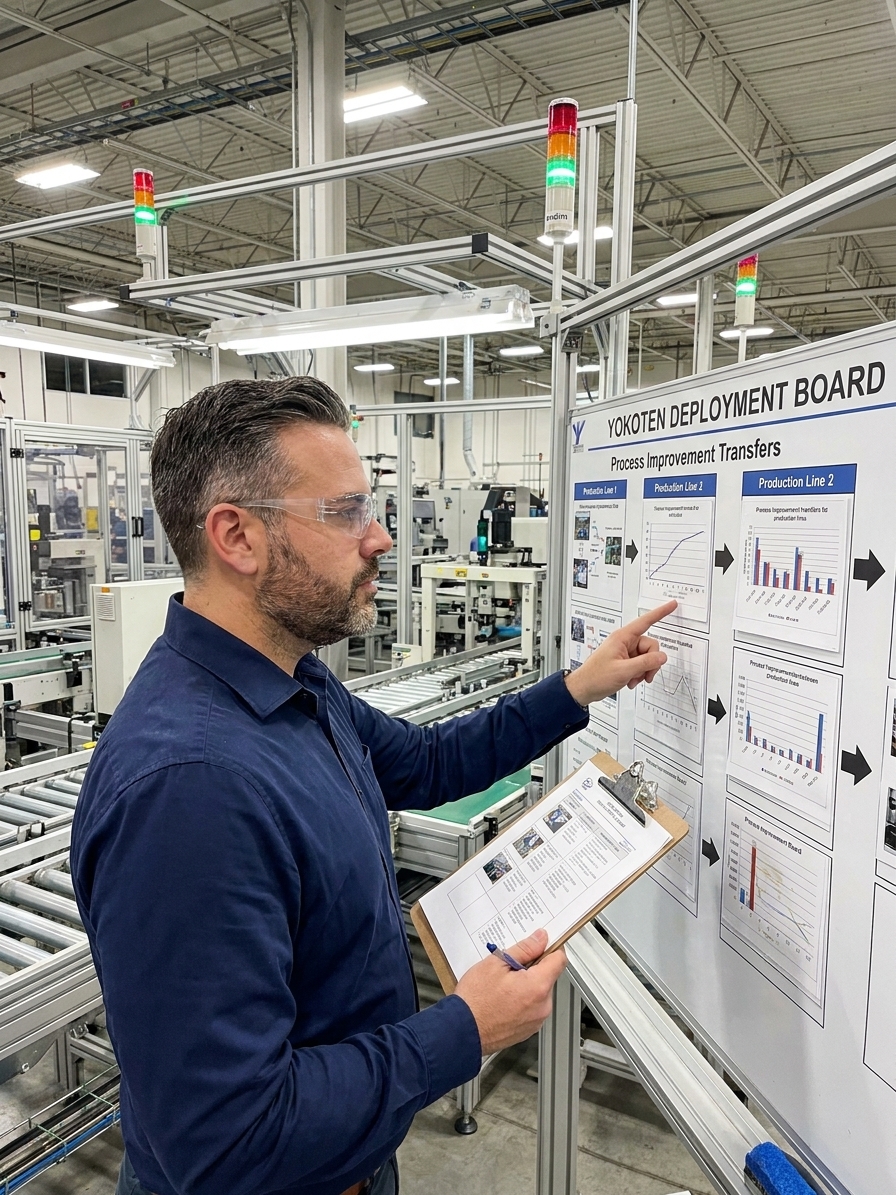
Yokoten, the Japanese practice of horizontal deployment, is meant to push proven improvements across an organisation until every relevant area benefits. Originating in the Toyota Production System, it treats a localised kaizen breakthrough not as an isolated win, but as a corporate asset. The goal is to ensure that a solution validated in one work cell eliminates the same defect across the entire manufacturing network.
Most quality managers understand this principle. Very few have seen it function reliably in practice. The gap between theory and execution is vast, driven by organisations confusing the announcement of an improvement with the actual deployment of its underlying mechanics.
I have audited plants where a welding line reduced rework by 40 percent through a specific fixture modification. The supervisor wrote a one-page summary, the continuous improvement manager circulated it in a monthly newsletter, and leadership expected other lines to follow suit. That is broadcasting. It is the corporate equivalent of throwing a paper airplane and hoping it lands somewhere useful.
The Mechanics of Active Deployment
Structured yokoten operates differently. It treats knowledge transfer as a formal project with assigned ownership, strict timelines, adaptation requirements, and verified results. The Japanese characters literally translate to spreading open across, implying an active, forceful unfolding rather than a passive hope that good ideas will naturally migrate on their own.
At Toyota, when a team validates an improvement, the results are documented in a standardised format. A representative from the originating area then physically visits the receiving areas. The person who owns the knowledge goes to the people who need it, because operational context does not fit neatly into a spreadsheet.
Receiving teams are expected to adapt, not adopt blindly. A fixture optimised for Plant A might require modification for Plant B due to different equipment geometry. The core engineering principle transfers exactly, but the specific physical solution adapts to the local environment.

Where Western Facilities Hit the Wall
The failure modes I see across automotive and aerospace facilities are remarkably consistent. The primary obstacle is prestige. In Western corporate cultures, originating an improvement carries professional status. Adopting someone else's proven solution simply does not. Engineers and supervisors want their names attached to new initiatives, not to a compliant replication of a peer's work.
This ego dynamic is compounded by the not invented here reflex. Even when teams do not consciously resist external ideas, they instinctively argue that their situation is fundamentally different. They claim their line runs faster or their product mix is more complex. Sometimes these objections are legitimate technical barriers. Often, they are defensive rationalisations.
The challenge for a Quality Director is distinguishing between genuine technical constraints and psychological resistance. That distinction requires someone to leave their desk, walk the line, and physically look at the process. It cannot be resolved in an email thread or during a teleconference.
The Documentation Delusion
Organisations routinely generate impressive-looking yokoten reports complete with photos, Cpk data, and step-by-step instructions. They upload these files to a quality management system or a shared drive. Then they file them away. The shared drive becomes a graveyard of hundreds of untouched reports, and nobody has looked at any of them in months.
The artifact became the deliverable. The actual knowledge transfer never took place. This is the documentation delusion: the belief that because a process was meticulously recorded, it has been successfully shared. This failure mode deepens significantly in the age of digital manufacturing, where beautifully produced video tours and augmented reality simulations mask a total lack of deployment.
Technology should accelerate the human process, not replace it. Use digital tools to prepare a receiving team before an originator visits. Use simulation to test adaptation ideas. But do not skip the physical visit, the joint problem-solving, or the adaptation conversation.
A Practical Yokoten Process for ISO 9001 Systems
Within an ISO 9001 framework, yokoten directly supports critical clauses. Clause 7.1.6 requires organisations to maintain and share knowledge. Clause 10.2 demands continual improvement. Yokoten is the operational mechanism that makes both clauses functional rather than aspirational. Satisfying auditors with a lessons-learned log is insufficient if the knowledge never reaches the shop floor.
To build a defensible, auditable approach to knowledge management, the process must be structured. It requires capturing the context, assigning explicit ownership, and verifying the physical results. This is the process that actually moves a validated solution out of its originating work cell and into the broader facility.
The Horizontal Deployment Cycle
- 01Capture with contextDocument the change, before condition, after metrics, and necessary conditions for replication.
- 02Assign a coordinatorName a specific facilitator responsible for identifying candidate areas and driving the transfer.
- 03Send the originatorThe knowledge owner visits the receiving area to walk the process and answer questions in person.
- 04Adapt and implementThe receiving team modifies the concept for their equipment geometry and owns the local result.
- 05Verify and feed backConfirm the metrics at 30-90 days. Capture secondary improvements and trigger reverse-yokoten.
Measuring What Actually Lands
If your yokoten ratio is stuck at one-to-one, meaning the improvement stayed exactly where it started, you do not have horizontal deployment. You have a single kaizen event with a newsletter. Organisations serious about knowledge transfer track the pipeline with hard metrics.
Forced mandatory adoption without adaptation produces superficial compliance that is quietly abandoned within six months.
I worked with one manufacturer that instituted a simple practice: every monthly operations review featured a segment asking what they had borrowed from another area. It took three months for the tone to shift from defensive excuses to competitive pride. Teams began reporting how they implemented improvements from a sister plant and added their own engineering twist to optimise it further.
Core Metrics for Horizontal Deployment
Engineering the Cultural Shift
Process and structure are necessary, but ultimately insufficient without leadership alignment. Yokoten depends entirely on whether your organisation values learning from others as much as it values originating new ideas. When a plant manager publicly recognises a team that adapted a peer's improvement with the same enthusiasm given to a ground-breaking invention, the culture shifts permanently.
Performance reviews must reflect this priority. When an engineer's evaluation includes a category for adopting or contributing to horizontal improvements, behaviour changes immediately. The defensive rationalisations fade, and the focus turns to solving problems using proven engineering principles rather than reinventing the wheel for the sake of recognition.
There is no software to buy and no certification to earn. What yokoten requires is the organisational will to treat knowledge sharing as real work. It requires budgeting time for supervisors to leave their areas, study proven solutions, and adapt them. If your shared drive is full of untouched reports, the solution is not better software. It is a plane ticket, a structured conversation, and the discipline to verify the result.