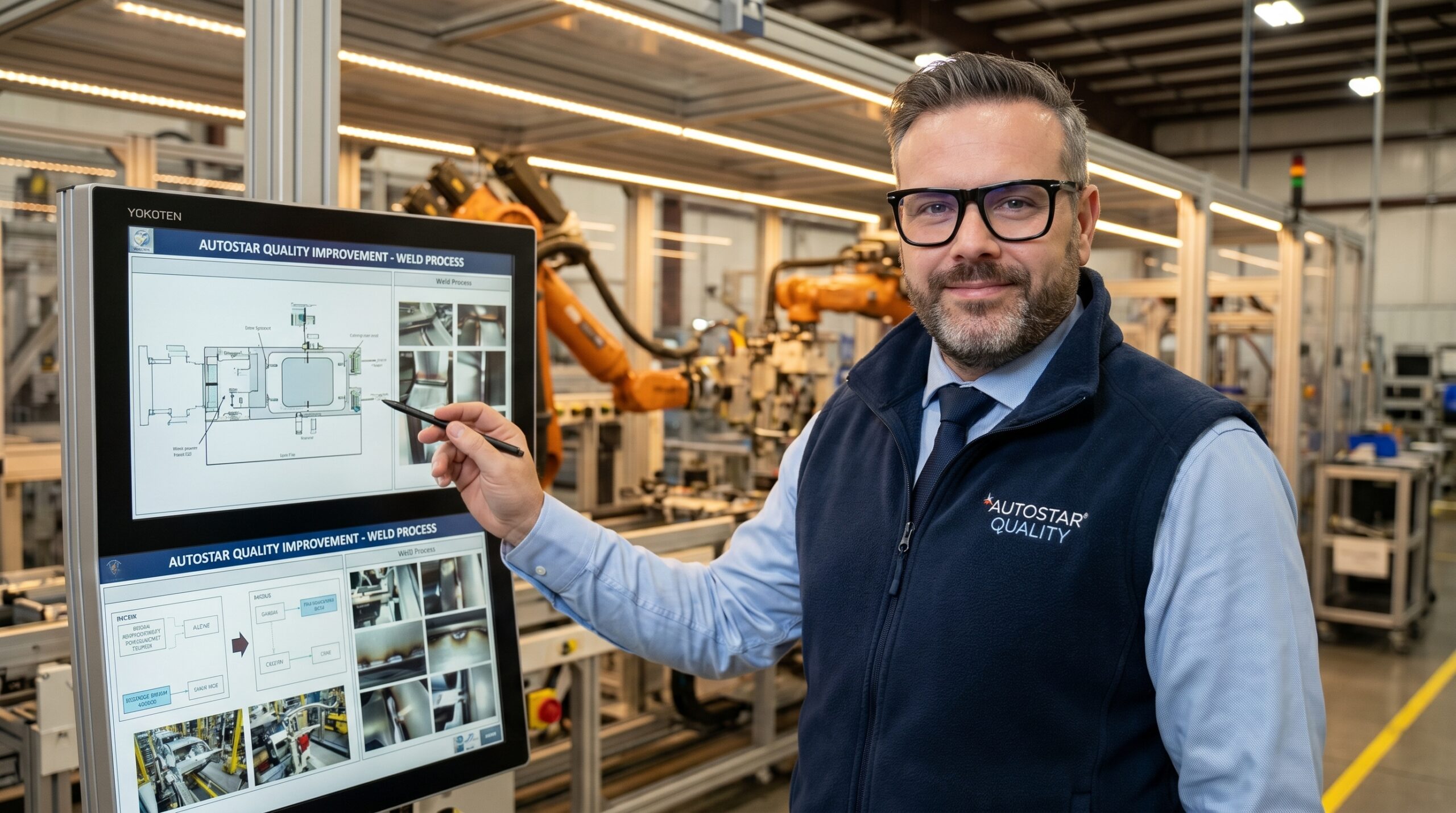
An operator on Line 3 develops a poka-yoke that cuts changeover time from eighteen minutes to six. The shift leader validates the results, quality rejects drop, and the cells run smoother. Yet three months later, Line 7—running an identical process—still bleeds twelve minutes of excess changeover per cycle. Nobody told them. This scenario plays out in manufacturing plants globally.
The failure is rarely a lack of capability. The failure is structural. Organisations lack the closed-loop mechanism required to transport validated improvements from their point of origin to adjacent processes. Without a formalised system for horizontal knowledge transfer, isolated wins die in their original department.
Yokoten translates from Japanese as horizontal deployment. Within the Toyota Production System, an improvement is considered fundamentally incomplete until it has been evaluated and integrated into all applicable parallel processes. In TPS logic, an isolated kaizen is a wasted kaizen. Yokoten is the administrative and engineering mechanism that closes that gap.
The Core Mechanism: Adaptation Over Duplication
The most common reason horizontal deployment initiatives fail in European and American plants is a fundamental misunderstanding of the process. Engineers treat Yokoten as a 1:1 copy-paste operation. When the copied solution inevitably conflicts with the physical constraints of the target cell, they declare the methodology flawed and abandon the effort.
Horizontal deployment requires transferring the underlying principle, not the physical hardware. When a visual indicator resolves cycle variability on one line, the target line might lack the physical mounting space. Transferring the adaptation means the target team must engineer their own application of the core logic.
I have implemented ISO 9001 transitions across automotive and aerospace plants, and the transfer of organisational knowledge is the consistent bottleneck. Leaders must enforce a strict separation between the technical solution and the fundamental problem it solved. Only the understanding of the problem travels horizontally.
Filtering: Separating Yokoten Candidates from Noise
Not every local improvement warrants horizontal deployment. Attempting to scale every minor kaizen overwhelms the engineering team and dilutes focus. You must establish rigid filtering criteria. Only validate improvements as Yokoten candidates if they address a systemic issue present across multiple cells or product families.
The impact must be quantifiable through existing quality metrics—Cpk shifts, OEE gains, or scrap reductions. If you cannot prove the financial or operational impact with standardised data, the improvement is not mature enough to scale. Subjective gains do not survive cross-departmental transfer.
Finally, assess the adaptability of the core principle. If the solution relies entirely on highly specific operator skills or proprietary machinery, it will fail during adaptation. The most successful deployment candidates are mechanical or procedural fixes built around simple, robust logic that any trained operator can execute.
Yokoten Candidate Thresholds
Structuring the Gemba Handoff
Deploying improvements through PDF manuals or digital work instructions guarantees failure. Operators do not integrate abstract concepts into their muscle memory through reading. Yokoten requires a physical handoff at the source. Bring the target process leaders to the origin cell to observe the validated improvement under live production conditions.
During the gemba session, the origin team demonstrates the mechanics of the change. More critically, they must explain the failure modes they encountered before the fix. Understanding the historical context of the problem arms the target team with the knowledge required to adapt the solution to their own constraints.
The handoff concludes with a collaborative engineering review. The target team maps their own process flow against the newly learned principle. They must physically sketch their proposed adaptation before leaving the gemba. This ensures the conceptual transfer has occurred and identifies immediate physical limitations.
Yokoten is not a copy mandate. It is an engineering challenge to solve your specific problem using proven logic.
Integration with ISO 9001 and IATF 16949 Requirements
Beyond lean manufacturing theory, horizontal deployment is a hard requirement embedded within automotive quality management systems. If you face external audits, a functional Yokoten process directly satisfies several stringent clauses. Treating knowledge transfer as a compliance mechanism forces structural discipline.
ISO 9001:2015 Clause 7.1.6 explicitly demands the management of organisational knowledge. Auditors look for mechanisms that transfer knowledge gained through experience across the operation. A documented Yokoten register, containing measurable improvements, serves as direct evidence of compliance.
IATF 16949 Clause 8.5.1.2 mandates standardised work. When a target team successfully adapts an improvement, the deployment cycle is not complete until the updated standard work, control plans, and PFMEA documentation reflect the change. Without locking the adaptation into the quality management system, the improvement degrades.
Digital Acceleration: Closing the Feedback Loop
Modern manufacturing execution systems (MES) and quality information systems (QIS) accelerate the identification phase of horizontal deployment. When a cell logs a measurable shift in first-pass yield, the system can automatically flag this data as a potential Yokoten candidate, prompting engineering to investigate the cause and document the principle.
Digital deployment boards—hosted on internal networks—replace static paperwork. Short video recordings of the origin process, captured on mobile devices, transfer visual context far more effectively than text. A two-minute clip of an operator executing a new poka-yoke communicates the physical reality of the process instantly.
However, digital tools are accelerators, not replacements, for the physical gemba walk. Technology transmits the data; it does not secure the buy-in. Without the target team physically touching the hardware and debating the adaptation with the origin team, the deployment remains theoretical and fails upon execution.
Compliance Evidence: Where Yokoten Meets Standards
Local Kaizen
- Fixes a problem on one specific line
- Lacks formal documentation of root cause
- Remains isolated to the initiating team
- Invisible during external QMS audits
Structured Yokoten
- Satisfies ISO 9001:2015 Clause 7.1.6 requirements
- Updates IATF 16949 standardised work documentation
- Triggers VDA 6.3 process control revisions across cells
- Provides auditable proof of organisational learning
Standardising and Auditing the Adaptation
Once the target team implements their engineered adaptation, the validation cycle restarts. You must measure the new cell using the exact same metrics applied to the original improvement. If the Cpk or OEE gains do not materialise, the adaptation logic is flawed. Do not accept the change until the data confirms the transfer.
Successfully validated adaptations must be immediately locked into the quality system. Update the visual work instructions, retrain the operators, and revise the process FMEA to reflect the new controls. If the improvement is not codified into standard work, operator turnover or the next shift leader will erode the gains.
Finally, feed the results back into the central Yokoten register. Often, the adapted solution on the target line proves superior to the original. By documenting the iteration, the system creates a compounding library of engineering solutions. The organisation stops solving the same problems in parallel silos and begins learning as a single entity.