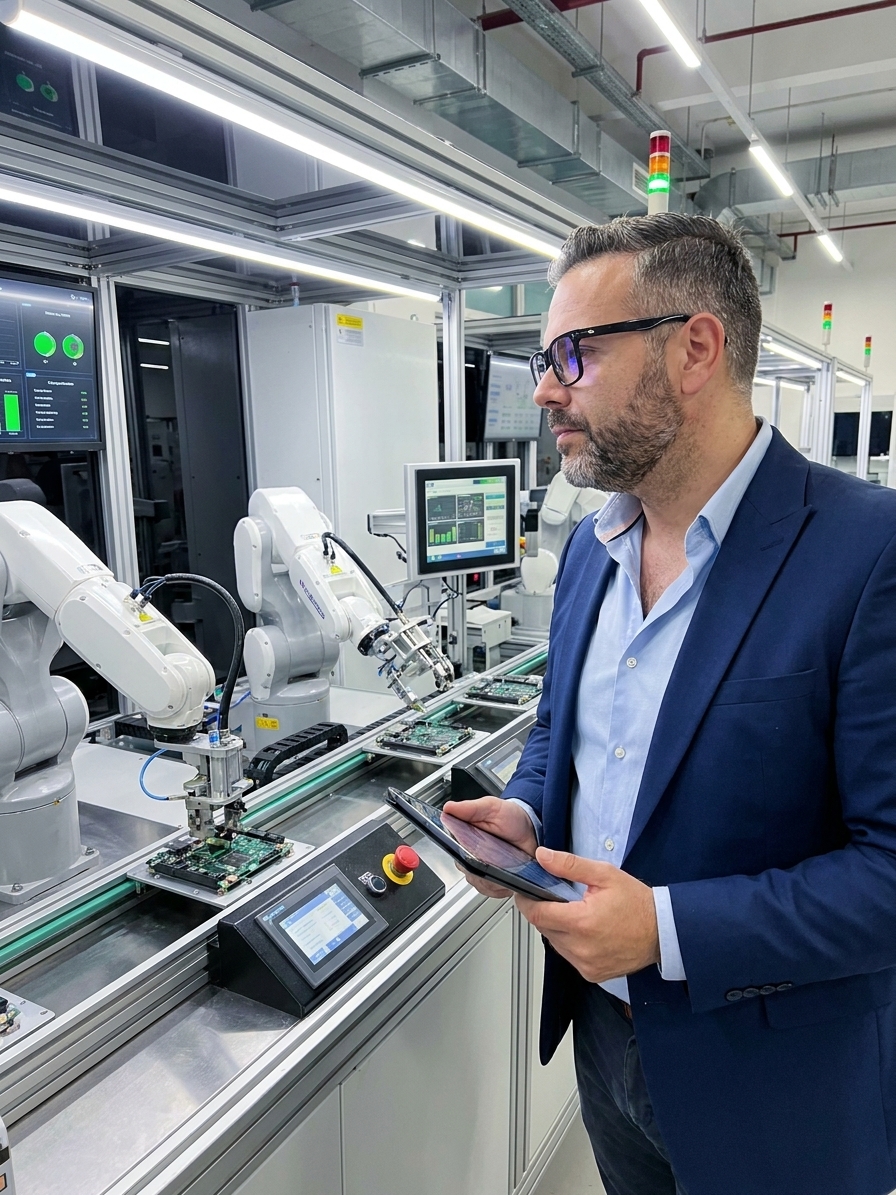
Most manufacturers translate Jidoka as 'autonomation' and focus on adding sensors to detect anomalies. The translation is accurate but incomplete. Jidoka is one of the two pillars of the Toyota Production System, and its core function is building quality into the process rather than attempting to inspect it into the final product.
The principle originated with Sakichi Toyoda's 1896 automated loom, which stopped itself when a thread broke. The breakthrough was not the detection technology, but the authority granted to the machine to halt production. Giving a process the authority to stop prevents defects from moving downstream.
Throughout my career implementing IATF 16949 and AS9100 systems, I have seen plants invest heavily in detection sensors while actively suppressing line stops to protect OEE. This approach produces the illusion of quality control while driving defect containment costs higher. True Jidoka requires a structural shift in how manufacturing organizations measure success and handle deviations.
The Mechanics of a Jidoka Stop
A functional Jidoka system operates through a strict four-step sequence. First, the abnormality is detected mechanically, electronically, or visually. Second, the process stops immediately. Third, the immediate problem is fixed or contained. Fourth, the organization investigates the root cause and implements permanent countermeasures.
Detection mechanisms vary by application. Stamping presses monitor tonnage profiles to identify die misalignments. CNC machining centres use tool breakage detection and post-process dimensional probing. Assembly lines rely on torque controllers and poka-yoke error proofing to prevent fastening defects.
The critical failure point in most operations is the transition from detection to the actual stop. I have audited facilities where sensors detect anomalies, but operators simply reset the machine to maintain cycle time. If the detection does not physically halt the process and segregate the suspect part, the system is purely decorative.
The Jidoka Response Sequence
- 01Detect AbnormalitySensor or operator identifies a deviation from standard parameters.
- 02Stop and SegregateLine halts automatically; suspect parts are physically isolated from conforming stock.
- 03Immediate CorrectionShift responder addresses the symptom to safely restart the process.
- 04Root Cause CountermeasureEngineering investigates the systemic failure and updates the PFMEA and control plan.
The Economics of Halting Production
Plant managers resist Jidoka because stopping production appears expensive. Machine utilization drops, operators stand idle, and shift output targets are missed. Leadership teams often build reporting systems that reward continuous running over quality interruption, creating a false economy.
The math proves the opposite. Consider a high-volume machining cell running at 97% utilization with a 0.8% defect rate. If that cell produces 100,000 parts a month, 800 units require sorting, rework, or scrap. When a defective part escapes to the customer, the cost of an 8D investigation, containment shipping, and potential line down charges at the OEM facility dwarf the lost utilization.
Implementing automatic stops and part segregation will initially lower machine utilization. However, the cost of lost production is consistently offset by the elimination of field failures, warranty claims, and the administrative burden of managing customer complaints.
Maturity Levels of Jidoka Implementation
Jidoka maturity is not defined by sensor density. It is defined by organizational behaviour. Most manufacturers operate at Level 1, where sensors trigger alarms and lights. Operators eventually ignore these signals due to alarm fatigue, categorizing them as false triggers or nuisance alerts.
Level 2 maturity introduces automatic stops and physical part segregation. The machine refuses to restart without intervention. This forces engagement but remains insufficient if the response protocol is simply reset and run.
Level 3 maturity treats every line stop as a structured 8D problem-solving opportunity. The organization drives down the frequency of stops over time by eliminating root causes. The goal is not to tolerate more variation, but to systematically improve process capability until stops become rare.
Jidoka Implementation Maturity
- Level 3: Root Cause EliminationStops trigger formal investigation; process capability improves; stop frequency drops.
- Level 2: Automatic Stop and SegregationMachine halts and isolates suspect parts; forces operational response and containment.
- Level 1: Detection and AlarmSensors identify issues but rely on human intervention; prone to being ignored.
Overcoming the Cultural Resistance to Stops
Jidoka fails when organizations punish operators for stopping the line. If supervisor bonuses are tied strictly to uptime, operators will bypass sensors to keep the process running. Thresholds will be widened, and defects will be hidden to protect the metrics.
To function, leadership must reframe line stops as actionable data. A line that never stops either has a perfect process or a compromised reporting system. In my experience validating AS9100 and IATF 16949 systems, the former rarely exists.
If you don't have line stops, you don't have a problem-solving culture. You have a problem-hiding culture.
Supervisors must be measured on first-time-through rate and defect escape rates, not just raw equipment uptime. The operator who pulls the andon cord to flag a deviation is actively protecting the customer and must be supported by the management structure.
Integrating Industry 4.0 Detection
Modern digital tools enhance Jidoka capabilities. Predictive maintenance systems monitor CNC spindle vibration signatures to identify tool wear before a break occurs. Machine vision systems verify part geometry in real-time, instantly flagging deviations outside control limits.
These systems provide higher resolution detection, but the underlying principle remains unchanged. A predictive algorithm that detects thermal drift is useless if the system lacks the authority to halt the cycle. Advanced analytics amplify a Jidoka system; they do not replace the requirement for a disciplined response.
When specifying new equipment, require integrated error proofing in the PPAP documentation. Force suppliers to demonstrate how the machine handles a detected fault. If the default response is a warning light rather than a hard stop, the equipment specification is incomplete.
A Practical Roadmap for Implementation
Begin by mapping defect escape points. Walk the process from raw material receiving to finished goods dispatch. Identify operations where a specific failure mode could propagate undetected to the customer. Update the PFMEA to reflect these vulnerability points and prioritize them based on severity.
Prioritize high-impact stations first. A critical safety characteristic requiring a Cpk of 1.33 or higher demands automated Jidoka before a cosmetic inspection point. Select detection methods—torque monitoring, vision systems, or mechanical limit switches—that directly address the failure mode.
Define the response protocol before installing the sensors. When the line stops, document who responds, who performs the containment, and who leads the root cause investigation. Finally, track the defect escape rate to validate the system, adjusting thresholds based on actual performance data.
Shift in Quality Metrics
Continuous Run Focus
- Primary metric: Equipment uptime
- Defects discovered at final inspection
- High scrap and rework costs
- Operator penalized for stopping line
Jidoka Enabled Focus
- Primary metric: Defect escape rate
- Defects contained at the source
- Scrap costs localized and reduced
- Stops drive root cause elimination