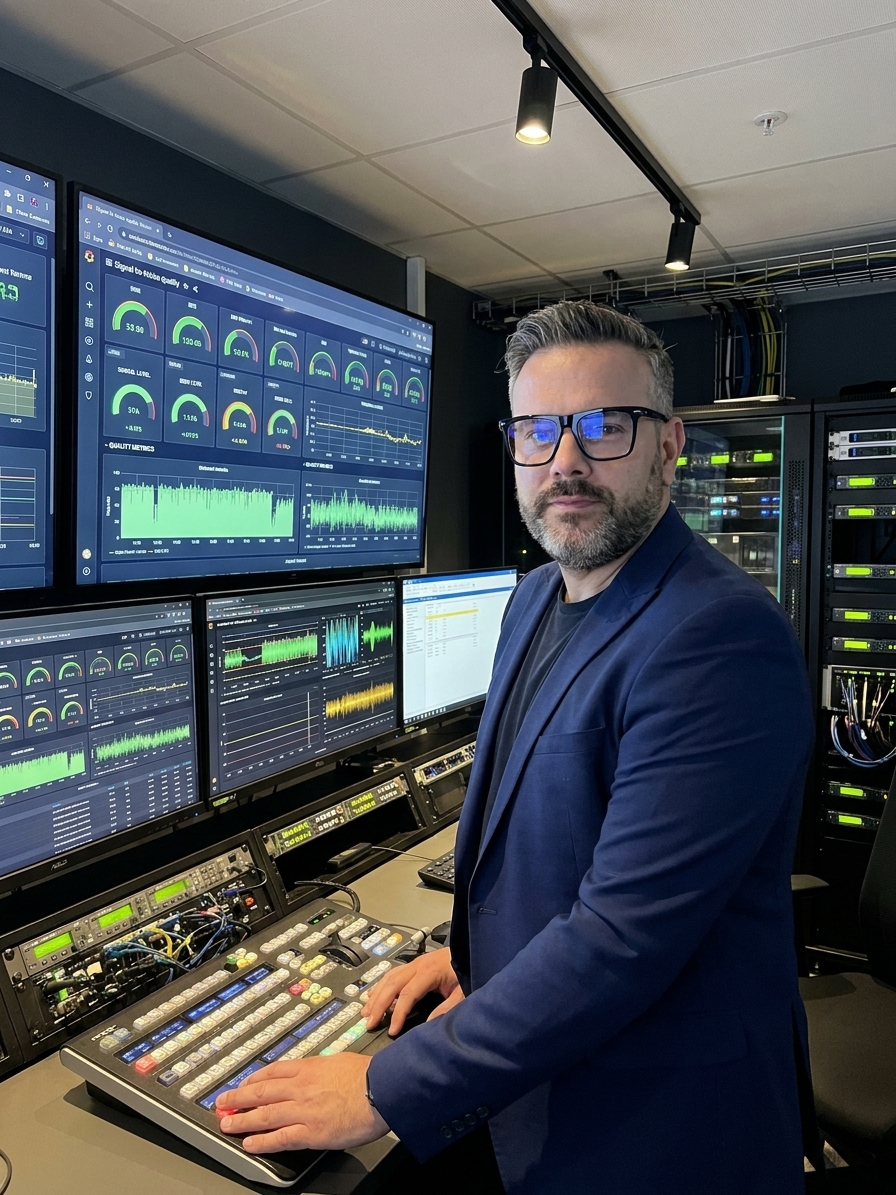
Modern manufacturing plants run on data, but that data is actively degrading quality oversight. I have audited facilities where the SPC system generates over three hundred alerts per week across dozens of control charts. Operators and engineers cannot distinguish a critical bearing bore drift from a routine tool-wear adjustment because both arrive in the same inbox with the same red flag.
When a system reports everything, it communicates nothing. Alert fatigue sets in, and teams learn to dismiss notifications reflexively just to keep the line running. The formal quality management system transforms into an administrative burden designed to satisfy auditors rather than a functional tool for detecting process shifts.
This is the signal-to-noise ratio problem applied to quality management. A high ratio means your information system clearly highlights emerging failures. A low ratio means critical safety defects are buried under trivial variation, redundant metrics, and decorative dashboards that obscure reality.
The Mechanics of Quality Noise
Noise in a quality system is any data that consumes attention without driving a decision. It manifests primarily through metric proliferation. An organization starts with five core KPIs. A customer audit adds three more. A new quality manager introduces a custom dashboard. Within two years, the plant tracks forty-two metrics, and nobody can articulate which five actually drive customer satisfaction.
This metric glut directly causes duplicate monitoring. A critical dimension gets measured by the CMM, charted by the SPC software, logged by the production supervisor, and analyzed by the quality engineer. Four independent systems generate four slightly different reports. The engineering team spends more time reconciling data variations than acting on the underlying process trend.
Decorative reporting compounds the dysfunction. Monthly quality reviews stretch to forty pages because volume feels like thoroughness. The actual insight—an emerging trend on page twenty-seven that warrants an immediate 8D investigation—dies in the gap between generation and consumption. Leadership skims the summary, confirms what they already knew, and misses the developing failure.

Indicators of a Degraded Signal-to-Noise Ratio
The Operational Cost of Drowning in Data
The consequences of a low signal-to-noise ratio are measured in nonconforming parts and escaped defects. When a critical process shift occurs, detection time is proportional to the noise floor. In a high-noise system, a 1-sigma drift can persist for days because it does not stand out from the background variation. Every hour of delayed detection represents hours of suspect product flowing downstream.
Resource allocation also suffers. Quality engineering teams naturally chase the loudest problems. If a specific non-critical aesthetic check generates the most alerts, engineers will target it to clear the queue. Meanwhile, highly consequential but quiet failures—like a heat treatment process slowly losing capability—accumulate in the background.
The most damaging cost is the erosion of trust in the quality system. When operators and supervisors experience quality data as static, they revert to personal intuition. They bypass the SPC system and rely on informal checks. The ISO 9001 or IATF 16949 infrastructure you invested in becomes theatre. Rebuilding that lost trust takes years.
Auditing and Tiering for Decision Utility
Rebuilding signal detection requires subtracting noise. Audit every metric your organization tracks and ask one question: what specific decision does this metric trigger? If the answer is reference, historical tracking, or general awareness, remove it from active dashboards. Decorative metrics tax attention without providing actionable intelligence.
Apply the same discipline to your alert infrastructure through a strict three-tier architecture. Tier 1 alerts require immediate production stoppage or containment and must reach the responsible person directly. Tier 2 alerts indicate a statistically significant shift requiring formal investigation within one shift. Tier 3 alerts log variation but generate no notifications.
The critical discipline is frequency control. Tier 1 alerts should represent no more than five percent of total alerts generated. If a system flags every minor deviation as critical, operators will treat critical alerts as routine. The objective is to ensure that when a Tier 1 alarm sounds, the entire team responds without hesitation.
Triage Flow for SPC Alert Architecture
- 01Alert TriggeredSystem detects a deviation from established control limits.
- 02Severity ClassificationAlgorithm routes to Tier 1, 2, or 3 based on characteristic impact.
- 03Tier RoutingCritical, investigative, or informational pathway assigned.
- 04Action and CloseoutImmediate stoppage, shift investigation, or passive logging.
Exception-Based Reporting and System Consolidation
Your default operational state should be silence. Standard daily reports that confirm every process is nominal constitute noise. They consume review time without adding value. Exception-based reporting flips this dynamic: the system generates output only when a process deviates from its validated state, ensuring that any communication demands immediate attention.
Consolidating redundant monitoring is equally vital. If a characteristic is tracked by a CMM routine, an SPC chart, and a manual supervisor log, pick one authoritative source. The reconciliation cost of maintaining duplicate systems is pure waste. It consumes engineering hours and creates conflicting interpretations of the same physical dimension.
A quality system that is quiet when things go well is not broken; silence is the strongest signal of control.
Consolidation requires political will because every redundant monitoring system has an owner who will defend its existence. Quality leadership must enforce the architectural standard. One characteristic equals one authoritative measurement system. The rest must be archived.
Dashboard Design and Cognitive Limits
Human working memory limits a person to actively monitoring five to seven information elements simultaneously. Your dashboards must reflect this biological constraint. Five well-chosen, universally understood metrics on a single screen will drive faster response times than forty-two metrics spread across fourteen tabs that nobody reviews comprehensively.
Every element on a dashboard must earn its position through a strict test. Ask if removing the element would cause a critical signal to be missed. If the answer is no, delete it. Visual real estate on a monitor is a finite resource. Cluttering it with low-impact data slows the recognition of high-impact failure modes.
This design philosophy extends to PFMEA and control plan linkage. If a dashboard tracks a characteristic, that characteristic must directly map to a high risk priority number. Tracking low-risk dimensions clutters the visual field and dilutes the focus required to monitor the true critical-to-quality characteristics defined in your PPAP documentation.
Subtraction as a Leadership Standard
Genichi Taguchi used signal-to-noise ratio to evaluate how well a physical process performed relative to variation. A system with high noise is a low-quality system, regardless of its average output. The same applies to your information infrastructure. The measure of a quality data system is not how much data it produces, but how clearly it isolates real failures from trivial variation.
Rebuilding signal detection is fundamentally a leadership discipline. The natural organizational instinct is to add more charts, more alerts, and more reporting layers to demonstrate control. The discipline of subtraction is harder but far more valuable. The best quality leaders function as editors, ruthlessly curating the information landscape so their teams can see clearly.
Organizations with the highest quality performance typically run the simplest information systems. They have invested heavily in the architecture of discernment. They build systems that amplify signal and attenuate noise. If your quality team feels overwhelmed by data but underserved by insight, the problem is not your data. The problem is your noise.