Most quality management systems are built for a world that no longer exists. Frameworks like ISO 9001 and IATF 16949 assume that with enough measurement and discipline, any variation can be eliminated. This assumption holds perfectly for deterministic manufacturing processes. It fails catastrophically when applied to emergent, nonlinear system failures.
I have audited plants where quality teams spent months perfecting a DMAIC project while the actual defect shifted to a completely different production line. The standard toolkit of 8D, fishbone diagrams, and 5 Whys becomes a liability when the underlying system is actively adapting to your interventions. You cannot analyze your way out of a problem that changes every time you measure it.
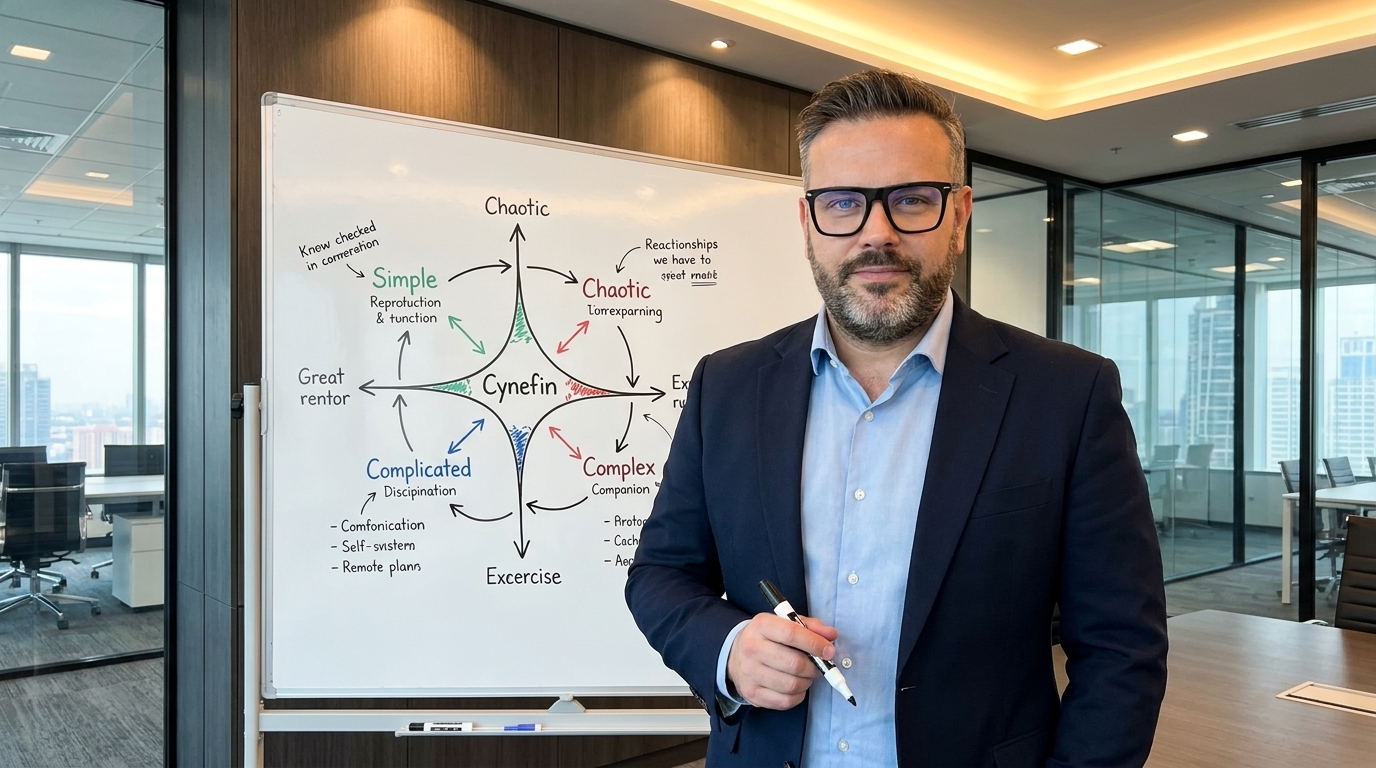
The Cynefin sense-making framework, developed by Dave Snowden, resolves this by forcing leaders to classify the problem environment before selecting a methodology. It divides situations into Clear, Complicated, Complex, Chaotic, and Confusion domains. The cost of misclassification is never neutral. Applying Complicated-domain tools to a Complex-domain problem does not just slow down resolution; it actively amplifies the failure.
Matching Methodology to the Problem Domain
In the Clear domain, cause and effect are obvious to any competent operator. A machine flags a deviation because a cutting tool has reached its wear limit. The gage R&R fails because the inspection fixture is worn. You sense the issue, categorize it against known standards, and respond with established procedure. These problems demand discipline and standard work, not investigation.
The Complicated domain covers your classic engineering investigations. A bearing fails prematurely after 10,000 cycles instead of the specified 50,000. Weld strength drops below the AS9100 requirement on a specific batch. The relationship between cause and effect exists, but it requires expertise, MSA, and designed experiments to uncover. This is where Six Sigma, DMAIC, and DOE deliver measurable results.
Complex domain problems are fundamentally different. Multiple interacting variables create emergent behavior that no root cause analysis can predict. Customer complaints cluster in patterns that do not match any known PFMEA failure mode. Process changes in the welding cell produce unexpected cosmetic defects at the final assembly station three days later. In these situations, cause and effect are only visible in retrospect.

The Failure Mode of Forced Analysis
Consider a dimensional drift on a CNC-machined housing that gradually worsens over three months. This is a Complicated problem. The system is predictable enough that experts can investigate, run experiments, and identify the root cause. Perhaps it is tool wear coupled with a subtle shift in raw material hardness. You deploy DMAIC, identify the countermeasures, update the control plan, and close the case.
Now consider a sudden, unexplained spike in surface defects that appears overnight on a completely different product line. The defects do not follow predictable patterns. They shift between lines and defy straightforward cause-and-effect analysis. The natural quality management reflex is to launch an 8D investigation, build a fishbone diagram, and analyze potential causes.
Three weeks later, the team has analyzed 47 potential causes and run 12 experiments. The surface defects are now appearing on a third product line. The 8D report is on revision 9. The customer is escalating. The forced analytical approach has failed because it assumed a linear relationship that does not exist in this specific environment.
The answer eventually emerges not from the 8D data, but through operator dialogue. A maintenance technician mentions that the plant switched cleaning solvent suppliers two days before the defects appeared. The new solvent leaves a microscopic residue that interacts with the coolant in unpredictable ways. No fishbone diagram would have connected those dots. The answer emerged through conversation and targeted probing, not statistical analysis.
Diagnosing Complexity in Your Plant
Modern manufacturing environments are becoming more Complex, not more Complicated. Supply chains are deeply entangled. Raw materials come from sub-tier suppliers influenced by geopolitical events and shipping disruptions. The chain of causality is a web, not a line. A single delay at a sub-tier supplier cascades through your PFMEA in ways your risk analysis never mapped.
Products themselves are now systems of systems. A modern automobile is a rolling software platform with mechanical components, sensors communicating over networks, and algorithms making real-time decisions. Quality failures in this environment rarely follow linear cause-and-effect paths. A software update intended to improve battery management can inadvertently increase motor vibration, which then causes a dimensional failure at the assembly plant.
Furthermore, organizations are adaptive systems. People react to your quality interventions. Implement a new inspection step, and operators may unconsciously relax their upstream attention because the inspection will catch defects. Tighten a tolerance, and the supply chain finds creative ways to meet the number while compromising on another characteristic. Your measurement fundamentally changes the system you are measuring.
Complicated vs. Complex Quality Problems
Complicated approach (DMAIC, 8D)
- Assumes linear cause and effect
- Applies root cause analysis to find the single answer
- Relies on historical data and SPC
- Fails when the system adapts to interventions
Complex approach (Probe, Sense, Respond)
- Assumes emergent, nonlinear behavior
- Runs multiple safe-to-fail experiments
- Identifies patterns in real-time observation
- Amplifies successful interventions, dampens failures
Intervention Strategies for Each Domain
In the Complex domain, you must replace analysis with experimentation. Run safe-to-fail probes. Try small, contained interventions and observe what happens. Look for emerging patterns across the production floor. Amplify the practices that reduce defects and dampen those that do not. Resist the urge to impose a single root cause when the system is still shifting.
The Chaotic domain requires immediate stabilization. A safety-critical failure reached the customer. The entire production line is down. There is no time for structured analysis. Act first to contain the damage, protect people, and establish order. Command-and-control leadership is correct here. But the moment stability returns, you must shift to a different methodology. Organizations that remain in crisis mode create new problems faster than they solve old ones.
Then there is the Confusion domain, where you do not know which environment you are in. This is where most quality organizations spend more time than they would admit. You reach for familiar tools like 5 Whys because they are familiar, not because they fit. Break the situation apart. Ask what would have to be true for this to be a Clear problem, a Complicated one, or a Complex one. The act of asking the question often reveals the correct classification.
Cynefin-Driven Quality Response
- 01Classify the DomainDetermine if cause and effect are obvious, discoverable, or only visible in retrospect.
- 02Select the ToolkitChoose SOPs for Clear, DMAIC for Complicated, safe-to-fail probes for Complex.
- 03Execute the InterventionApply the methodology without forcing analytical frameworks onto emergent systems.
- 04Stabilize and ReviewOnce the immediate issue is resolved, update the PFMEA and standard work.
Embedding Framework Classification in Your QMS
At the start of every quality investigation, ask the team to formally classify the domain. Add a section for domain classification to your A3 and 8D templates, right alongside the problem statement and affected parties. This creates a documented record that helps future teams recognize similar patterns and avoids the reflexive application of DMAIC to every nonconformance.
In the Complicated domain, you find the answer. In the Complex domain, you grow the answer.
Review your closed CAPA records and 8D reports through the Cynefin lens. Identify which problems were genuinely Complicated and which were Complex problems treated as Complicated. If an 8D report went past three revisions without containment, you likely forced a deterministic framework onto an adaptive system. This retrospective builds institutional knowledge about how your specific plant environment actually behaves.
Train your quality engineers in all four domains. Most quality engineering training focuses heavily on Complicated-domain tools like SPC, MSA, and Cpk calculation. Add systems dynamics, complexity thinking, and sense-making to your development programs. The goal is not to abandon standard tools, but to equip your team with the judgment to know when standard tools will actively make the problem worse.
Applying Clear-domain solutions to Complex problems produces bureaucracy. You add procedures, checks, and sign-offs that address nothing, while the organization becomes slower and more rigid. Applying Chaotic-domain solutions to non-crisis situations demoralizes teams, kills operator initiative, and drives out the experienced people you need most. The cost of mismatching the domain is always higher than the cost of taking an extra hour to classify the problem correctly.
Cynefin Intervention Thresholds