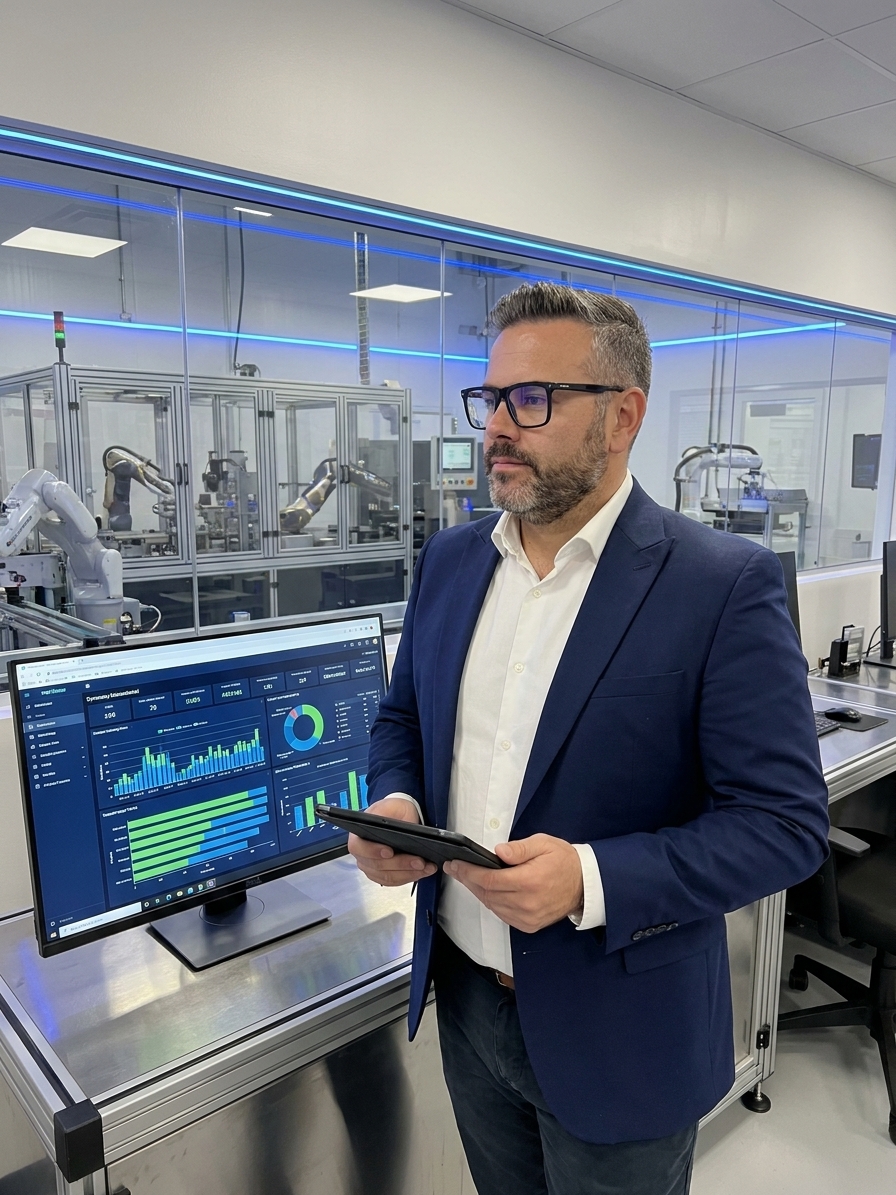
A plant manager returns from a customer review battered over one number: scrap rate. Within a week, scrap dashboards dominate every screen, morning meetings open and close with that metric, and engineers are reassigned to a Six Sigma scrap-reduction project. Ninety days later, scrap drops by 28% and the team receives a bonus.
During those same 90 days, delivery performance fell from 98.2% to 91.7%. Customer complaints rose by 40%. Preventive maintenance was deferred on seven critical machines. Two key process engineers resigned. A growing backlog of unreleased material sat in quarantine because the quality team had been redirected. The plant solved the problem it was staring at and created five it wasn't.
This is the Focusing Illusion, a cognitive bias identified by Daniel Kahneman. In quality management, it destroys systems more thoroughly than any individual defect. The mechanism is brutally simple: whatever your attention is drawn to feels more important than everything else, not because it actually is, but because you are thinking about it.
Why Quality Organisations Are Especially Vulnerable
Quality systems are built on measurement, and measurement is the fuel of the Focusing Illusion. Dashboards, scorecards, KPI trees, layered process audits, and daily huddles each act as a spotlight. Every spotlight creates a corresponding shadow, the area it doesn't illuminate.
The problem is that focusing on one metric neurologically depresses your ability to see others. Attention is a zero-sum game. Every hour devoted to scrap rate is an hour not devoted to delivery, maintenance, or the fifteen other variables that determine whether your IATF 16949 system actually functions.
The irony is that the better your measurement system, the more vulnerable you are. Organisations with weak data cannot focus with precision. But plants with real-time SPC, automated OEE tracking, and sophisticated reporting can focus with surgical accuracy on the wrong target, at the wrong time, with complete confidence.

The Customer Audit Fixation
A customer auditor flags a traceability nonconformance. The organisation enters emergency mode. Cross-functional teams are assembled, procedures are rewritten, and training is conducted. The follow-up audit is passed without findings.
Meanwhile, the PFMEA identifies process parameters that actually determine product quality, but those parameters are drifting. Nobody is monitoring them because all engineering attention is consumed by the paperwork the auditor cared about. The Focusing Illusion has conflated the auditor's priorities with actual quality priorities.
Auditors examine evidence of systems. Quality is produced by the systems themselves. These are not the same thing, and the distinction matters. I have audited plants that maintained flawless documentation while their Cpk values dropped below 1.00 on safety-critical characteristics.
The Celebrity Defect and Tool Obsession
One defect escapes to a customer, or the CEO sees it on a plant tour. Suddenly it has a name, a war room, and a weekly review. It becomes the defect. Meanwhile, the twelve other failure modes that collectively represent 80% of your cost of poor quality continue generating losses. They don't have a name, so they don't exist in the organisation's focused mind.
A similar pattern occurs with quality tools. An organisation discovers DOE, or Statistical Process Control, or A3 problem solving. Initial results are impressive. The leadership team mandates it everywhere. Every problem gets an FMEA, every process gets a control chart, and the tool becomes the sole lens for all quality issues.
The organisation doesn't fail because the tool is bad. It fails because the Focusing Illusion makes the tool feel comprehensive when it is actually narrow. Problems that fit the tool's framework get attention. Problems that don't are ignored, regardless of severity.
Recognising the Focusing Illusion Patterns
What teams do under the illusion
- Rally resources around the single KPI flagged by leadership or a customer
- Celebrate improvement in the target metric without checking system health
- Apply the latest quality tool (FMEA, DOE, A3) to every problem uniformly
- Elevate one defect to celebrity status and starve attention to systemic issues
What actually sustains quality
- Maintain balanced scorecards across defect rate, delivery, and cost of quality
- Investigate gains that come at the expense of another dimension as redistribution
- Match the improvement tool to the specific failure mode and process data
- Use Pareto analysis to allocate effort based on total cost of poor quality
The Hierarchy Focus Trap
The plant manager focuses on cost. The quality manager focuses on defect rates. The production manager focuses on throughput. The maintenance manager focuses on uptime. Each level focuses on what its performance review incentivises, and the Focusing Illusion makes each person genuinely believe their metric is the most important.
They are not being selfish. The brain automatically elevates whatever it is measured on. From each person's perspective, they are right. Scrap rate really is the most important thing to the quality manager. Throughput really is the most important thing to the production manager.
But the organisation needs all metrics balanced. A Tier 1 supplier I worked with hit every departmental target for six consecutive quarters while overall plant OEE declined. Each department optimised locally. The system degraded globally. The balance felt unnecessary to every individual caught in their own KPI loop.
The Hidden Cost of Organisational Tunnel Vision
The real cost of the Focusing Illusion isn't in what you're looking at. It's in what stops being monitored. When your organisation focuses on reducing scrap, the cost is the delivery failures you didn't see coming, the deferred maintenance, the engineers who burned out, and the customer who quietly started qualifying a second source.
Improvement in one area accompanied by decline in another isn't improvement — it's redistribution.
These costs are invisible to the focused organisation because the bias suppresses awareness of everything else. The things you stopped looking at drop out of your mental model entirely. I implemented Routing Verification KPIs at a major aerospace manufacturer that cut internal lead time by 97%, but only after verifying that the new routing controls didn't shift bottleneck pressure into final assembly.
A medical device manufacturer spent eighteen months intensely focused on reducing incoming inspection rejection rates. They succeeded, dropping from 4.2% to 0.8%. What leadership didn't notice was that supplier approval criteria had been quietly relaxed, and the inspection team had shifted from a patient-safety mindset to a metric-protection mindset.
The quality of material entering the process had worsened, but the metric had improved. The number felt like reality. Eighteen months later, a field failure traced to a raw material defect that should never have passed incoming inspection. The cost of that single event exceeded the entire savings from the rejection-rate programme by a factor of twelve.
Building Systems That Counteract the Bias
You cannot eliminate the Focusing Illusion. It is a feature of human cognition. But you can build management systems that counteract its effects. The starting point is a genuine balanced scorecard with three to five quality dimensions: defect rate, delivery, cost of quality, customer satisfaction, and employee engagement.
Set targets for each, then enforce a hard rule: no single dimension can be improved at the expense of another without explicit leadership review. When scrap improves but delivery worsens, the scrap improvement doesn't get celebrated. It gets investigated, because in a balanced system, that pattern signals redistribution, not improvement.
Institute a shadow metric review alongside your regular monthly quality review. Pick three metrics that aren't on anyone's priority list and examine their trends. Ask directly: what are we not seeing because we're looking at something else? This forces the brain to engage with the information it has automatically suppressed.
Balanced Scorecard Alarm Triggers
Rotate organisational focus on a planned cycle rather than letting the latest 8D or customer complaint dictate priorities. Deliberate rotation means Q1 targets process capability, Q2 targets supplier quality, Q3 targets employee competence, and Q4 targets customer experience. You are controlling what the organisation thinks about instead of surrendering that decision to the loudest voice.
Run attention audits every quarter. Have someone outside the quality function, a finance manager or production supervisor, present what the quality team is paying attention to and what is being ignored. External perspectives cut through the bias because outsiders are not caught in the same attentional loop. These audits consistently reveal teams focused on customer-facing metrics while internal process stability degrades unnoticed.
The Kahneman Question
Before every major quality initiative, before every PPAP escalation, before every resource allocation decision, ask one question: is this actually the most important thing, or does it just feel important because we're thinking about it right now?
Asked honestly, this question has prevented more quality failures than any tool I have encountered. It forces the brain to acknowledge the bias exists. It doesn't eliminate the distortion, but it creates a moment of awareness, a gap between the feeling of importance and the reality of importance. Better decisions get made in that gap.
The best quality leaders I have worked with share one trait: they are suspicious of their own focus. They know that whatever they are paying attention to feels overwhelmingly important. They also know that feeling is unreliable. They don't trust the urgency. They build systems that force breadth, insist on balanced metrics, and ask the Kahneman question with a regularity most people reserve for checking their phones.
Your organisation isn't failing because it can't focus. It's failing because it can only focus on one thing at a time, and it doesn't realise that's a problem. The most important quality metric in your plant might not be the one on the dashboard right now. Given how the Focusing Illusion works, it probably isn't.