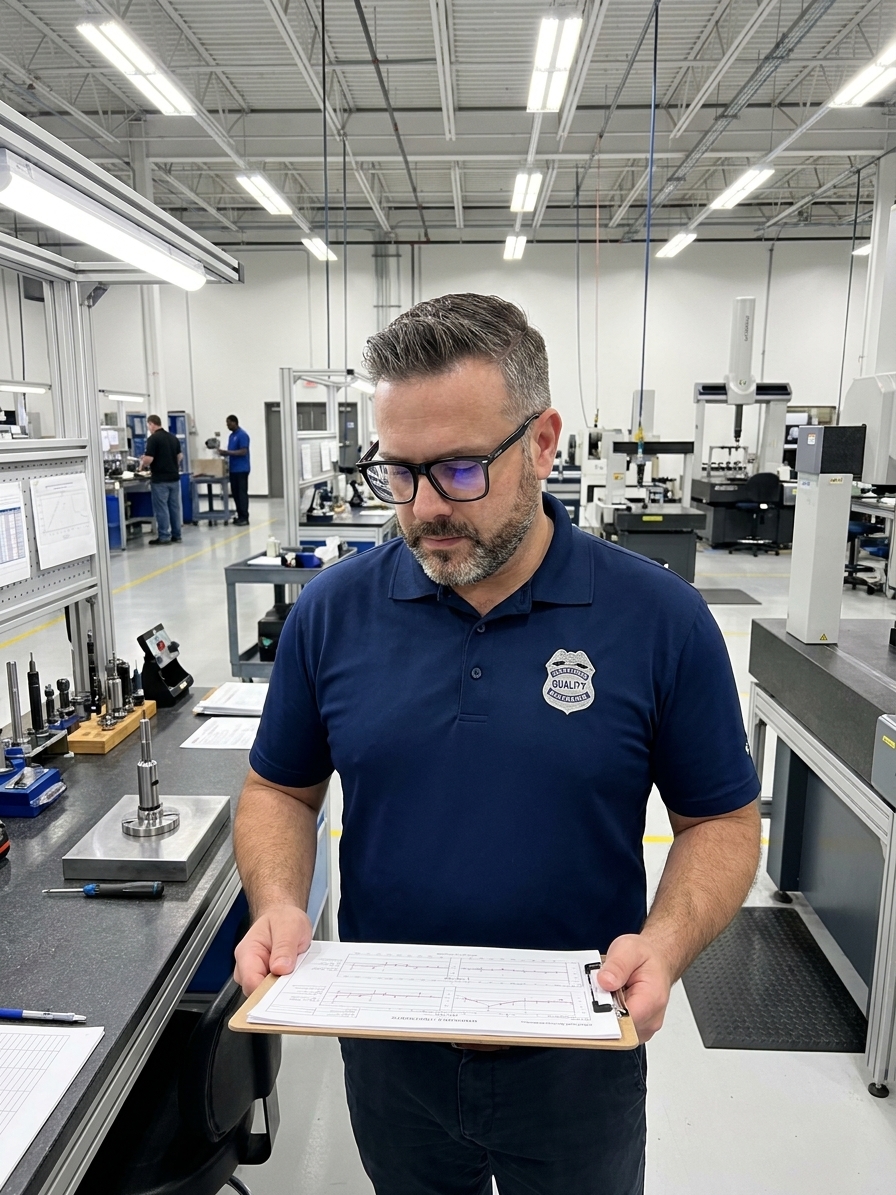
A major automotive supplier once shipped a batch of brake calipers with incorrectly machined mounting holes. The defect was visible to the naked eye. The parts passed through six separate inspection points: incoming material verification, first-article inspection, in-process checks, final inspection, packaging verification, and the customer's receiving dock. Six qualified people looked at those parts. Not one of them flagged the nonconformance.
The subsequent root cause investigation revealed no incompetence. No one was distracted, fatigued, or poorly trained. Every procedure was documented. Every IATF 16949 checklist was signed. The failure was not procedural. It was psychological. Every inspector along the chain assumed someone else would catch the defect.
The incoming inspector trusted first-article. First-article assumed in-process had already verified it. The in-process checker deferred to final inspection. The final inspector relied on packaging for one last look. By the time the parts reached the customer's dock, the receiving team signed off with a glance. Six checkpoints yielded zero catches because responsibility was diffused across the entire chain.
The Psychology of Diffused Responsibility
The bystander effect was documented in 1968 by Bibb Latane and John Darley. Their research revealed a counterintuitive truth: the more people who share an obligation, the less likely any single individual is to act. Responsibility becomes diffused across the group. It is present everywhere but concentrated nowhere.
Latane and Darley identified three mechanisms that drive this diffusion in group settings. Understanding these mechanisms is critical because they directly map to the daily operations of standard quality control departments.
- Responsibility diffusion: When multiple people share the same obligation, individual accountability decreases. Two inspectors feel half as responsible as one. Six feel one-sixth as responsible.
- Evaluation apprehension: People fear the social cost of a false alarm more than the cost of a missed detection. An inspector who flags a conforming part faces delays and conflict. An inspector who misses a defect usually faces nothing, because no one else caught it either.
- Pluralistic ignorance: When people are uncertain, they look to others for cues. If no one else reacts, they interpret that inaction as evidence the situation does not require action.
The bystander effect is not a character flaw. It is a predictable, reproducible psychological phenomenon. In quality organisations, it silently degrades defect detection from the inside out. You cannot audit it away with a standard ISO 9001 checklist. You have to engineer against it.
Where Diffusion Hides in Standard Quality Architecture
You do not need a catastrophic failure to see diffused responsibility at work. It shows up in the ordinary architecture of multi-layered quality systems. Many organisations build inspection redundancy assuming more checks equal better detection. The logic seems sound if inspectors operate independently. In practice, the bystander effect inverts the probability.
Inspector A knows Inspector B is also checking, so Inspector A relaxes their focus. Inspector B knows Inspector A already checked, so Inspector B relies on that implied endorsement. Instead of multiplying your detection probability, the interdependence reduces it. Two loosely linked inspectors can easily perform worse than a single inspector working alone with total ownership.

I have audited cross-functional PFMEA review teams where this exact dynamic played out. You assemble experts from quality, engineering, and production. You present the failure mode and ask for input. The production engineer stays quiet about machine vibration because they assume the quality engineer will raise it. The quality engineer overlooks measurement uncertainty because they figure the calibration specialist owns it.
Everyone speaks within their lane. No one speaks across lanes. The gap between those functional lanes is precisely where critical failure modes hide. The team leaves the room with a signed document and a false sense of security.
The Failure of the Multi-Signature Approval Chain
Consider your engineering change control process. If your forms require more than two or three signatures, you have engineered a bystander problem. I have reviewed change control forms requiring seven approval signatures: quality, engineering, production, regulatory, supply chain, plant manager, and division head.
By the fifth signature, the approval is purely ceremonial. The person is not evaluating the technical merits of the change. They are approving the existence of the previous signatures. The first signer knows six more eyes will review the document, so they do not scrutinise the details as deeply as they would if their signature were the only barrier to implementation.
You have built a seven-layer safety net where only one layer actually carries weight, and that layer is operating at reduced capacity because it knows six other layers exist. Adding more people to a bystander-prone system amplifies the problem. Every additional layer further diffuses responsibility and dilutes the signal any single person feels obligated to act on.
Serial Approval vs. Single-Point Accountability
Serial Approval Chain
- Five to seven sign-offs per change request
- Approvers rely on implied endorsement of previous signatures
- First signer relaxes focus knowing others will check
- Final signatures are ceremonial, not technical
Named Accountability
- One named owner per critical quality checkpoint
- Owner knows they are the final barrier to the customer
- Redundancy is structured without sharing prior results
- Individuals verify from a clean sheet every time
Why Standard Corrective Actions Fail
When a defect escapes, most organisations respond by adding layers. Another inspection step. Another approval signature. Another cross-functional 8D review. This is exactly the wrong approach. Adding checkpoints to a system suffering from diffused responsibility only accelerates the psychological decay.
Retraining is equally ineffective because the bystander effect is not a knowledge gap. Your inspectors know what defects look like. Your engineers understand PFMEA severity. Your approvers know what they are supposed to verify. The problem is that in the moment, the psychological pressure of the group overwhelms the individual's impulse to act.
Running a training session that tells inspectors to pay closer attention is the most useless response to a bystander-driven escape. You cannot train away a fundamental psychological mechanism with a PowerPoint slide. You must redesign the environment so that acting on a defect feels like the only logical option.
Six inspectors who are each waiting for someone else to catch the defect are worse than one inspector who knows they are the last line of defense.
Designing Independent Verification
The most powerful antidote to diffused responsibility is named, individual accountability. For every critical quality checkpoint, there must be one person whose name is explicitly attached to it. Not a department. Not a generic role. A specific person who knows they are the sole barrier between the nonconformance and the customer.
This principle does not eliminate redundancy. It requires that redundancy be structured for genuine independence. In high-reliability organisations like nuclear submarine crews and aerospace manufacturers, this is enforced through blind verification protocols. The second checker does not know what the first checker found. They verify from scratch.
This architecture eliminates the diffusion effect because each person operates as if they are the only check. When you assign inspection, the language must reflect that reality. The inspector must understand that their check is the only check. Their signature is the one that matters. That level of clarity is the direct antidote to psychological diffusion.
Implementing Independent Verification Architecture
- 01Define the critical characteristicIdentify the exact safety or regulatory feature requiring redundant checks.
- 02Assign named primary ownerOne person holds full accountability for the initial verification and disposition.
- 03Execute blind secondary checkA second inspector verifies the feature without seeing the first inspector's results or checklist.
- 04Resolve discrepancies immediatelyIf results conflict, quarantine the batch and trigger an immediate root cause investigation.
Cross-Functional Ownership and Cultural Intervention
Instead of assembling a group to review a problem and hoping someone speaks up, assign specific aspects of the investigation to specific individuals before the meeting. One person owns the materials angle. Another owns the process parameters. A third owns the measurement system analysis. They arrive prepared to present their independent findings.
This structure eliminates pluralistic ignorance because everyone knows they are expected to speak. It eliminates evaluation apprehension because they have been explicitly tasked with their domain. The meeting transforms from a bystander-prone group discussion into a structured synthesis of independent technical investigations.
Finally, leadership must establish a cultural norm where the person who sees something says something first. This requires management to model and reward early flagging, even when it turns out to be a false alarm. When the cultural cost of speaking up is zero and the cultural cost of staying silent is high, people act. It is a difficult standard to sustain, but it is the only one that neutralises the diffusion effect permanently.