You’ve seen it before. The consultant arrives on Monday. By
Wednesday, there are red tags on everything, colored tape on every
floor, and a cleanup schedule laminated and posted on the break room
wall. The plant looks immaculate. The general manager walks through,
nods approvingly, and the lean transformation is declared a success.
Six months later, the tape is peeling. The shadow boards have gaps
where tools went missing. The red tags are in a drawer somewhere. And
the cleaning schedule? It became a piece of wallpaper — just like
everything else.
This is the story of 5S in most manufacturing organizations. Not the
version taught in the textbook. The version that actually happens when a
methodology designed to build discipline, ownership, and continuous
improvement gets reduced to its most superficial element: cleaning.
What 5S Was Actually
Designed to Do
Let’s start with what 5S is supposed to be. Developed in Japan as
part of the Toyota Production System, 5S is a systematic approach to
workplace organization and standardization. The five S’s are:
Seiri (Sort): Distinguish between what’s needed and
what’s not. Remove the unnecessary. This isn’t about tidying up — it’s
about eliminating everything that doesn’t add value from the
workspace.
Seiton (Set in Order): Arrange what remains so that
everything has a place and is in its place. The goal isn’t neatness for
its own sake — it’s making abnormalities instantly visible. If a tool is
missing from its outlined spot, you know immediately. That visibility is
the point.
Seiso (Shine): Clean everything — not to make it
look nice, but to inspect it. Cleaning IS inspection. When you wipe down
a machine, you notice the oil leak. When you sweep under a press, you
find the cracked bolt. Cleaning is the mechanism for early problem
detection.
Seiketsu (Standardize): Create the rules and visual
controls that sustain the first three S’s. Make it obvious when
something is wrong. Make the abnormal visible at a glance.
Shitsuke (Sustain): Build the discipline and habit
so this becomes the way you work — not a special event, not a monthly
campaign, but the daily operating system of the facility.
Here’s the critical insight that most implementations miss:
each S builds on the previous one. Sort without Set in
Order is just decluttering. Set in Order without Sort is organizing
junk. Shine without Sort and Set in Order is cleaning a workspace that
will be messy again tomorrow. Standardize without the first three is
writing procedures for a system that doesn’t exist. And Sustain without
the first four is trying to build discipline around a process that was
never properly designed in the first place.
When organizations skip steps — and almost all of them do — they’re
not implementing 5S. They’re implementing 1S, maybe 2S, and calling it a
transformation.
Where It All Goes Wrong
The failure pattern is remarkably consistent across industries.
Here’s how it unfolds.
The Event-Driven Launch
It starts with a kickoff event. Someone senior attended a conference,
read a book, or hired a consultant. 5S is presented as the “foundation
of lean” — easy to understand, easy to implement, visible results fast.
A cross-functional team is assembled. A pilot area is selected. Everyone
gets red tags and tape.
The event lasts three to five days. People sort through years of
accumulated stuff — obsolete fixtures, broken gages, expired chemicals,
mystery cables nobody can identify. It feels productive. It feels like
progress. The area looks dramatically better in before-and-after
photos.
Here’s the problem: the event created cleanup, not
capability. The team didn’t build a system for deciding what
stays and what goes. They just threw things away in a burst of
enthusiasm. When the next batch of obsolete tooling arrives — and it
will — there’s no process to handle it. The clutter returns.
The Shadow Board Illusion
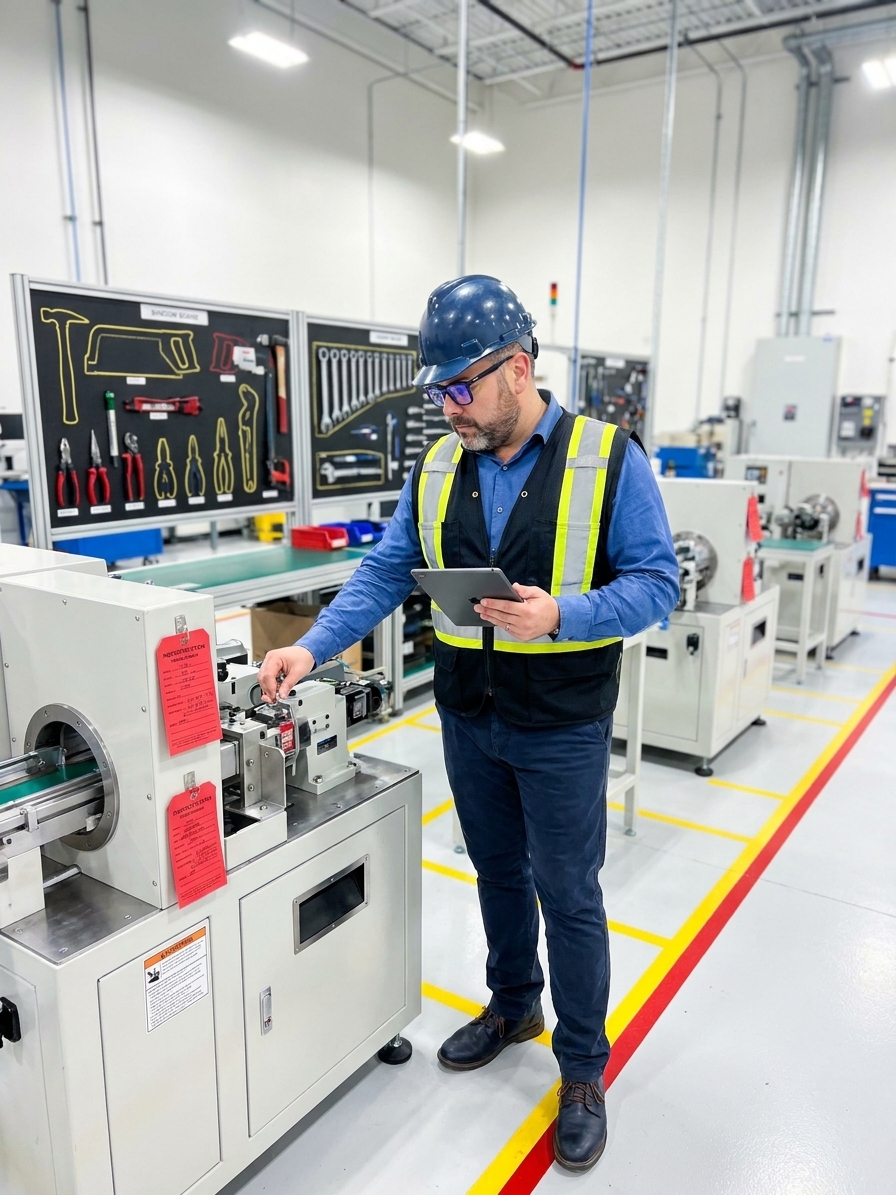
Set in Order gets reduced to its most visible artifact: shadow boards
and tape outlines. Every tool gets a painted silhouette. Every shelf
gets a label. The plant looks organized, and visitors are impressed.
But here’s what’s actually happening: nobody asked WHY those tools
were there in the first place. The organization outlined the existing
chaos instead of questioning it. You gave every tool a designated spot —
including the tools that shouldn’t exist, the duplicates that were never
needed, and the obsolete gages that should have been scrapped in
Sort.
A shadow board for tools you don’t need isn’t organization. It’s
decorated waste.
Cleaning Without Inspection
This is where 5S loses its soul. Shine — the third S — was designed
as a diagnostic tool. The act of cleaning is the act of inspecting. When
an operator wipes down a machine, they’re supposed to notice the leak,
the vibration, the wear pattern that signals an impending failure.
Cleaning is how you catch problems early.
In practice, cleaning becomes a janitorial function. It’s assigned to
the newest employee, done at the end of the shift when everyone wants to
go home, and checked off a list. Nobody trains operators on WHAT to look
for during cleaning. Nobody creates a feedback loop for the problems
they might find. An operator spots a crack in a hydraulic line during
cleaning — but there’s no process to report it, no mechanism to act on
it, and no incentive to speak up because last time they reported
something, it was ignored.
So they stop looking. They wipe and sweep and mop, and the crack
becomes a leak, and the leak becomes a rupture, and the rupture becomes
a shutdown. And nobody connects it to the fact that Shine was supposed
to prevent exactly this.
Standardization as
Documentation Theater
The fourth S — Standardize — is supposed to create visual controls
and rules that make the abnormal instantly visible. Think of it as
designing a workspace that self-reports problems. A glance
should tell you if something is wrong.
Instead, Standardize becomes a documentation exercise. Procedures are
written. Checklists are created. Audit forms are designed. Three-ring
binders are assembled and placed on shelves.
The documents describe how things SHOULD be. They don’t govern how
things ARE. Nobody follows the checklist because it was written by
someone who doesn’t work in the area. The audit happens once a month,
it’s announced in advance, and everyone scrambles to make the area look
good for two hours. Then it’s back to normal.
The purpose of standardization is to make deviations visible — not to
create more paperwork to ignore. A standard that nobody follows isn’t a
standard. It’s a suggestion. And a suggestion that’s been laminated and
posted on the wall is still just a suggestion.
Sustain: The Step Nobody
Earns
The fifth S is where every 5S program lives or dies. And it’s the
step that almost universally fails.
Sustain is about discipline — building the habit of maintaining the
first four S’s as a daily practice. Not a monthly audit. Not a quarterly
campaign. Every day, every shift, every operator.
Here’s the uncomfortable truth: you cannot sustain what was
never properly established. If Sort was a one-time purge, it
won’t sustain. If Set in Order was shadow boards for unnecessary tools,
it won’t sustain. If Shine was janitorial work without inspection, it
won’t sustain. If Standardize was documentation theater, it won’t
sustain.
Organizations try to force sustainability through audits, scores, and
penalties. They create a 5S audit scorecard, rate each area on a scale
of 1-5, and post the results. Low-scoring areas get a talking-to.
High-scoring areas get a pizza lunch.
The audit becomes the goal. People optimize for the audit, not for
the workplace. They clean before the audit and stop cleaning after it.
They tape lines before the audit and let them peel after. The score goes
up. The actual workplace doesn’t change.
The Real Purpose:
Making Problems Visible
Here’s what organizations miss about 5S at the deepest level. It’s
not about cleanliness. It’s not about organization. It’s not about
discipline for its own sake.
5S is about making problems visible.
When you’ve truly Sorted, the only things in the workspace are things
that are needed. Any unnecessary item immediately stands out.
When you’ve truly Set in Order, everything has a designated place. A
missing tool is visible instantly. An unreturned gage is noticed
immediately. The abnormal becomes obvious.
When you’ve truly Shined, the equipment is clean enough that any new
leak, crack, or wear is immediately apparent. You can’t see a fresh oil
leak on a machine that’s already covered in grime.
When you’ve truly Standardized, the visual controls tell you at a
glance whether the process is in its normal state. You don’t need to
check a document. You can SEE it.
When you’ve truly Sustained, this level of visibility is continuous.
Problems are caught when they’re small. Fixes happen before they become
failures. And the workplace itself becomes a quality control
mechanism.
This is why 5S is called the foundation of lean. Not because clean
workplaces are inherently better — but because a properly implemented 5S
system turns the entire workspace into a real-time problem detection
system. Every surface, every tool, every visual control is a sensor. And
when those sensors are working, problems can’t hide.
But when 5S is reduced to cleaning and organizing, those sensors are
dead. Problems hide in the clutter. Defects hide in the grime.
Abnormalities hide in the chaos. And the organization wonders why its
quality doesn’t improve despite all the money it spent on lean.
What Real 5S Looks Like
A facility that has genuinely implemented 5S operates differently.
You can feel it within minutes of walking onto the floor.
Operators don’t just clean — they inspect. They know what to look for
because they’ve been trained. When they spot something abnormal, they
know exactly how to report it, and they trust that it will be addressed.
They have ownership of their workspace because they were the ones who
designed its organization — not a consultant, not a manager, not a
cross-functional team that visited for a week.
Tools are where they’re supposed to be, and if one is missing,
someone notices within minutes — not during next month’s audit. Shadow
boards contain only the tools that are actually needed, and every tool
on them was placed there deliberately after asking whether it earned its
spot.
Machines are clean enough to show any new leak or wear. Not
showroom-clean — working-clean. There’s a difference. Showroom clean is
about appearances. Working clean is about visibility.
Standards are visual, not textual. You don’t read a procedure to know
if the workspace is correct. You look at it. Color coding, outline
marks, min-max indicators, andon lights — the workspace tells you its
own story.
And the discipline isn’t enforced through audits. It’s enforced
through culture. The operators maintain the workspace because they built
it, they own it, and they understand why it matters. Not because someone
is going to score them on a checklist.
The Diagnostic Question
If you want to know whether your 5S program is real or theater, ask
one question:
When was the last time your 5S process helped you catch a
problem before it became a failure?
If the answer is “never” or “I don’t know” or “we mostly use it to
keep the place tidy,” then you don’t have 5S. You have a cleaning
program with laminated signs.
If the answer is specific — “an operator noticed a coolant leak
during Shine last Tuesday because the machine was clean enough to see
it, and we fixed the seal before it failed” — then you’re on the right
track.
The purpose of 5S isn’t to look organized. It’s to surface problems.
If your 5S isn’t surfacing problems, it isn’t working. No matter how
good your audit scores look.
The Path Back
If your organization has fallen into the 5S-as-cleaning trap, the
path back starts with honesty. Acknowledge that what you’ve been doing
isn’t 5S. It’s a parody of 5S. Then start over — not with a kickoff
event and red tags, but with a fundamental shift in understanding.
Teach operators that cleaning is inspection. Train them on what to
look for. Create a simple, fast, responsive mechanism for reporting
abnormalities — and then ACT on every report within 24 hours. Nothing
kills a reporting system faster than silence.
Let the people who work in the space design its organization. They
know what they need, what they don’t, and what gets in their way. A
consultant’s shadow board will never have the ownership of an operator’s
shadow board.
Replace audit scores with problem detection rates. Measure how many
abnormalities your 5S system surfaces — and celebrate those findings,
not punish them. An abnormality found is a failure prevented. That’s the
metric that matters.
And stop calling it a program. Programs have start and end dates. 5S
is supposed to be the way you work. Every day. Every shift. Forever.
Peter Stasko is a Quality Architect with over 25
years of experience in manufacturing quality management, process
improvement, and lean implementation across automotive, electronics, and
industrial sectors. He writes about the gap between how quality systems
are designed and how they actually function on the factory floor.