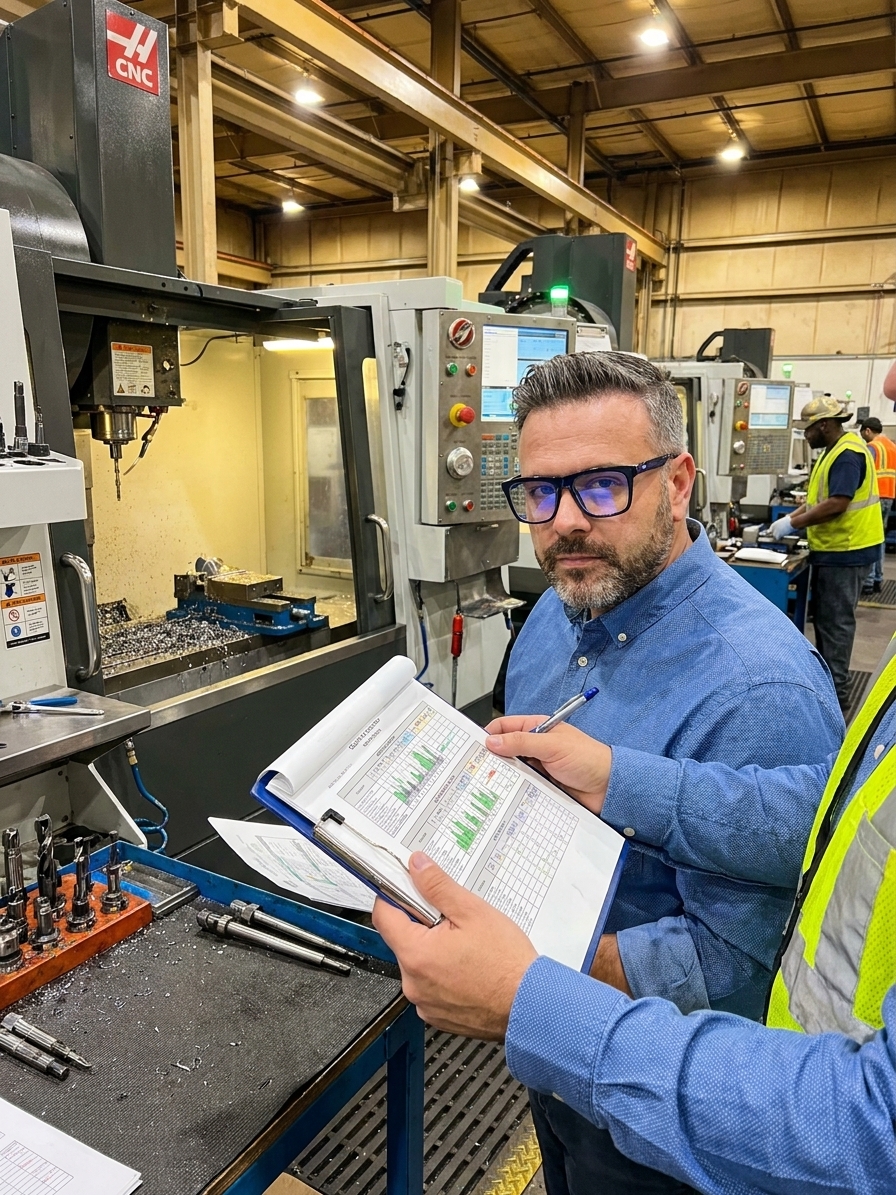
Walk into most manufacturing plants and you will find control charts posted near the production lines. X-bar and R charts, individual and moving range charts, p-charts for attributes. They were laminated and updated daily six months ago. Today, the operators glance at them on the way to break, the quality engineers fill them in because the procedure demands it, and the production manager reviews them only when a customer audit is scheduled.
Most organisations that implement SPC get the mechanics right and the meaning completely wrong. They collect the data, plot the points, and calculate the control limits. Then they do absolutely nothing with the information the charts are screaming at them, until something fails catastrophically and everyone stares at the chart asking why nobody saw it coming. The data points march across the charts in neat little lines, plotted and forgotten.
SPC remains one of the most powerful tools for understanding manufacturing processes. Walter Shewhart developed it at Bell Laboratories in the 1920s to distinguish between normal process variation and the kind of variation that signals a real change. W. Edwards Deming later refined it into a management philosophy that helped rebuild Japanese industry. The mathematics are elegant, the logic is sound, and yet in plant after plant, the tool has been reduced to a compliance ritual.
Common Cause vs Special Cause Variation
Everything in manufacturing varies. No two parts are identical. Shewhart's fundamental insight was that this variation comes in two forms, and understanding which form you face determines your correct response. Confusing the two is the most common and costly mistake a quality team can make when interpreting process data.
Common cause variation is the background noise of your process. It is the inherent, natural variability that exists in every stable system, driven by dozens of small sources. Minor fluctuations in material hardness, tiny shifts in ambient temperature, imperceptible differences in how operators load a fixture. Individually, each source is too small to matter. Collectively, they create a stable, predictable statistical distribution. You can calculate the probability of producing a nonconforming part tomorrow based on today's data.
Special cause variation is a signal that something has fundamentally changed in your process. A new and assignable cause has entered the system. A tool is wearing beyond its expected life, a batch of raw material is out of specification, a fixture has loosened, or a bearing is beginning to fail. Special causes create patterns that are unpredictable from historical data. They appear as points outside the control limits, or as runs, trends, and non-random patterns within them. They tell you the process you understood yesterday is no longer the one you have today.
Treating common cause variation as if it were special cause is called tampering. Deming demonstrated that adjusting a stable process in response to a single data point adds variation. You take a predictable system and throw it out of control through your own interventions. Conversely, treating special cause variation as common cause means missing the opportunity to eliminate an assignable issue before it creates a significant quality problem. Both errors degrade your process capability over time.
Stability Is Not Capability
A control chart is not a specification gauge. It does not tell you whether a part is good or bad. It tells you whether a process is stable or unstable. The control limits on a chart are calculated from the process data itself, typically at plus and minus three standard deviations from the process mean. They represent the voice of the process, not the voice of the customer.
This distinction is lost on the majority of people who use control charts daily. A process can be in perfect statistical control and still produce entirely defective parts. If your process mean is far enough from the specification target, or if your variation is large relative to the specification width, you can be in complete control while shipping nothing but scrap. Stability is a prerequisite for capability, but it guarantees nothing on its own.

This is why the Cp and Cpk indices exist alongside control charts. Cp tells you whether your process variation is narrow enough to fit within the specification tolerance. Cpk tells you whether your process is centred well enough to stay within those limits. A process with a Cpk of 1.33 or higher is generally considered capable, with enough margin to absorb normal variation without producing nonconforming parts.
The sequence matters: you must achieve stability before you can meaningfully assess capability. If special causes are present, your process distribution is shifting, and any Cpk you calculate is just a snapshot of a moving target. First, identify and eliminate the special causes. Bring the process into statistical control. Then measure capability, and finally improve it by reducing common cause variation through systemic changes.
Interpreting Cpk Values
Detection Rules Beyond the Control Limits
Most people using control charts know only one detection rule: if a point falls outside the control limits, something is wrong. This is the most obvious signal, and it is important. But it is far from the only one. The Western Electric rules and the Nelson rules define a set of non-random patterns that indicate special cause variation even when every single point remains within the control limits.
A single point beyond three sigma is the classic out-of-control signal. Nine consecutive points on one side of the centre line indicate a sustained shift in the process mean. Six consecutive points steadily increasing or decreasing reveal a trend, often pointing to tool wear or gradual material degradation. Fourteen consecutive points alternating up and down expose systematic variation from two sources, such as two machines or operators, being plotted on the same chart.
There are subtler early warnings. Two out of three consecutive points beyond two sigma on the same side signal an emerging shift before it becomes obvious. Four out of five consecutive points beyond one sigma serve the same function. Counterintuitively, fifteen consecutive points within one sigma of the centre line is also a signal: it often indicates incorrectly calculated limits, manipulated data, or a measurement system lacking the resolution to detect real variation.
In my experience auditing and implementing quality systems at a major aerospace manufacturer, SNOP, and WITTE Automotive, fewer than one in ten plants actively check all these rules on the shop floor. The charts are plotted, the obvious out-of-limit points are noted, and the subtler signals providing early warning are completely ignored. The data is collected, but the information is discarded.
The Human Architecture of Failed SPC
Technical failures of SPC are well documented, but the human failures are far more common and damaging. The most frequent pattern is implementation without education. The company buys SPC software, installs terminals, trains operators to enter data, and declares SPC implemented. Nobody has explained the difference between common and special cause variation. Operators collect data they do not understand for a purpose they cannot articulate. This is not process control. It is data entry.
Compliance SPC vs Closed-Loop SPC
Compliance approach
- Operators enter data blindly without understanding variation rules.
- Out-of-control signals are noted in a log but rarely trigger immediate action.
- Special causes are treated as operator errors, encouraging hidden variation.
- SPC reports live in quality silos, disconnected from production decisions.
Closed-loop approach
- Operators are trained to detect non-random patterns and respond independently.
- Signals trigger a defined, immediate escalation procedure on the shop floor.
- Every special cause is investigated systemically, not punitively.
- Root cause data drives fixture, tooling, and supplier improvement decisions.
Measurement without action is equally destructive. An operator reports a point outside the control limit, and the supervisor says to keep running and note it in the log. The quality engineer reviews it next week and files it. The corrective action never happens because the schedule cannot wait, or resources are unavailable, or the problem seems too small. After a few cycles of this, the operators stop reporting signals entirely. Why would they? Nothing ever changes.
Punishing the signal rather than the cause is tampering at the organisational level. When special cause variation is consistently attributed to operator error rather than investigated as a systemic issue, two things happen. Operators learn to hide variation, and the real causes go unaddressed. The charts start looking suspiciously clean, with too few points near the limits. This is not a process in control. It is a process being gamed by people who have learned that honesty is punished.
If your control charts always look perfect, your process is either genuinely world-class or your operators have learned that honesty is punished.
Building the Feedback Loop That Matters
Effective SPC is not about charts. It is about a closed feedback loop that connects measurement to understanding, understanding to action, and action to improvement. The operator sees a signal and knows what it means because he has been trained with examples from his own process. He does not need to call a quality engineer to interpret the data. He can see that something has changed, and he knows the first steps to take.
The signal must trigger an immediate response. There is a defined procedure for what happens when a control chart signal is detected. It does not require a committee meeting or management approval for every action. The operator has the authority and the responsibility to stop the process, investigate obvious potential causes, and escalate if the cause is not immediately apparent. Running an out-of-control process is more expensive than the downtime required to fix it.
The root cause is then identified and documented. Every special cause is investigated, not just the ones that produce defective parts. Over time, this database of root causes becomes one of the most valuable assets in the plant: a detailed map of process weaknesses, recurring failure modes, and the systemic issues that drive variation. This is the information you need to make fundamental improvements, not just react to individual events.
The SPC Response Sequence
- 01DetectionOperator identifies a non-random pattern or out-of-limit point on the control chart.
- 02Immediate responseProcess is stopped. The operator initiates the predefined escalation procedure.
- 03ContainmentPotential nonconforming product is quarantined. The immediate cause is investigated.
- 04Root cause analysisThe systemic issue driving the special cause variation is identified and documented.
- 05Systemic changeProcess, tooling, or material is updated to eliminate the root cause permanently.
Reducing Common Cause Variation
Once the special causes are eliminated and the process is stable, attention shifts to reducing common cause variation. This is where organisations must transition from reactive firefighting to proactive engineering. Reducing common cause variation requires fundamentally different tools than eliminating special causes. You cannot simply adjust the process; you must redesign elements of it.
Designed experiments (DOE), process optimisation, equipment upgrades, and material improvements all play a role here. The control charts provide the baseline. They tell you objectively whether your systemic changes are working, or whether they have introduced a new special cause. Without this statistical evidence, process improvement becomes a matter of opinion rather than fact.
Organisations that implement SPC as a formality, with charts on walls and signals ignored, pay a hidden cost that compounds over time. They experience higher scrap rates than their capability should allow because they tamper with stable processes and fail to correct unstable ones. They miss the early warning signs of process degradation that a simple trend analysis would have caught. They fail customer audits because IATF 16949 and AS9100 auditors can see what the organisation cannot: the SPC program is theatre.
The cost of doing SPC right is not high. It requires real training, a culture that values honest signals over smooth charts, and a closed feedback loop between detection and action. These investments require something harder than capital. They require that the organisation actually cares about what the data is telling it. Your control charts are talking to you. The question is whether anyone is listening.