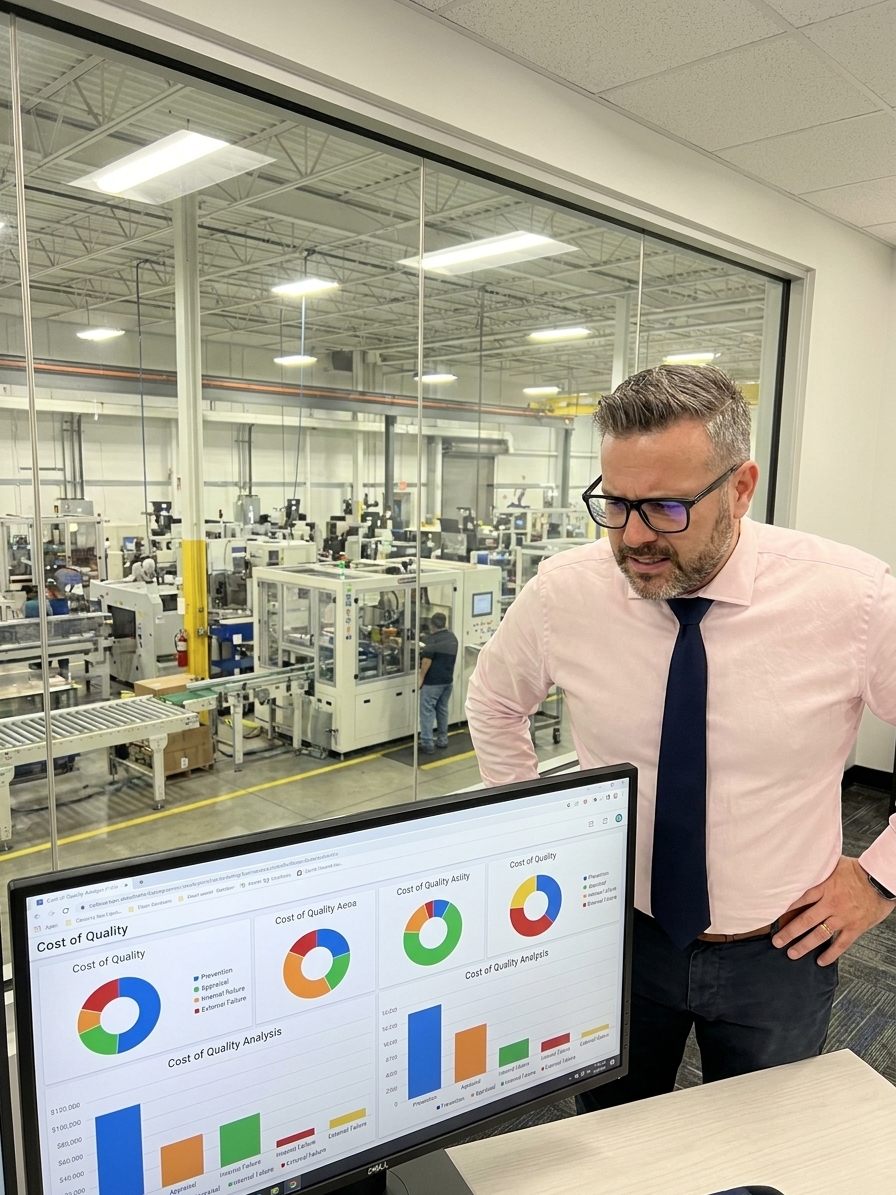
The Cost of Quality (COQ) model was supposed to be a catalyst. Philip Crosby's premise is straightforward: the cost of doing things wrong vastly exceeds the cost of doing things right. Every scrapped part, rework cycle, warranty claim, and line shutdown represents real capital leaking from the business. The COQ framework gave quality professionals a language to communicate waste in terms executives understand: money.
But somewhere between Crosby's insight and the quarterly quality cost review, the tool transformed. The measurement became the deliverable. The cost categories became permanent budget lines. And the organisation settled into a comfortable relationship with its quality costs — not comfortable enough to celebrate them, but comfortable enough to stop aggressively attacking them.
I have audited plants where the COQ report is meticulously maintained, yet the scrap rate hasn't moved in three years. The quality team spends weeks reconciling data across departments to present a number leadership already expects. The report generates discussion, but rarely triggers the capital investment required to fix the underlying process failures. The organisation is measuring the problem instead of solving it.
Prevention: The Category Everyone Funds Last
The COQ model divides spending into four buckets: Prevention, Appraisal, Internal Failure, and External Failure. The theory is elegant: invest in Prevention, reduce the need for Appraisal, and watch failure costs plummet. Total quality cost drops as you shift spending leftward. In theory, every executive agrees this is where quality dollars should go.
In practice, Prevention is the first budget line cut when the quarter gets tight. Prevention spending is invisible when it works. A well-designed PFMEA and robust process plan produce no dramatic success story. There is no fire to put out, no crisis to avert, no hero to celebrate. The APQP training that prevented a thousand defects cannot show you the thousand defects that didn't happen. Prevention is treated as discretionary.
Meanwhile, the failure costs — which are typically an order of magnitude larger — are treated as fixed. Scrap, rework, warranty claims, expedited shipping to replace defective product: these hit the budget as unavoidable costs of doing business. Nobody questions them because questioning them would mean admitting something fundamental about the operation is broken. It is easier to fund the fire department than to mandate fire-resistant construction.
The result is an annual COQ report that shows the same inverted investment year after year. Prevention stays underfunded while failure categories stay enormous. You stop being surprised by the numbers. That is the first sign the framework has stopped working.
Appraisal: Building the Inspection Empire
If Prevention is the category everyone underfunds, Appraisal is the category everyone overbuilds. Inspection, testing, and audit programmes grow with a logic all their own. Each defect escape triggers a new inspection step. Each customer complaint adds another check. Each audit finding creates a new verification requirement. The inspection apparatus expands because adding a check feels like taking action, even when the check adds no value.

Here is how the appraisal empire grows. A defective batch reaches the customer. The 8D corrective action demands an end-of-line inspection. Another defect slips through that checkpoint, so the response is to add an in-process inspection upstream. The in-process check catches some defects but misses others. The solution is a second inspector, then a third shift of inspectors, then an audit of the inspectors.
At no point does anyone ask the foundational question: why are we producing defects in the first place? The inspection empire exists because the process is incapable. Fixing the process requires investment in Prevention — and Prevention is the discretionary budget. So instead of fixing the process, you build a parallel quality organisation whose entire purpose is to catch the output of a broken process.
Your COQ report shows Appraisal costs rising every year. Many managers interpret this as increased quality commitment. In reality, it is evidence of process deterioration. More inspection means more defects being generated upstream. The bigger your inspection budget, the worse your process capability has become.
Internal Failure: The Scrap Pile Nobody Owns
Internal failure costs — scrap, rework, downtime, line stoppages — are the most visible quality costs and somehow the least addressed. This seems paradoxical until you understand the organisational dynamics. Scrap happens on the shop floor. The operator logs it. The supervisor signs off. The quality engineer investigates and writes a report. A corrective action is opened. And then the scrap continues.
The root cause — a machine past its maintenance window, a supplier whose material is marginally out of spec, a process that was never properly validated — is deemed too expensive or too politically sensitive to fix. So the organisation adapts. The scrap rate becomes a known number, a line item in the COQ report. It gets budgeted. Variance analysis is performed. If the rate stays within the expected range, nobody panics.
The Normalisation of Waste
What teams do
- Establish a scrap baseline (e.g. 5%) and budget around it
- Accept incremental increases as machines age or materials shift
- Open 8D investigations that close without capital investment
- Track variance against the accepted waste level
What works
- Target the process capability (Cpk) driving the scrap
- Reject baseline drift and link it directly to prevention budgets
- Escalate recurring root causes to capital expenditure requests
- Measure improvement by cost eliminated, not cost managed
If the rate spikes, there is a flurry of activity — another task force, another investigation — until the rate settles back to its normal level of waste. The problem is that normal is whatever the organisation has decided to tolerate. Five percent scrap becomes the baseline. Then six percent, because the machine is older. Then seven percent, because the supplier changed their formulation. Each increment is explained, justified, and absorbed.
External Failure and the Optimisation Paradox
External failure costs — warranty claims, field recalls, customer returns, lost business — are the category that should keep executives awake at night. A single field failure can cost a hundred times more than catching the defect internally. A recall can cost a thousand times more. Yet external failure costs are routinely underestimated in COQ reports.
The reporting system captures direct costs: the warranty payment, the replacement shipment, the legal settlement. It misses the indirect costs. The customer who quietly takes their business elsewhere doesn't generate a cost line. The engineering team that spends three months managing a field failure instead of developing new products has their salaries allocated to R&D, not to poor quality. The reported number looks manageable, so leadership doesn't feel the urgency the real number demands.
This creates a dangerous feedback loop that triggers what I call the optimisation paradox. Attempting to reduce COQ by cutting measured costs often increases the actual cost of quality by shifting defects into unmeasured channels. Some organisations set targets to reduce quality costs by fifteen percent. The easiest category to cut is Appraisal — reduce inspection points, eliminate tests, narrow audit scope. The COQ number improves. Leadership celebrates.
The framework measures what it can see, and what it can see is never the whole picture.
But the defects those inspections were catching do not disappear. They move downstream — from Internal Failure, where they are cheap to fix, to External Failure, where they are expensive. The COQ report shows improvement for one or two quarters, then deteriorates sharply as warranty claims rise. The response is predictable: the organisation adds back the inspection steps it cut, plus a few more. The Appraisal budget returns to its previous level, or higher.
The Supply Chain Blind Spot
Most COQ systems stop at the factory door. They measure what happens inside the four walls and ignore the quality costs imported through the supply chain. The supplier whose material is marginally within spec but causes excessive tool wear shows up as Internal Failure in your report, but the root cause sits upstream. The supplier whose declining process capability forces you to tighten incoming inspection inflates your Appraisal budget.
In automotive and aerospace manufacturing, supplier-driven quality issues are significant. IATF 16949 and AS9100 both demand supplier development, yet most COQ reports fail to capture the financial impact of poor supplier performance on internal operations. The expedited freight, the line stoppages, the additional sorting — these costs are real, but they are dispersed across logistics and production budgets, invisible to the quality cost model.
Addressing supplier quality costs requires treating suppliers as extensions of the internal process. That means investing Prevention dollars outside the organisation — conducting joint process reviews, sharing Cpk data, collaborating on PPAP submissions rather than just checking the paperwork. The ROI is harder to measure and the budget owners have less control. So the supplier dimension remains unaddressed, and the imported quality costs keep flowing.
Breaking the Reporting Cycle
If your COQ reporting system has become a ritual rather than a catalyst, you are not alone. But recognising the pattern is only the first step. Breaking it requires a fundamental shift in how the organisation views quality spending. Stop reporting and start acting. The COQ report has already told you everything it is going to tell you. You know where the failure costs are concentrated.
Shift the conversation from cost to investment. The COQ framework frames quality spending as a cost to be minimised. Reframe it: prevention spending is an investment with a measurable return. Present it that way to leadership, and the budget conversation changes. Take the top three failure cost categories and launch improvement initiatives targeting root causes — not another data collection exercise.
From Cost Reporting to Cost Elimination
- 01Identify the top three failure modesUse Pareto analysis on scrap, rework and warranty data to pinpoint where capital is actually leaking.
- 02Trace to the process capability gapLink each failure mode to the specific Cpk or process instability driving it, not to a general category.
- 03Build the prevention investment caseCalculate the ROI of equipment, training or supplier development spend against the eliminated failure cost.
- 04Execute and measure cost eliminatedTrack the reduction in failure cost directly, not the maintenance of the reporting system.
- 05Reallocate appraisal savingsAs process capability improves, shift inspection budget into further prevention rather than absorbing it as savings.
Measure what matters, not what is easy. The four-category model is a simplification. Your real quality costs are concentrated in a handful of specific processes, materials, and failure modes. Find those through targeted analysis of where defects are generated and where they cost the most. Include the supply chain: your suppliers' quality problems are your quality costs. Bring them into the prevention investment.
Finally, kill the annual report — or stop treating it as the primary output of your quality organisation. The energy that goes into maintaining the COQ reporting system would, redirected to actual process improvement, reduce quality costs by more than the reporting system could ever measure. Philip Crosby was right: quality is free. The cost of poor quality dwarfs the cost of prevention. The math hasn't changed. The question is whether you will keep polishing the mirror or finally turn around and fix what it shows you.