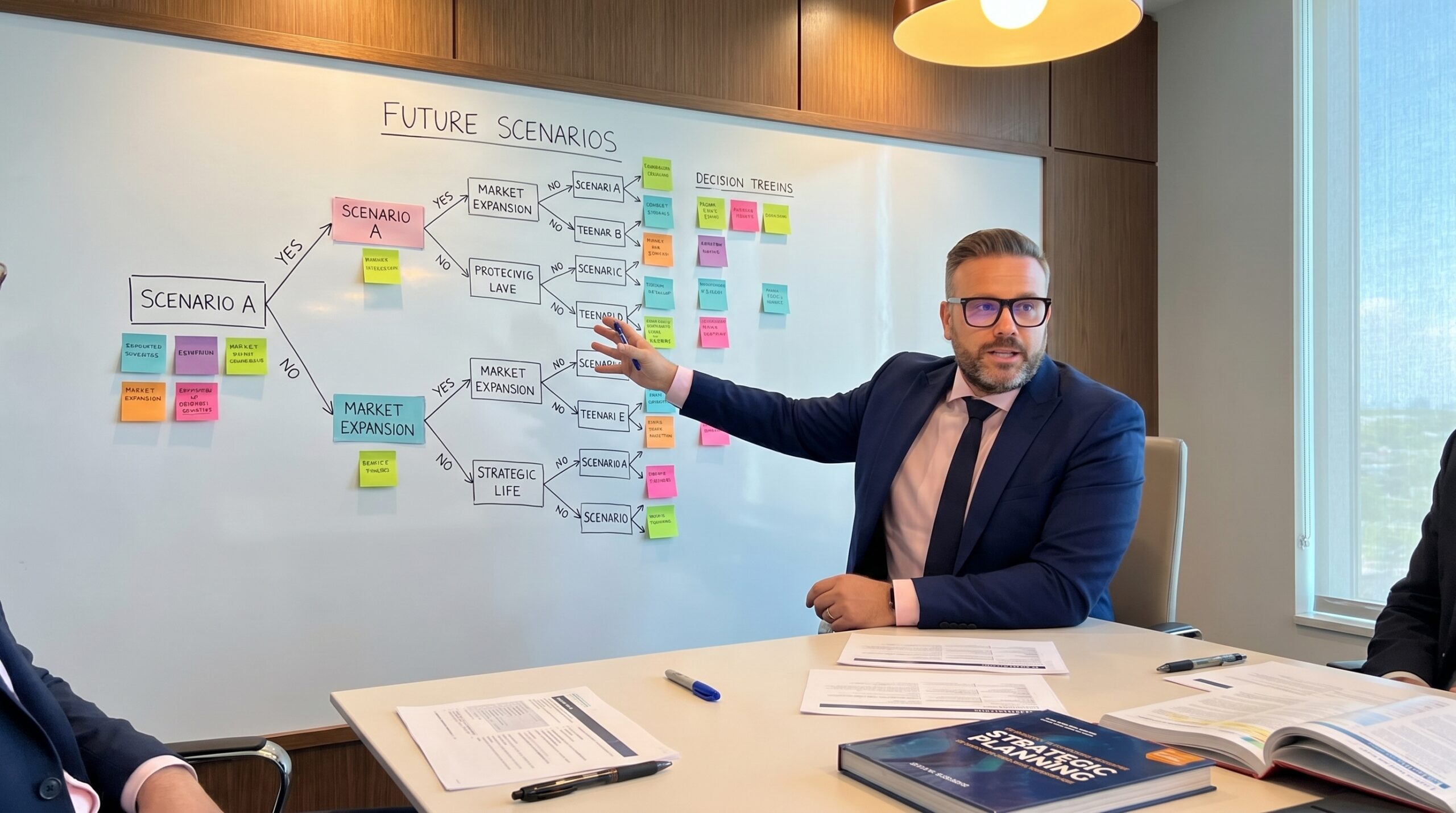
Every quality manager has a contingency plan. It sits in a binder or a SharePoint folder, describing how the system responds when things go wrong. It includes corrective action procedures, risk assessments, and backups for supplier failure. But that plan was written for one future. It assumes problems arrive one at a time and announce themselves politely.
Real manufacturing environments do not read your procedures. Consider an automotive supplier holding IATF 16949 certification with updated PFMEA documentation and quarterly risk reviews. If a key supplier shuts down, a new regulatory requirement drops with a six-month deadline, and a senior quality engineer resigns in the same month, that documented system collapses under the weight of concurrent disruptions.
Standard ISO 9001 frameworks are built to handle isolated deviations. They are not built for convergence. Scenario planning for quality systems is the disciplined practice of constructing multiple plausible future states and stress-testing your QMS against them. It is how you find vulnerabilities before they become audit findings or line stoppages.
The limit of standard risk management
Organisations handle risk through FMEAs and standard cross-functional reviews. These tools evaluate single failure modes in isolation. A process FMEA identifies what happens if a specific tool wears out. A risk register tracks the probability of a supplier missing a delivery. This satisfies compliance auditors, but it creates a dangerous false sense of security.
Risk matrices fail when disruptions compound. A supplier failure rated as a medium risk becomes critical when it coincides with a regulatory audit or a sudden loss of process knowledge. Standard quality tools lack the mechanism to calculate this interactive risk. They treat each threat as an independent variable.
Scenario planning does not replace your PPAP or APQP processes. It amplifies them. By forcing your team to imagine unfamiliar combinations of standard disruptions, you move from compliance-driven documentation to operational resilience. You stop guessing which single event will happen and start building a system that can absorb multiple shocks.

Disruption archetypes to rehearse
Quality systems must be tested against specific disruption archetypes. The Talent Cliff simulates the loss of your three most critical quality professionals within 90 days. This exposes the fragility of undocumented knowledge. If your IATF-specific requirements live in one engineer's inbox, or if calibration schedules run on personal memory, this scenario will find the gap.
The Supply Chain Earthquake tests your APQP depth. Your top two suppliers fail simultaneously—one loses certification, the other declares force majeure. Most plants have backup suppliers listed in documentation. Few have actually validated them, and fewer still have tested whether those backups can deliver at volume without compromising PPAP requirements.
The Regulatory Shock evaluates your management of change process. A new regulation arrives with a compliance deadline shorter than your typical change cycle. Organisations with rigid document control—those taking ninety days to update a control plan—will face non-conformities. Your system must be agile enough to deploy new training and update work instructions within thirty days.
Detecting silent process drift
The Silent Drift is the most dangerous archetype. Over eighteen months, process capability gradually degrades from a Cpk of 1.67 to 1.10. There is no single point failure or dramatic event. Control charts might show trends, but if reaction protocols are tied to control limits rather than gradual shifts, the drift continues invisibly.
This scenario exposes the effectiveness of your SPC monitoring and management review depth. If your internal audits only verify procedural compliance rather than systemic health, they will miss the degradation. An external customer audit will catch it, resulting in a major non-conformity and potential business loss.
Stress-testing this scenario requires examining how your quality team reacts to subtle data changes. Do they wait for out-of-control signals, or do they act on negative trends? Your quality system must have the sensitivity to detect slow erosion before it breaches specification limits. This requires defined escalation triggers for capability loss, not just dimensional rejects.
Process Capability Thresholds
Running a scenario planning workshop
Execute scenario planning with a cross-functional team of six to ten people. Quality professionals alone cannot map systemic risk. You need supply chain, engineering, production, and commercial perspectives in the room. Quality scenarios span departmental boundaries, and the response will require resources outside the quality department's direct control.
Select two scenarios that feel most relevant. If your supply chain is concentrated, run the Supply Chain Earthquake. Build a detailed narrative, not bullet points. Tell the story of a Monday morning where a supplier's IATF certification is suspended effective immediately. A narrative forces participants to imagine themselves in the crisis, making the exercise visceral rather than abstract.
Walk through the QMS step by step. Identify who gets notified, what documentation is triggered, and where decisions stall. Be brutally honest about dependencies. If a step relies on a specific person, flag it. If a procedure dictates management review without specifying timelines, the system will freeze under pressure.
Scenario Execution Methodology
- 01Define the triggerEstablish the exact disruption narrative and the immediate operational impact.
- 02Map the responseTrace the existing QMS procedures to see who acts and what forms are completed.
- 03Identify breakdownsPinpoint exactly where the process stalls due to missing data, authority, or resources.
- 04Document vulnerabilitiesRecord the gaps with the same rigour applied to formal 8D corrective actions.
- 05Build the playbookCreate a scenario-specific action plan with clear decision authority and escalation triggers.
Building actionable response playbooks
Every vulnerability discovered during the workshop requires documentation. Treat these gaps as preliminary audit findings. Define what is at risk, the specific trigger that will expose the failure, and the impact on product quality or compliance. Finally, define the required action to close the vulnerability before a real crisis hits.
A risk rated medium in isolation becomes critical when it collides with another concurrent event on the shop floor.
For the highest-impact vulnerabilities, write response playbooks. These are not standard operating procedures. They are scenario-specific action plans activated when a situation unfolds. A playbook dictates immediate actions for the first twenty-four hours, communication protocols, and decision authority.
A functional playbook prevents organisational paralysis. When two critical suppliers fail simultaneously, the quality team must know who has the authority to approve an emergency source change. If the playbook requires three levels of sign-off that take a week, the line stops. Playbooks must designate clear escalation criteria that bypass standard bottlenecks.
Integrating scenarios into the QMS maturity model
Organisations progress through observable maturity stages. Level 0 is purely reactive, treating every disruption as a surprise. Level 1 is risk-aware, maintaining ISO-compliant risk registers where threats are treated independently and plans remain untested. Most manufacturing plants currently operate at Level 1.
Level 2 is scenario-aware. The organisation has conducted cross-functional exercises and documented vulnerabilities. Level 3 is scenario-ready. Quality teams run quarterly tabletop exercises, maintain response playbooks, and can articulate their most critical vulnerabilities without consulting a document.
The goal is Level 4: scenario-embedded. Here, cross-functional teams evaluate every new process launch against multiple futures. Organisations at this level do not just respond to scenarios; they design quality strategy to be robust against them. This integration ensures resilience becomes a structural characteristic of the manufacturing system, not an afterthought.
Scenario Planning Maturity Progression
- Level 4: Scenario-EmbeddedQuality strategy is designed around multiple futures; resilience is structural.
- Level 3: Scenario-ReadyPlaybooks are tested in tabletop exercises; vulnerabilities are memorised.
- Level 2: Scenario-AwareCross-functional exercises conducted; critical vulnerabilities documented.
- Level 1: Risk-AwareISO-compliant registers exist, but risks are treated independently.
- Level 0: ReactiveNo scenario thinking; the QMS only reacts after the line stops.