A blockchain is a distributed ledger in which each block carries a cryptographic hash of the previous one. Alter a committed entry and every subsequent hash breaks, so tampering becomes evident. That property is genuinely useful when multiple parties who do not fully trust each other must share a transaction history: a tier-three supplier, a logistics provider, a certification body and an OEM all reading from the same chain.
What the ledger guarantees is integrity after commitment. Once a batch record, heat number or certificate hash sits on the chain, nobody can quietly rewrite it. What it does not guarantee is truthfulness at the point of origin. If an operator scans the wrong reel barcode, or a supplier uploads a mill certificate fabricated in a spreadsheet before it ever touched the chain, the ledger will faithfully and permanently preserve that falsehood. Immutability cuts both ways: a wrong entry is as permanent as a right one.
Across two decades in automotive and aerospace quality, I have seen this distinction decide whether a blockchain pilot survives contact with production. Plants whose traceability failures stem from disputes — the supplier says they shipped the right material, incoming inspection says otherwise — can benefit from a shared ledger as neutral ground. Plants whose failures stem from clerical error, sensor drift or hand-keyed entries get nothing from the chain except a more expensive way of being wrong. Diagnose your failure mode before signing anything.
Trust boundaries: where the ledger starts and stops
Draw the trust boundary on paper before you draw the architecture. Inside your own four walls you control the network, the terminals, the operators and the MES. A blockchain within a single plant is largely redundant: a properly permissioned database with audit logging, row-level versioning and append-only tables gives equivalent accountability at a fraction of the operational overhead. I have yet to see an intra-plant blockchain project that justified its own infrastructure once the novelty wore off.
The boundary that matters is the inter-company one. When material crosses from supplier to processor to sub-assembler, each party keeps its own records, and reconciling them after a quality escape means exchanging spreadsheets, certificates and emails, then arguing about whose timestamp is authoritative. A shared ledger across that boundary establishes a single sequence of custody events everyone has already agreed to trust. Each party validates the blocks it cares about; no single party can backdate a shipping event without counterparties noticing the discrepancy.
But note what remains outside the boundary: the physical world. The chain records a scan event, not the physical transfer itself. If a driver signs a delivery into the system from the lorry park without unloading, the ledger says goods received. If a label falls off a coil and is reattached by guesswork, the chain now certifies a guess. Cryptographic trust between organisations cannot extend through a human being with a handheld scanner at two in the morning. Whatever trust you place in the chain ends at the edge of the screen.

First-entry quality: the unglamorous bottleneck
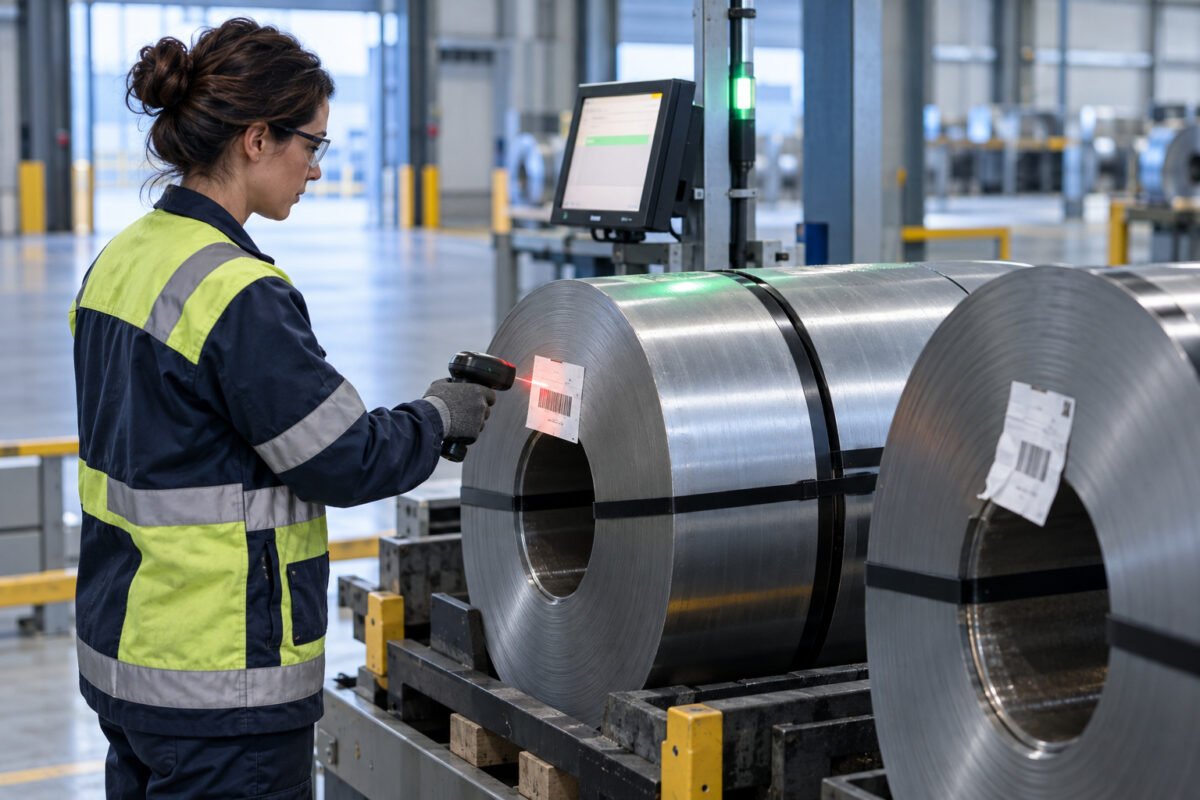
Audit your first-entry failure modes honestly. In most traceability deployments I have reviewed, the dominant error sources are barcode mis-scans on similar part numbers, manual keying of heat numbers from smudged tags, batch splits recorded against the parent lot instead of the child, and rework loops that bypass scanning stations entirely. Not one of these is touched by blockchain. The chain validates the format and sequence of a record; it has no opinion on whether the record matches physical reality.
Measure the right things. Scan success rate at each station, re-key frequency, time between scan and physical move, and the count of material reversals or negative inventory transactions per shift — these tell you where your traceability data goes bad. A useful discipline is periodic blind verification: pull finished units at random, trace them backwards through the system, and physically confirm the recorded lot actually sits in the recorded bin. When I have run these checks, the mismatch rate between system and reality was always higher than the plant believed, regardless of whether the system was SAP, a bespoke MES or a pilot ledger.
Improving first-entry accuracy is engineering work, not procurement work. It means foolproofing the label itself: larger fonts, check digits, colour coding by product family, 2D codes that survive degreasing. It means scanner stations that physically constrain which part can be presented, with light curtains or fixtures that read the code only when the part is seated correctly. It means exception handling designed in advance, so an operator who spots a wrong scan has a fast, sanctioned correction path rather than a reason to work around the system. None of that ships with a blockchain licence.
Blind verification of the traceability chain
- 01Sample finished unitsPull random units from stock without telling the shift in advance.
- 02Trace backwards in the systemFollow lot, heat number and custody records to their recorded source.
- 03Physically confirmCheck the recorded lot actually sits in the recorded bin.
- 04Classify mismatchesSort errors into capture, transfer and reconciliation causes.
- 05Fix and re-measureEngineer the failure mode out, then re-run the check on a fixed cadence.
Practical alternatives that often beat the chain
Before committing to a distributed ledger, exhaust the conventional toolkit. An append-only event log in a relational database, with a hash chain computed per record, gives you tamper-evidence — anyone altering a historical row invalidates the stored hash — without consensus machinery, nodes or token governance. For most internal and even many supplier-facing scenarios, digitally signed EDI transactions with a retained, timestamped message archive achieve the disputed-record resolution that blockchain vendors sell. Signature plus independent archive is a mature, well-understood pattern.
Where a genuine multi-party case exists, ask whether a permissioned ledger with three or four known validators is enough. Public chains add cost, latency and energy overhead that industrial traceability rarely needs. Keep the payload off-chain in each party's own systems and store only a hash plus minimal metadata on the chain; the ledger then serves as a common notary rather than a database, which keeps it fast and keeps the governance arguments small. Decide up front what happens when a party leaves the consortium, because I have seen that question kill projects eighteen months in.
The honest comparison is total cost of error correction versus total cost of prevention. A ledger makes errors discoverable but essentially uncorrectable in place: you issue a counter-record, and both live forever. A conventional system lets an authorised person amend with an audit trail. If your first-entry error rate is high, the conventional route with good correction workflows is cheaper and kinder to operate. If your error rate is already low and the problem is inter-party disputes, the ledger earns its keep. Sequence matters: fix the data, then consider the chain.
What to check before any pilot
Start with a structured walk of the data path. For each traceability event you intend to record, document who or what creates it, at which station, from which source document or sensor, with what validation at capture, and what happens when capture fails. Gaps in that map — events recorded from memory at shift end, stations where scanning is optional, suppliers emailing PDFs that someone re-keys — are exactly where the ledger will preserve rubbish. Fix those gaps first and measure the fix; a pilot on a broken data path tells you nothing.
Examine the identity and key management story closely. A blockchain proves that a transaction was signed by a key, not that the key belongs to the person or machine it should. If private keys sit on shared shop-floor terminals or in a configuration file on a PLC, the trust model collapses. Ask who can revoke a compromised key, how long revocation takes, and what happens to historical records signed by that key. In supplier-facing deployments, ask how a small tier-three with one PC and no IT staff joins the network without becoming the weakest link.
Finally, define the exit before the entrance. Agree in writing how records are exported, how long the chain must remain verifiable if the consortium dissolves, and who bears the cost of maintaining verification nodes once pilot enthusiasm fades. I have watched two ledger initiatives quietly rot because nobody budgeted for running validator infrastructure after year two, and the permanent records became unreadable in practice even though they were intact in theory. Permanence you cannot read is not permanence.
The chain validates the format and sequence of a record; it has no opinion on whether the record matches physical reality.
Where distributed ledgers genuinely help
Fairness demands naming the cases where I have seen distributed ledgers earn their place. Multi-tier recall scoping is one: when supplier, processor and customer share custody events on a neutral chain, narrowing a recall from a week of production to two specific lots takes hours instead of days of reconciliation emails. Conflict-mineral and cobalt chain-of-custody reporting is another, where several independent parties must attest to custody without any one of them owning the system of record.
Certified material in regulated flows benefits too. Aerospace first-article and material certification documents, hashed and anchored to a shared ledger, give the OEM a way to detect a doctored certificate — the hash will not match any previously recorded version. Critical spare parts and returns handling across authorised networks is a third niche, where counterfeit interception depends on multiple parties verifying provenance without trusting a single central database run by whichever party has the most bargaining power.
Choosing ledger versus conventional tooling
Ledger earns its keep
- Inter-party disputes over custody and timestamps
- Multiple organisations, none trusted to own the system of record
- First-entry data already engineered to high accuracy
- Regulated chain-of-custody attestation requirements
Conventional tooling wins
- Intra-plant traceability under your own control
- High first-entry error rate needing correction workflows
- Tamper-evidence satisfied by hashed append-only logs
- Signed EDI plus independent archive resolves disputes
Conclusion: fix the data, then decide
The pattern across every successful deployment is the same: multiple organisations, genuine distrust, a need for a common sequence of events, and — crucially — first-entry data already engineered to be reliable. Get the first entry right and the chain adds real value. Get it wrong and you have built a very expensive notary for fiction.
The ledger cannot fix the first entry. Only the label design, the scanner fixture, the operator procedure and the exception workflow can. Spend your effort there first, measure the mismatch rate honestly through blind verification, and let the blockchain decision follow the evidence rather than the vendor pitch.
That discipline costs a fraction of a ledger pilot and pays off regardless of which technology you eventually choose. It also has a habit of fixing quality problems beyond traceability, because a plant that cannot trust its scan data cannot trust its defect pareto either. The first entry is where quality is either created or lost — the chain merely keeps the score.