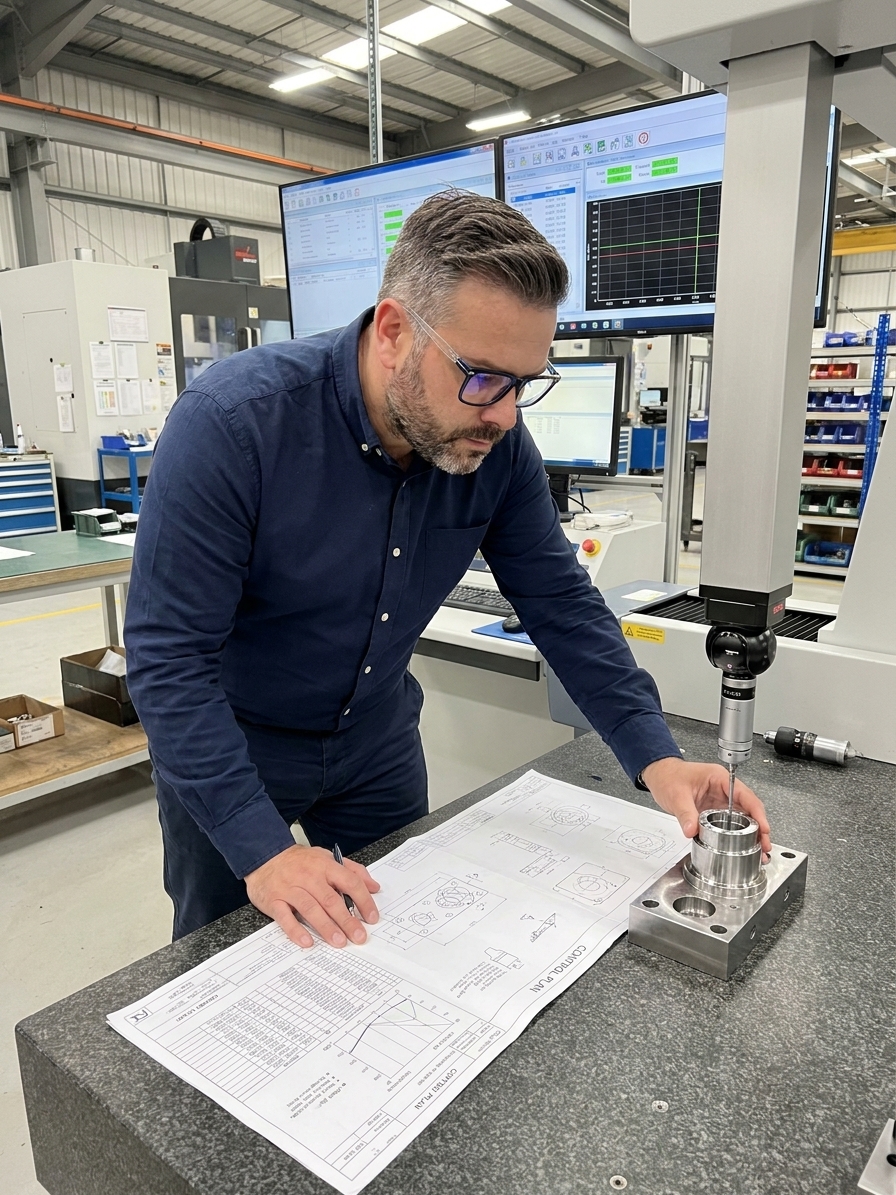
Every manufacturing organisation that completes an APQP launch produces a Control Plan. In theory, this document bridges your PFMEA risk analysis and your daily operations. It defines exactly what to monitor, the required sample frequency, and the specific reaction plan when a process drifts out of tolerance.
In practice, the document is often the most expensive piece of fiction the plant ever writes. It is created under the extreme pressure of a product launch, submitted to the customer, and filed away. It sits dormant until an auditor arrives, a customer complaint triggers an 8D, or a defect rate climbs on a characteristic that was supposedly under strict control.
I have reviewed hundreds of Control Plans across automotive and aerospace manufacturing. The pattern is remarkably consistent. The gap between documented control and actual floor reality is one of the most underappreciated sources of quality failure. The danger is that the document itself creates an illusion of safety, masking the absence of genuine process control.
What a Control Plan Must Actually Do
A properly constructed Control Plan is a comprehensive summary of process controls. It links every significant process step to the product and process characteristics being monitored. It defines the specification, the evaluation method, the sample size, the frequency, and the exact reaction plan required when a check fails.
Done correctly, it is a communication tool that translates process development knowledge into actionable instructions. The failure modes identified in the PFMEA and the special characteristics flagged by the customer are engineered into specific tasks for the operators running the line day after day.
The document must answer one question: how do we ensure this process produces conforming product consistently? If an operator or a process engineer cannot answer that question by reading the Control Plan, the document has fundamentally failed its purpose and has no operational value.
The Anatomy of a Fictional Document
The most common failure mode I audit is the copy-paste from the PFMEA. The launch engineer exports the risk analysis into a new template. Every failure mode becomes a row, and every current process control becomes an evaluation method. The result is technically complete but functionally useless. The PFMEA describes what could go wrong; the Control Plan must describe what you physically do to prevent it.
Inherited documents are equally dangerous. When a new part launches on an existing line, the team copies the previous plan and changes the part number. But the new geometry creates different stress concentrations, and the new tolerance stack-up shifts the process window. The controls remain unchanged because nobody evaluated whether they still match the new manufacturing reality.

Evaluation methods frequently exist only on paper. The document specifies a CMM measurement for a feature actually measured with a caliper, because the CMM queue is three days long. It demands an SPC chart that was printed during launch and taped to a workstation, never updated. It references a visual standard that was never actually created or calibrated.
Sample sizes suffer the same fate. Engineers routinely write 5 pieces every 2 hours because it matches the row above and satisfies an auditor. There is no statistical rationale, no calculation of process capability, and no consideration of how quickly the process drifts. The frequency is chosen to make the document look complete, not to control the process.
Reaction Plans and the Illusion of Control
The reaction plan is where the illusion of control becomes most obvious. When a critical characteristic is found out of specification, the typical instruction is to notify the supervisor or contact engineering. These are not reaction plans. They are an abdication of planning disguised as a protocol. They mean the author did not know what to do and hoped someone else would figure it out.
When auditors and management review these documents, they see comprehensive coverage. Every characteristic has a method, a frequency, and a reaction. The process looks stable. But if the floor is using calipers instead of the CMM, and ignoring the SPC chart, the system is entirely fictional. The document has become a substitute for control rather than a description of it.
This paper control trap is the most dangerous state a quality system can occupy. It is more hazardous than having no documentation at all. Without a plan, everyone knows the process is uncontrolled. With a paper plan, the organisation is actively deceived about its level of risk. Management allocates resources elsewhere, entirely unaware that the floor is operating without a net.
Root Causes of Documentation Drift
Time pressure during APQP is the primary driver. The document is treated as a customer deliverable with a submission deadline, not an operational tool. When the deadline drives the work rather than process stability, the columns get filled with plausible text. The priority is sign-off, not manufacturing truth.
Ownership ambiguity accelerates the decay. The launch engineer moves to the next project. The quality engineer maintains the file but is spread across dozens of part numbers. The production supervisor inherited a document they did not create and cannot challenge. Nobody is accountable for ensuring the document drives daily behaviour on the floor.
Paper Control vs Operational Control
What teams do
- Copy PFMEA rows directly into the template
- Assign 5 pieces every 2 hours to fill the column
- Specify generic actions like notify supervisor
- Update the file only before a scheduled audit
What works
- Define methods operators can physically execute
- Calculate sample sizes based on drift and severity
- Write step-by-step containment and adjustment logic
- Review against floor reality every single quarter
Finally, there is no feedback mechanism. Control Plans are supposed to be living documents. In most plants, there is no systematic trigger for review. The document sits untouched even when tooling wears, materials change, and cycle times are adjusted to meet new takt times. The document describes a process that vanished months ago.
Building an Operational Control Plan
The antidote is operational control. Every evaluation method must be verified as feasible before approval. An engineer must go to the floor and confirm the measurement can be performed in the specified cycle time, by the actual personnel, using the available equipment. If the gauge is unavailable, the method is changed to match reality, not the other way around.
Frequencies must be engineered based on risk. The sample rate is driven by how quickly the process produces nonconforming product, the severity of the characteristic, and the historical Cpk. A critical dimension on an unstable process requires 100% inspection. A stable, non-critical characteristic may need only periodic verification.
A reaction plan must contain the engineering knowledge so the operator does not have to make judgment calls under pressure.
Instead of stating notify supervisor, the plan must specify exact physical actions. Quarantine the last 50 pieces. Adjust the die temperature to 385 degrees. Re-check 5 consecutive pieces. Escalate to a specific process engineer if the adjustment fails after one attempt. If the reaction plan requires an engineering degree to execute, it is a draft, not a plan.
The review cycle must be meaningful. It cannot be just a signature and a date. A quarterly review requires engineering and operations to walk the line together. They must verify that operators are physically following the specified methods and that the frequencies are being maintained despite cycle time pressure.
Engineering Change Control Plan Update
- 01Identify process changeNew tooling, revised material, or modified parameter identified by engineering.
- 02Evaluate current controlsDetermine if existing evaluation methods and reaction plans still apply.
- 03Revise the documentUpdate methods, frequencies, and reaction plans before the change goes live.
- 04Communicate to the floorTrain operators on the revised plan before the first modified piece is run.
Measuring Document Health and Audit Readiness
The specific moment that reveals an organisation's quality culture is how it handles a process change. In a healthy AS9100 or IATF 16949 system, an engineering change triggers an immediate review. The team asks if existing controls still apply. The document is revised and communicated to the floor before the first piece is run.
In an unhealthy system, the change is implemented immediately to hit production targets. The Control Plan is updated later, if at all. Often, it is updated just before the next surveillance audit and backdated to create an illusion of timeliness. The document becomes historical fiction that fails to describe the reality of the process.
To assess system health quickly, pull the last ten engineering change orders for a product family. Compare the physical implementation dates to the Control Plan revision dates. If the document consistently trails the physical change by weeks or months, the system is running on paper control. The gap between those dates is a more accurate quality metric than any internal audit score.
Building operational Control Plans requires time and discipline. It requires management commitment to stop production when the reaction plan dictates, even when the customer is screaming for parts. But the cost of paper control is exponentially higher. Every customer line stop and every 8D investigation traces back to a process shift that the document would have caught, if anyone had actually been following it.