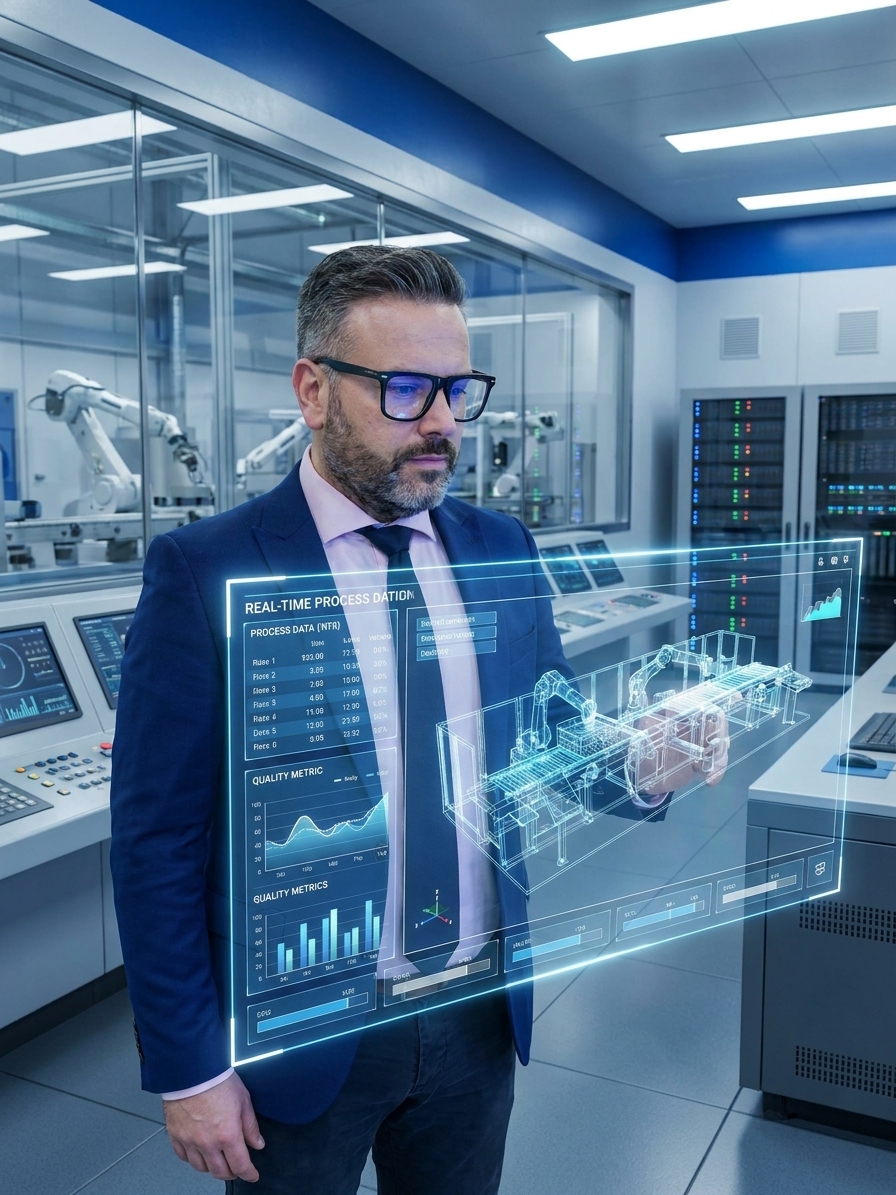
Quality engineers know the plan, the SOP, and the final inspection result. What remains invisible is the dynamic process running between those data points. Variations in melt temperature, micro-adjustments by operators, and ambient humidity shifts interact to create defects that only surface downstream.
Traditional problem-solving fails here. Statistical Process Control (SPC) charts detect the dimensional shift, but they cannot explain the root cause. Standard 8D methodology struggles when the defect requires three simultaneous conditions to manifest. You chase a ghost through a maze of valves, pipes, and machine settings.
A functional digital twin resolves this. It is not a 3D CAD model or a management dashboard. It is a physics-based, computational representation of your production line that ingests real-time sensor data to simulate process dynamics. The twin exposes invisible variables and predicts defects before they occur.
Where Traditional Quality Methods Hit a Wall
Core quality tools were designed for static manufacturing environments. SPC assumes your process is stable enough to maintain a meaningful average and standard deviation. Modern production lines are dynamic. Tool wear, material lot variation, and ambient conditions interact nonlinearally, rendering static control limits ineffective.
Process FMEAs rely on your ability to enumerate failure modes in advance. In complex processes, the most damaging failures emerge from variable interactions you never thought to model. A 5-Why analysis fails because the root cause is not a single event, but a network of simultaneous, interacting conditions.
A digital twin does not replace IATF 16949 or AS9100 methodologies. It supercharges them. Your PFMEA becomes a living document updated by the twin's predictive simulations. SPC transforms from a rearview mirror into a forward-looking radar. Your CAPA process gains simulated evidence that isolates variables physical experiments cannot.
Architecture: Physics First, Machine Learning Second
Organisations routinely spend millions on digital twins that become expensive screensavers. The difference between success and failure is architecture. The most effective models are rooted in first principles: thermodynamics, fluid dynamics, and structural mechanics. Machine learning fills the gaps, but physics provides the backbone.
A purely data-driven model can interpolate within its training data. A physics-based model extrapolates beyond it. When your production line encounters a completely novel set of ambient conditions, the physics model still provides a mathematically sound answer. The purely algorithmic model gives you a highly confident, incorrect prediction.
Fidelity must be layered intelligently. You do not need a high-fidelity simulation of every process step. Start with a coarse model of the entire line to identify where quality is most sensitive. Increase the simulation fidelity only at those critical stations. This concentrates computing power exactly where defect prevention matters.
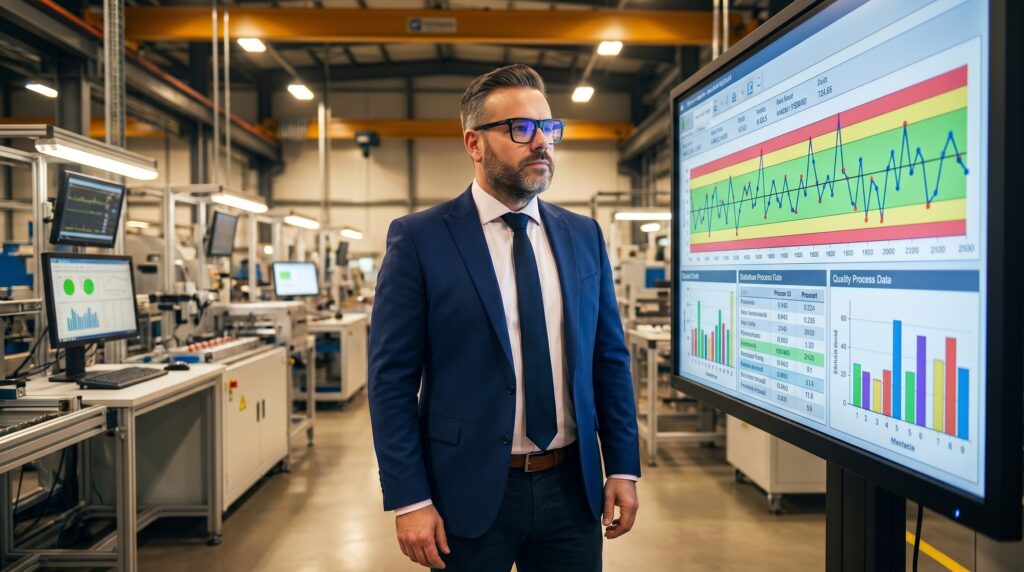
Closing the control loop is the ultimate objective. When the twin detects an emerging quality issue, it sends adjustment commands directly to the PLC. Not every process is ready for closed-loop control, and robust validation is required before handing the keys to an algorithm. But automated defect prevention is the goal.
Closed-Loop Digital Twin Sequence
- 01Data IngestionSensors, MES, and inspection equipment feed real-time parameters.
- 02Physics SimulationThe model calculates current process state and predicts variation.
- 03Predictive AnalysisAlgorithms evaluate the probability of defect formation against Cpk targets.
- 04Automated AdjustmentValidated models send closed-loop correction commands to the PLC.
Delivering Measurable Quality Outcomes
A calibrated digital twin allows you to run thousands of virtual Design of Experiments (DOE) without touching the production line. Every physical DOE burns capacity and generates scrap. Routing experimental matrices through a validated twin first drastically reduces qualification lead times and physical confirmation costs.
Traditional inspection samples a fraction of production. The twin predicts quality for every single part based on actual process conditions. Instead of sampling one in fifty parts, the system flags part number 12,847 for verification because it experienced a temperature excursion that the model predicts will cause a dimensional shift.
Tooling and equipment life prediction is drastically improved. Instead of replacing tools on a fixed preventive maintenance schedule, the twin tracks cumulative stress and recommends replacement when the quality risk curve crosses your threshold. This eliminates both premature tooling costs and downstream scrap generation.
Supply chain quality propagation is another critical use case. When incoming material properties vary, the twin simulates the downstream manufacturing impact before you commit that material to production. It routes material characteristics to the process window most likely to produce conforming parts, maximising yield.
Implementation Realities and Data Governance
Building a useful digital twin is organisationally difficult. Data quality is the silent killer. If your sensors are miscalibrated, your MES timestamps are inconsistent, or your measurement systems have unacceptable Gage R&R, your twin will confidently predict nonsense. Audit your data infrastructure before writing a single line of simulation code.
You need cross-functional expertise. A modelling engineer who understands finite element analysis but has never stood on a shop floor will build a beautiful simulation that misses operational reality. A quality engineer who knows every failure mode but cannot read code cannot validate the model. Bridge this gap deliberately.
A purely data-driven model interpolates. A physics-based twin extrapolates. When conditions change, algorithms guess. Physics calculates.
Model governance matters more than initial deployment. Who owns the model? How do you handle model drift when predictions diverge from physical reality? You must establish clear protocols for when the twin contradicts your experienced operators. Without governance, the model becomes an expensive decoration.
Return on investment takes time. The first six months of a digital twin project feel like building infrastructure with nothing to show for it. You are calibrating, validating, and building trust. The returns compound in the following months as scrap reduction, capacity recovery, and Cpk improvements hit the bottom line.
The Maturity Progression
Digital twin adoption in quality engineering is not binary. It is a measured progression of capabilities. Most organisations begin by simply mirroring their process passively. They advance to predictive simulations, and eventually to closed-loop systems that actively prevent defects before they form in the physical environment.
Understanding where your organisation sits on this spectrum dictates your immediate capital expenditure and engineering strategy. Do not attempt to jump straight to autonomous optimisation. Build the foundation, prove the physics, and earn operator trust before removing the human from the control loop.
Digital Twin Maturity in Quality Management
- Level 1: Digital ShadowPassive model receiving real-time data for improved visibility and anomaly detection.
- Level 2: Predictive TwinSimulates forward to test scenarios, issue warnings, and accelerate root cause analysis.
- Level 3: Closed-Loop TwinDrives automated or semi-automated process adjustments to actively prevent defects.
- Level 4: Self-Optimising TwinLearns continuously from production data and optimises parameters autonomously.
The Pragmatic Path to Deployment
Do not attempt to twin your entire factory on day one. Pick one critical process where quality failures are expensive, root causes are hard to find, and you already possess reliable sensor data. Success on a single difficult process funds the expansion of the technology across the wider facility.
Start simple. A validated regression model that predicts a critical-to-quality characteristic from three process variables is a functional digital twin. It is not sophisticated, but it establishes the workflow. Every prediction must be compared against actual physical outcomes. Publish the accuracy. Investigate every discrepancy.
Build trust gradually through evidence, not mandates. Let early adopters demonstrate the value on the shop floor. Once operators see the twin successfully predict a defect they would have missed, they become believers. Mandates build compliance; evidence builds conviction. The twin gets better over time, and so does your process understanding.
The future of quality engineering is not more inspections or longer audit checklists. It is deeper process understanding driven by mathematical representation. The digital twin is a lens that exposes the complex, nonlinear, interconnected reality of your production line. It gives you the ability to finally see what you have been managing in the dark.