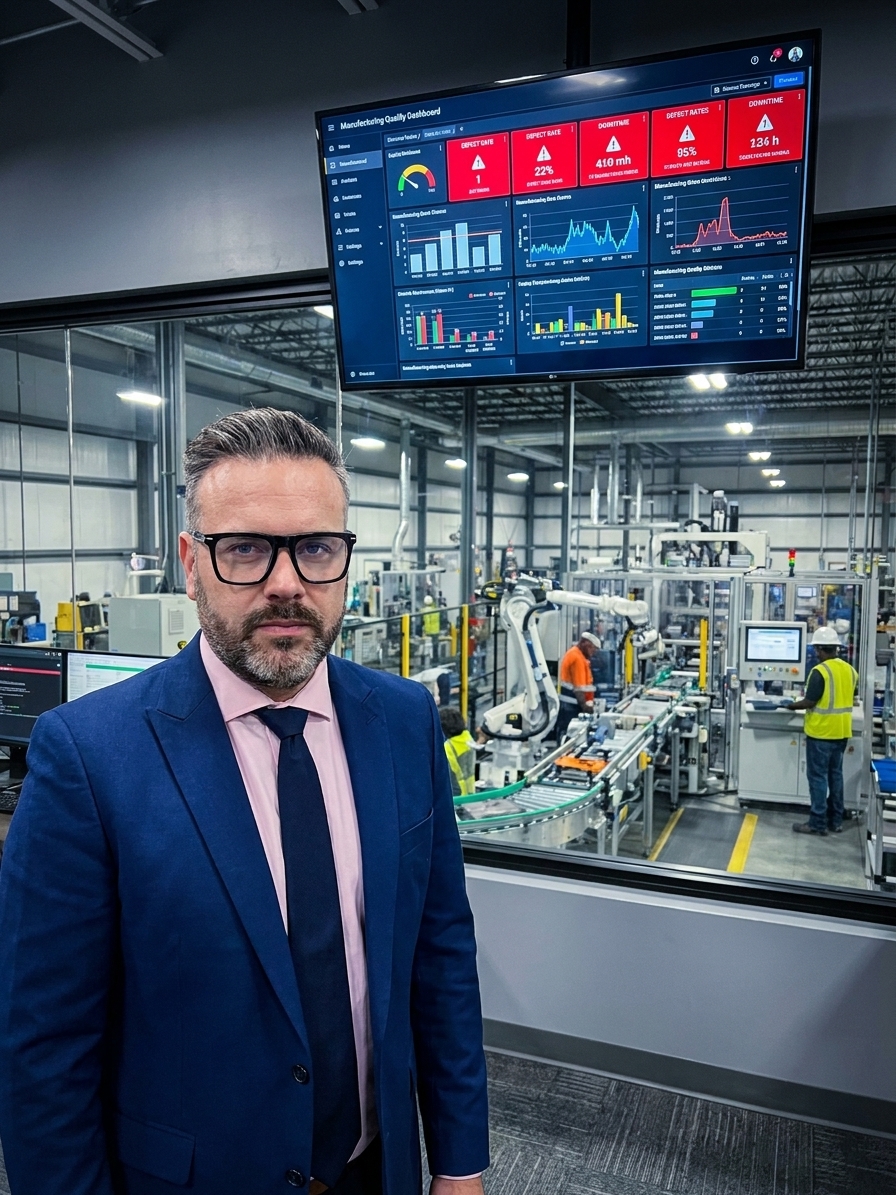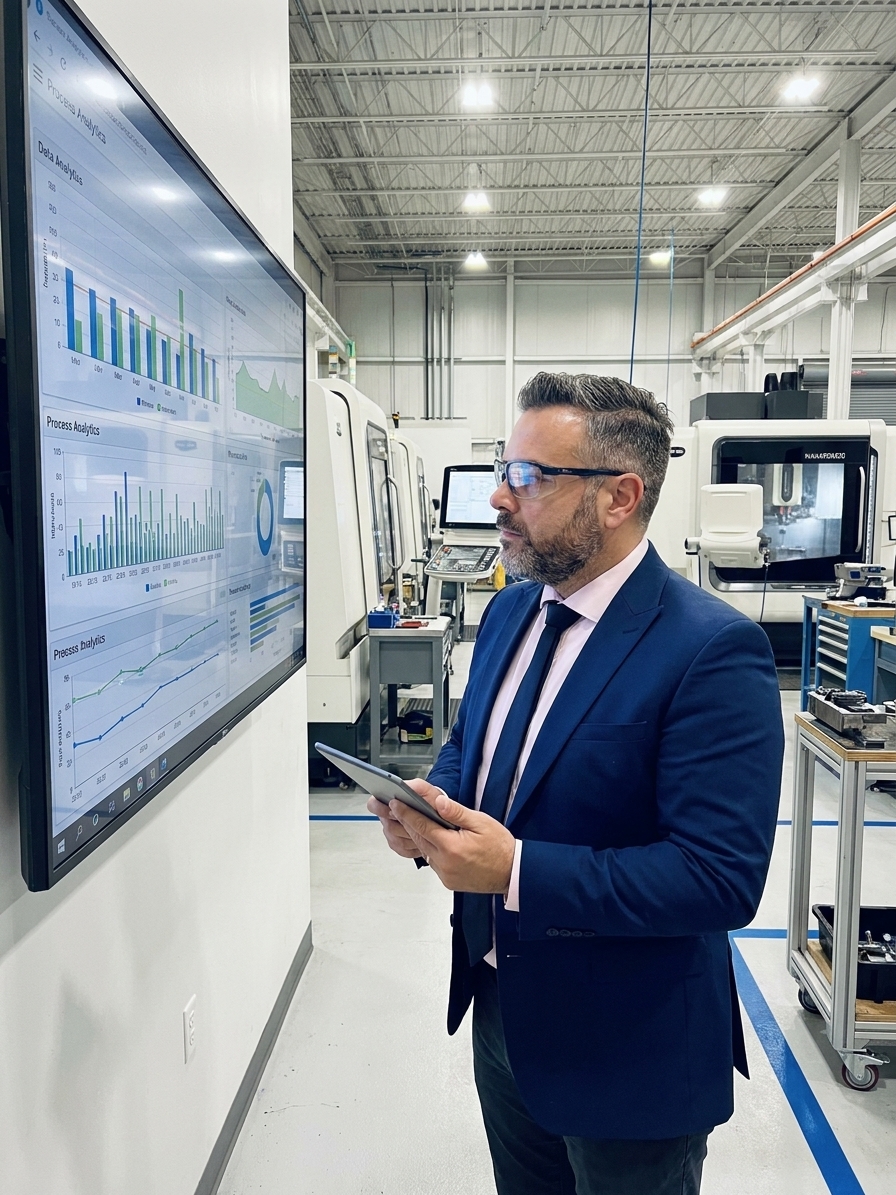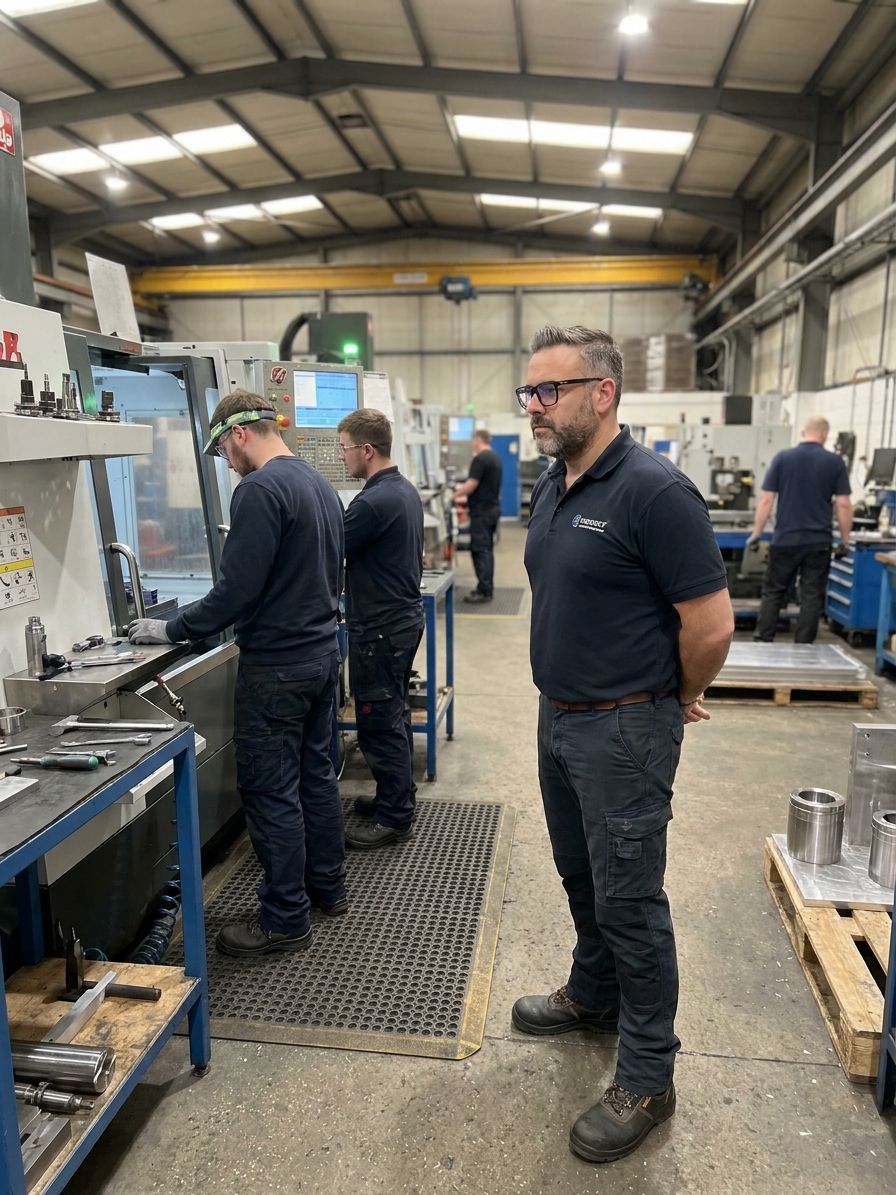
The Word Everyone Uses
and Nobody Lives
If you have spent any time in manufacturing quality, you have heard
the word. Gemba. It shows up in presentations, in training
materials, on the walls of conference rooms where people sit discussing
problems they have never walked fifty feet to observe. The Japanese term
means “the actual place” — where the work happens, where the value is
created, where the truth lives. Taiichi Ohno, the architect of the
Toyota Production System, was famous for drawing a circle on the factory
floor and making managers stand in it for hours, watching a single
process until they understood it. That was the original gemba walk. It
was uncomfortable, slow, and profoundly effective.
What most organizations practice today is something else entirely. It
is a scheduled event on a calendar, a procession of managers walking
through a plant in clean vests, nodding at operators, snapping photos
with their phones, and returning to a conference room to discuss what
they “observed.” The walk has been preserved. The watching has not. The
activity has survived. The insight has died. And nobody seems to notice,
because the act of walking feels productive enough that no one questions
whether anything was actually learned.
This is the story of how one of the most powerful practices in
quality management was hollowed out into performance art — and what it
actually takes to reclaim it.
What a Gemba Walk Is
Supposed to Be
The premise is simple: to understand a process, you must observe it
where it happens. Not in a meeting room. Not in a dashboard. Not in a
report someone else wrote. You go to the place, you watch the work, you
talk to the people doing it, and you let reality challenge your
assumptions.
Ohno’s practice was not a casual stroll. He would position a manager
at a specific spot and require them to observe a single operation — a
machine, a workstation, a material flow — for an extended period. The
instruction was not to fix anything, not to judge anything, not to say
anything. Just watch. The purpose was to develop what Toyota called “the
eyes for waste” — the ability to see the small inefficiencies, the extra
motions, the waiting, the rework, the confusion that had become
invisible to the people working in the process every day.
The gemba walk was never about the walking. It was about the seeing.
And seeing, in this context, means something very specific: the
willingness to stand still long enough for your mental model of the
process to collide with the actual process, and to let the gap between
those two things become visible.
That gap — between what you think is happening and what is actually
happening — is where every improvement begins. If you cannot see the
gap, you cannot close it. And you cannot see the gap from behind a
desk.
What It Actually Becomes
Here is what happens in practice, in organization after organization,
across industries and continents:
The scheduled tour. Someone in leadership decides
the organization should “do gemba walks.” A schedule is created. Every
Tuesday at 10 AM, the management team walks the floor. The route is
predetermined. The stops are the same each week. The operators at each
station have been told in advance that the managers are coming, so they
have cleaned up, staged materials neatly, and prepared a brief
explanation of what they are doing. What the managers observe is not the
process. It is a rehearsed performance of the process.
The delegation walk. A senior leader, recognizing
that they cannot personally walk every area, assigns gemba walks to
middle managers. Those middle managers, already overloaded with their
own responsibilities, assign it to supervisors. The supervisors,
stretched thin and skeptical of another initiative, walk through the
motions — literally. They walk through the area, check a box on a form,
and return to their desks. The walk has been completed. Nothing has been
observed.
The audit in disguise. Many gemba walks are, in
reality, compliance checks. The manager walks the floor with a clipboard
or a tablet, verifying that operators are following procedures, wearing
the right PPE, filling out the right forms. When they see something
wrong, they correct it — tell the operator to fix the form, adjust the
process, follow the standard. This is not observation. It is inspection.
And the difference matters enormously, because inspection creates
defensiveness while observation creates understanding.
The question that is actually a directive. A manager
stops at a workstation and asks the operator, “Why are you doing it that
way?” The operator, reading the tone, understands that the question is
not curious but critical. They explain their process defensively. The
manager suggests an “improvement.” The operator nods and ignores it
after the manager leaves. The walk has produced no learning — only a
brief interaction that both parties would prefer to forget.
** the photo walk.** The manager takes pictures of problems —
cluttered workstations, missing labels, WIP accumulating between
operations — and sends them in an email with a subject line like
“Opportunities observed during gemba walk.” The email generates a flurry
of activity: people scramble to fix the specific items photographed, the
area looks better for a week, and then it reverts. The manager feels
satisfied that they “found problems.” The operators feel surveilled. The
root causes — the systemic reasons why the clutter, the missing labels,
and the WIP accumulation exist — are never investigated, because the
walk was about documenting symptoms, not understanding causes.
Why It Breaks Down
The failure of gemba walks is not accidental. It is structural,
rooted in several dynamics that are deeply embedded in how most
organizations operate:
Managers are trained to solve, not to observe. The
entire career trajectory of a manager in most organizations is built on
providing answers. You get promoted because you fixed things. You do not
get promoted because you stood still and watched something for
forty-five minutes without intervening. The gemba walk asks managers to
do the thing they have been trained their entire careers not to do:
suspend judgment, withhold solutions, and simply observe. Most cannot do
it. The instinct to fix — or at least to appear to be fixing — is too
strong.
Observation is a skill, and nobody teaches it.
Seeing waste is not a natural ability. It is a learned skill, developed
through repetition and coaching, much like statistical analysis or
welding. Toyota understood this and invested years in developing
managers’ observation abilities. Most organizations send their managers
to a two-hour gemba walk training session, hand them a checklist, and
declare the competency established. The checklist, of course, transforms
the walk from observation into audit — which is precisely the
problem.
The power dynamic distorts everything. When a
manager appears at a workstation, the operator’s behavior changes. This
is not a character flaw; it is a rational response to the presence of
someone who controls your performance review, your compensation, and
potentially your employment. The operator shows their best work, hides
their workarounds, and says what they think the manager wants to hear.
The manager, observing this modified behavior, believes they are seeing
the real process. They are not. They are seeing a polished version of
it, shaped by their own presence. Ohno’s standing circle worked partly
because it was not a surprise — it was a regular, expected practice that
normalized the presence of observers over time, reducing the
distortion.
The metrics reward the walk, not the learning. When
organizations track gemba walks as a KPI — number of walks completed,
number of observations logged, number of improvements generated — they
get exactly what they measure: a high count of walks, observations, and
improvements, many of which are superficial or fabricated. The metric
becomes the target, and the purpose — deep understanding of the process
— is lost. This is Goodhart’s Law applied to observation: when a measure
becomes a target, it ceases to be a good measure.
What Gets Lost
The cost of a failed gemba practice is not just wasted time. It is
the opportunity cost of the understanding you could have gained but did
not.
The real gemba walk reveals things that no report, no dashboard, and
no meeting ever will. It reveals that the operator has been working
around a broken fixture for three months because nobody came to fix it.
It reveals that the standard work document says the cycle time is 45
seconds but the actual cycle time is 62 seconds because the material
quality has degraded and the operator has to reposition parts. It
reveals that the andon cord was disconnected because management got
tired of the line stopping. It reveals that the “trained” operator on
the night shift was actually trained by someone who was never properly
trained themselves, and the process has been drifting for two quarters
without anyone noticing.
These are not minor details. These are the hidden realities of your
operation — the realities that determine whether your quality system is
functioning or merely documented, whether your processes are capable or
merely described, whether your improvement efforts are targeting real
problems or chasing ghosts. When gemba walks fail, these realities
remain invisible. Decisions get made based on the documented process
rather than the actual process. Resources get allocated to solving
imagined problems while real ones fester. And the gap between what
leadership believes is happening and what is actually happening grows
wider, month after month, until it manifests as a customer complaint, a
field failure, or an audit finding that catches everyone by surprise —
except the operators, who knew all along.
How to Reclaim It
The path back to effective gemba practice is not complicated, but it
is difficult, because it requires leaders to abandon behaviors that have
served them throughout their careers.
Go alone or in pairs, not in delegations. The larger
the group, the more theatrical the walk becomes. A single observer, or
two at most, can move through an area without disrupting it. The
operator does not feel the need to perform. The observer can stand and
watch without the social pressure of a group waiting for them to say
something insightful.
Leave the clipboard behind. Do not bring a
checklist, a form, or an audit sheet. Bring a notebook if you must, but
use it only to record questions — not answers, not action items, not
corrections. Questions. The purpose of the walk is to generate
questions, not to confirm what you already believe.
Stand still. This is the hardest part. Find a spot
where you can see a complete cycle of work — a full part cycle, a
changeover, an inspection routine — and watch it three times. The first
time, you will see the obvious. The second time, you will notice details
you missed. The third time, you will start to see the rhythm of the work
— where it flows, where it stutters, where the operator has to hesitate
or compensate. This is where insight lives, and you cannot get there in
a thirty-second stop.
Ask “show me” instead of “why.” When you engage an
operator, do not ask them to explain or justify. Ask them to show you.
“Can you show me how you handle that when the material comes in
damaged?” “Can you show me where you record that measurement?” “Can you
show me what you do when the machine alarms?” Show-me questions invite
demonstration. Why questions invite defense. The difference is
everything.
Do not fix anything during the walk. This feels
wrong. You see a problem — a safety hazard, a quality risk, an obvious
inefficiency — and every instinct tells you to address it immediately.
Resist. If it is a genuine safety emergency, of course, intervene. But
for everything else, record it and come back to it. The moment you start
fixing things during the walk, the walk becomes an inspection, the
operators shift into defensive mode, and the observation stops. The fix
can wait. The observation cannot.
Go repeatedly, to the same place. One walk tells you
very little. Ten walks to the same workstation, at different times of
day, on different days of the week, tell you everything. You begin to
see patterns. You notice what changes and what stays constant. You build
rapport with the operators, who gradually stop performing and start
being honest. This repetition is what transforms gemba from an event
into a practice — and it is only as a practice that it produces
sustained understanding.
The Leadership Test
Here is a simple test for whether your gemba walks are working: the
next time you are in a meeting where a quality problem is being
discussed, ask yourself whether you have personally observed the process
in question. Not the dashboard. Not the report. The actual process,
performed by the actual people, on the actual equipment.
If the answer is no — and for most leaders, most of the time, it is —
then you are making decisions about a reality you have not experienced.
You are navigating by map in terrain you have never walked. And the map,
as every quality professional eventually learns, is not the
territory.
The gemba walk is the practice that keeps your map honest. It is the
disciplined act of leaving the conference room and entering the real
world, of trading your assumptions for your eyes, of letting the process
teach you instead of the other way around. It is simple, it is slow, and
it is the single most undervalued practice in quality management
today.
Not because organizations do not know about it. Because they know
about it, and they still cannot bring themselves to do it properly. The
knowing is easy. The doing — the standing still, the watching, the
not-fixing — is the hardest thing a leader will ever be asked to do in a
factory.
And it is the one thing that separates organizations that improve
from organizations that only talk about improving.
About the Author: Peter Stasko is a Quality
Architect with over 25 years of experience in manufacturing quality,
process improvement, and operational excellence. He has implemented and
assessed quality systems across automotive, electronics, and industrial
manufacturing sectors, and writes about the real-world failures and
recoveries of quality practices at iaec.online.