You’ve seen it. The annual strategy offsite. The leadership team
retreats to a conference room — sometimes a nice hotel, sometimes just
the big room down the hall that nobody usually uses — and emerges two
days later with a “strategic plan.” It’s bound. It has a mission
statement. It has five pillars, seven goals, and forty-three
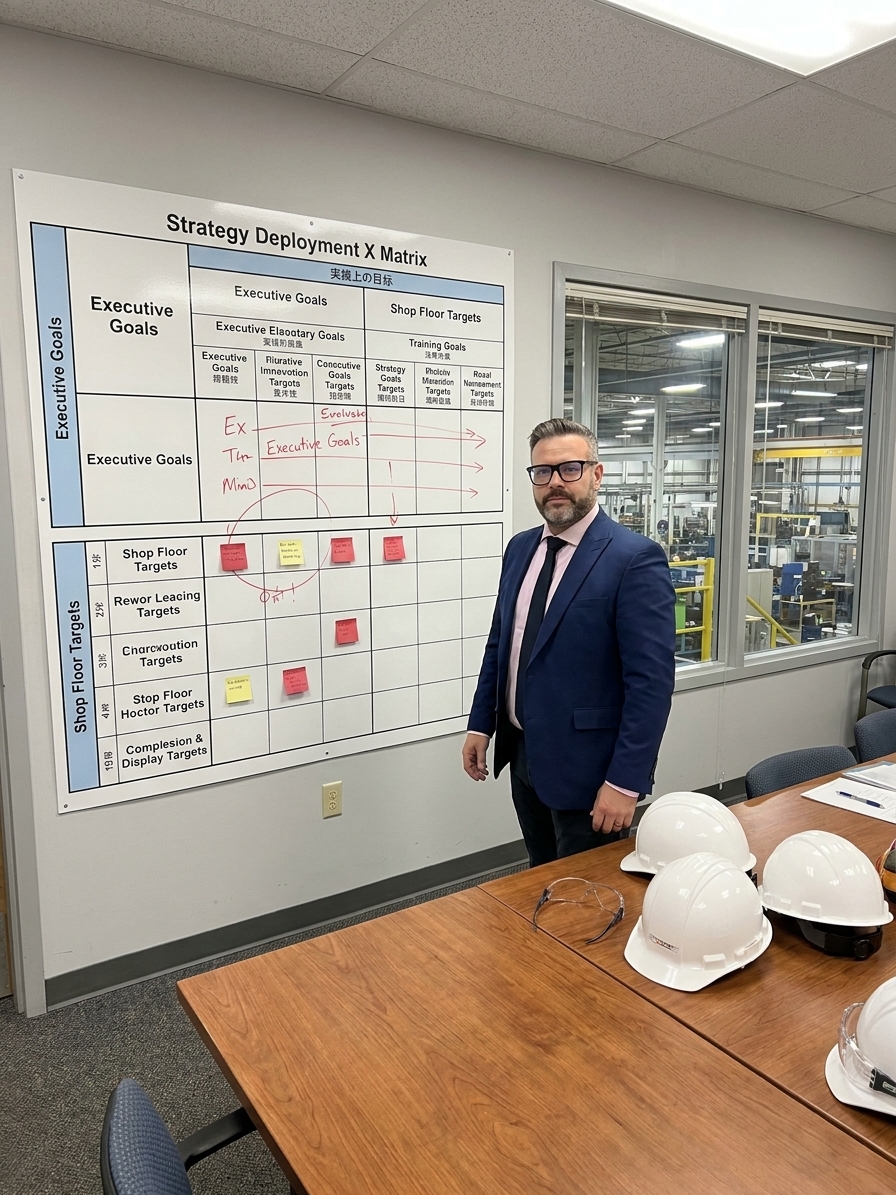
initiatives. It has a Hoshin Kanri matrix — the X-shaped catchball
diagram that’s supposed to cascade strategy from the executive suite to
the shop floor.
And then nothing happens.
Six months later, somebody finds the binder in a drawer. The KPIs on
page twelve haven’t been updated since March. The breakthrough
objectives — the ones that were supposed to transform the organization —
are stalled at 30% completion, and the 30% is generous because the
metrics were quietly redefined to make them look achievable. The
catchball sessions? They happened once, in February, and the feedback
from the floor was filed under “noted” and never revisited.
This is what Hoshin Kanri looks like when it fails. Not with a bang,
but with a binder.
What Hoshin Kanri
Was Actually Supposed to Do
Let’s give the methodology its due before we autopsy its corpse.
Hoshin Kanri — literally “compass management” or “policy deployment”
— emerged from the Japanese quality movement of the 1960s, drawing on
the planning cycles at Bridgestone, Toyota, and Komatsu. The idea was
deceptively simple: instead of letting strategy live in the executive
suite and operations live on the factory floor, with the two
communicating through a chain of increasingly distorted memos, you
create a structured process where direction flows down and reality flows
up.
The mechanism is the Hoshin X matrix — a single-page
document that forces you to connect three things:
- Long-term breakthrough objectives (3-5 year goals
that, if achieved, fundamentally change the organization’s competitive
position) - Annual improvement priorities (the specific,
measurable targets for this year that move you toward the
breakthroughs) - Top-level improvement measures and projects (the
actual work — who does what, by when, with what resources)
The X matrix isn’t the point. The point is the
process of building it. You start at the top with a
small number of strategic priorities — three to five, never more. Then
you do catchball: leadership tosses the strategic
direction to the next level down, who refine it, add operational detail,
and toss it back up. The metaphor is from baseball — you throw the ball,
they catch it, they throw it back. Each round of catch tightens the
alignment between intent and execution. Each round surfaces the
constraints, trade-offs, and feasibility issues that executives sitting
in a conference room couldn’t possibly see.
The discipline of Hoshin Kanri is in what it
excludes. You don’t get to put twenty priorities on the
matrix. You don’t get to declare that everything is important. You
choose three to five things that matter more than everything else, and
you accept that by choosing them, you are explicitly de-prioritizing
everything else. This is the act of strategy. If you can’t choose, you
don’t have a strategy — you have a wish list.
Done well, Hoshin Kanri creates an organization where the person on
the shop floor can tell you why their work matters to the company’s
three-year plan, and the executive can tell you what’s actually
happening on the production line this week. It creates what every
quality system claims to create but few deliver: genuine alignment
between strategy and execution.
How It Actually Plays Out
Now let’s talk about what happens in reality.
The Offsite produces the
Binder
The strategy offsite is where Hoshin Kanri goes to die. Not because
offsites are bad — some of the best strategic thinking happens when you
get the right people in a room away from daily firefighting. The problem
is what happens after.
Leadership emerges with genuine excitement. They’ve identified three
breakthrough objectives. They’ve built a draft X matrix. They feel
aligned — for the first time in months, maybe years. And they
communicate this to the organization the way you’d expect: a PowerPoint
deck, an all-hands meeting, maybe a printed summary card for every
employee.
And then they go back to their day jobs.
The binder goes on the shelf. The X matrix gets formatted by the
quality department into a “communications package” that is distributed
to managers, who glance at it and file it. The catchball sessions are
scheduled — but they compete with production meetings, customer audits,
supplier fires, and the seventeen other initiatives that are also
running. So they get shortened, postponed, or turned into one-way
briefings where the manager presents the strategy and the team nods.
The KPI Cascade That Isn’t
Here’s where the rot really sets in. Hoshin Kanri is supposed to
cascade a small number of strategic priorities through
every level of the organization, so that each level defines how it
contributes to the breakthrough objectives. What actually happens in
most organizations is that each level adds its own KPIs on top of the
strategic ones.
The CEO has five strategic priorities. Each VP adds departmental KPIs
— another ten or fifteen. Each manager adds team KPIs — another twenty
or thirty. By the time you reach the shop floor, the operator is staring
at a dashboard with forty metrics, half of which were dreamed up by
middle managers who wanted to look proactive in the last strategy
review. The operator has no idea which of these forty numbers matter and
which are noise. Neither does the manager, honestly.
This is the opposite of Hoshin Kanri. The whole point was to
reduce the number of priorities so that the
organization could focus its finite improvement energy on the things
that mattered most. Instead, the cascade has become an accumulation —
every layer adding weight until the structure collapses under its own
complexity.
The Review Cycle
That Became a Reporting Cycle
Hoshin Kanri includes a structured monthly review process — not to
punish people for missing targets, but to surface the gaps between plan
and reality early enough to act on them. The review is supposed to ask:
What’s working? What’s not? What do we need to change? What resources
need to shift?
In practice, the monthly Hoshin review becomes another status
meeting. People report their KPIs. Green means on track. Yellow means
slightly behind but “we have a plan.” Red means behind with no credible
plan — and red is so politically loaded that nobody ever reports it
honestly until the number is so bad it can’t be hidden.
The review doesn’t ask “should we change our approach?” It asks “are
we hitting the number?” And if the number isn’t being hit, the response
isn’t to rethink the strategy — it’s to add more effort to the same
approach that isn’t working, or to quietly adjust the target so it
becomes achievable, or to redefine the metric so it captures something
more favorable.
This is how you end up with organizations that hit 95% of their
Hoshin targets every year and still lose market share. They’ve optimized
the reporting, not the reality.
The Catchball That Never
Bounced
Catchball is the single most misunderstood element of Hoshin Kanri,
and the one most consistently executed wrong.
The idea is dialogue. Leadership proposes a direction. The next level
down examines it against their operational reality — do we have the
capacity? The capability? What would this require us to stop doing? They
push back, negotiate, and the strategy is refined. Back and forth, like
a ball in a game of catch.
What actually happens is that leadership throws the ball — and nobody
throws it back. The “catchball session” is a 45-minute meeting where the
VP presents the annual priorities, asks for “input,” and is met with
silence because everyone in the room knows that pushing back on the VP’s
priorities is a career-limiting move. Or the input is given but it’s of
the form “we support this direction” rather than “here’s why this target
isn’t achievable with our current capacity and here’s what we’d need to
make it work.”
Catchball requires two things that most organizational cultures don’t
have: the psychological safety to push back upward, and the intellectual
honesty to admit that a target might be wrong. Without those, catchball
is just a one-way broadcast with a feedback form nobody fills out
honestly.
The
Symptoms: How to Know Your Hoshin Kanri Is Dead
If you’re reading this and wondering whether your organization’s
Hoshin Kanri process is actually working, here are the diagnostic
signs:
Your X matrix has more than seven priorities. The
moment you exceed five to seven, you no longer have a strategy. You have
a comprehensive list. Comprehensive lists don’t focus effort — they
dilute it.
Nobody can explain the connection between their daily work
and the breakthrough objectives. Ask a supervisor on your
production floor what the company’s top three strategic priorities are
this year. If they can’t answer — or if they give you three different
answers from three different people — your cascade has failed. The
information never reached the people who are supposed to execute it.
Your monthly review spends more time on variance reporting
than on course correction. If 80% of the meeting is people
explaining why numbers are what they are, and 20% is discussing what to
do differently, your review process has become an accounting exercise.
It should be the reverse.
The same priorities appear year after year with the same
targets. If “improve first-pass yield” is a breakthrough
objective for the third year in a row, and the target is still “95%” —
the same target you set three years ago — you haven’t made progress.
You’ve institutionalized the gap.
Nobody has ever killed a project during a Hoshin
review. This is the tell. If your review process has never
resulted in stopping an initiative that isn’t working — reallocating its
resources to something that might — then you don’t have a review
process. You have a monitoring process. Monitoring isn’t management.
What Actual Hoshin Kanri
Looks Like
I’ve seen it work. Not often, but enough times to know it’s not a
fantasy.
The organizations where Hoshin Kanri delivers are the ones that treat
it as a conversation, not a document. The X matrix
exists, but it’s on a wall — a physical wall, in a physical room — and
people gather around it. Not once a year. Every month. And the
conversation isn’t “are we hitting the number?” It’s “what is the number
telling us about our assumptions?”
These organizations have leaders who are willing to say, in front of
their teams, “we set this target six months ago, and the data is telling
us it was wrong. Let’s talk about what that means.” They have teams that
are willing to say, in front of their leaders, “we can hit this target,
but only if we stop doing these three other things — and here’s what we
recommend stopping.”
The matrix is small. Three breakthrough objectives. Five annual
priorities. Ten projects max. The discipline of keeping it small is the
discipline of making choices — and making choices is the act that
distinguishes strategy from aspiration.
The review focuses on the gaps. Not the green KPIs —
those are working, move on. The gaps are where the learning lives. A gap
between target and actual isn’t a failure; it’s information. What
assumption did we make that turned out to be wrong? What constraint did
we underestimate? What capability did we think we had that we don’t?
This is the conversation that Hoshin Kanri was designed to enable — and
it’s the conversation that most organizations never have.
The Path Back
If your Hoshin Kanri process has become a binder exercise, the path
back isn’t to redesign the matrix or buy better software. The path back
is to restart the conversation.
Cut your priorities in half. Right now. Whatever you
have on your current X matrix, remove half of them. Not forever — for
this year. The remaining priorities get the full focus of your
improvement resources. The ones you removed get nothing. This is the act
of choosing. It will be painful. People will object. That’s how you know
it’s working.
Kill a project this month. Find one initiative
that’s been limping along at 30% completion for months, absorbing
resources without delivering results. Kill it. Reallocate those
resources to one of your remaining strategic priorities. Announce it
publicly. Make it clear that stopping things that aren’t working is not
only acceptable — it’s expected.
Ask your operators. Walk the floor. Ask five
operators: “What are the company’s top three priorities this year?”
Write down their answers. If you get five different answers, or five
blank stares, your cascade has failed — and no amount of matrix redesign
will fix it. You need to simplify the message, repeat it more often, and
connect it to daily work in language that makes sense at the point of
execution.
Change the review question. Stop asking “are we on
track?” Start asking “what have we learned?” The first question produces
defensive reporting. The second produces genuine reflection. You’ll know
the shift is working when people start bringing problems to the review
voluntarily, instead of hiding them.
The Deeper Lesson
Hoshin Kanri fails for the same reason every quality system fails:
organizations treat the tool as the outcome. The X matrix is not the
strategy. The catchball session is not the alignment. The monthly review
is not the improvement. These are mechanisms — structures that create
the opportunity for strategic thinking, dialogue, and course correction.
But they only work if the people using them are actually thinking,
actually dialoguing, and actually willing to correct course.
The binder on the shelf is not Hoshin Kanri. It’s the corpse of
Hoshin Kanri. What’s alive is the conversation — the messy,
uncomfortable, honest conversation about what matters most, what’s
working, what isn’t, and what we’re going to do about it. That
conversation can happen without a matrix. It can happen in a hallway, on
a shop floor, in a break room. The matrix just makes it visible.
But here’s the thing about visibility: it works both ways. A matrix
that’s visible but ignored is worse than no matrix at all. It signals to
the organization that strategy is something that gets documented, not
something that gets done. And once that signal is sent, it’s very hard
to unsend.
So the question isn’t whether your Hoshin Kanri process exists. The
question is whether it’s alive. And if it’s not — if it’s a binder, a
deck, a review meeting that nobody wants to attend — then the most
strategic thing you can do is kill the process and start the
conversation.
Not the matrix. Not the cascade. Not the KPIs. The conversation.
That’s where strategy actually lives.
About the Author: Peter Stasko is a Quality
Architect with over 25 years of experience in manufacturing quality,
process improvement, and strategic deployment. He has implemented and
rescued Hoshin Kanri systems across automotive, electronics, and
industrial manufacturing environments, and writes about the gap between
what quality frameworks promise and what they actually deliver.