The
Principle Everyone Quotes and Nobody Practices
Jidoka is the second pillar of the Toyota Production System, standing
alongside Just-In-Time as one of the two foundational concepts that
built the most studied manufacturing system in human history. Sakichi
Toyoda invented it in the early 1900s when he designed a loom that would
automatically stop when a thread broke. No operator needed to watch the
machine. No supervisor needed to sound an alarm. The machine detected
its own defect and halted production.
That invention changed manufacturing forever. It also created a
principle so simple, so elegant, and so profoundly misunderstood that
most organizations who claim to implement it today are performing
theater.
The principle is this: build quality in, don’t inspect it
in. When a defect occurs, stop. Fix the problem. Then restart.
The machine — or the process, or the line, or the person — has the
authority to halt production the moment something goes wrong. Not after.
Not at the end of the shift. Not at final inspection. Immediately.
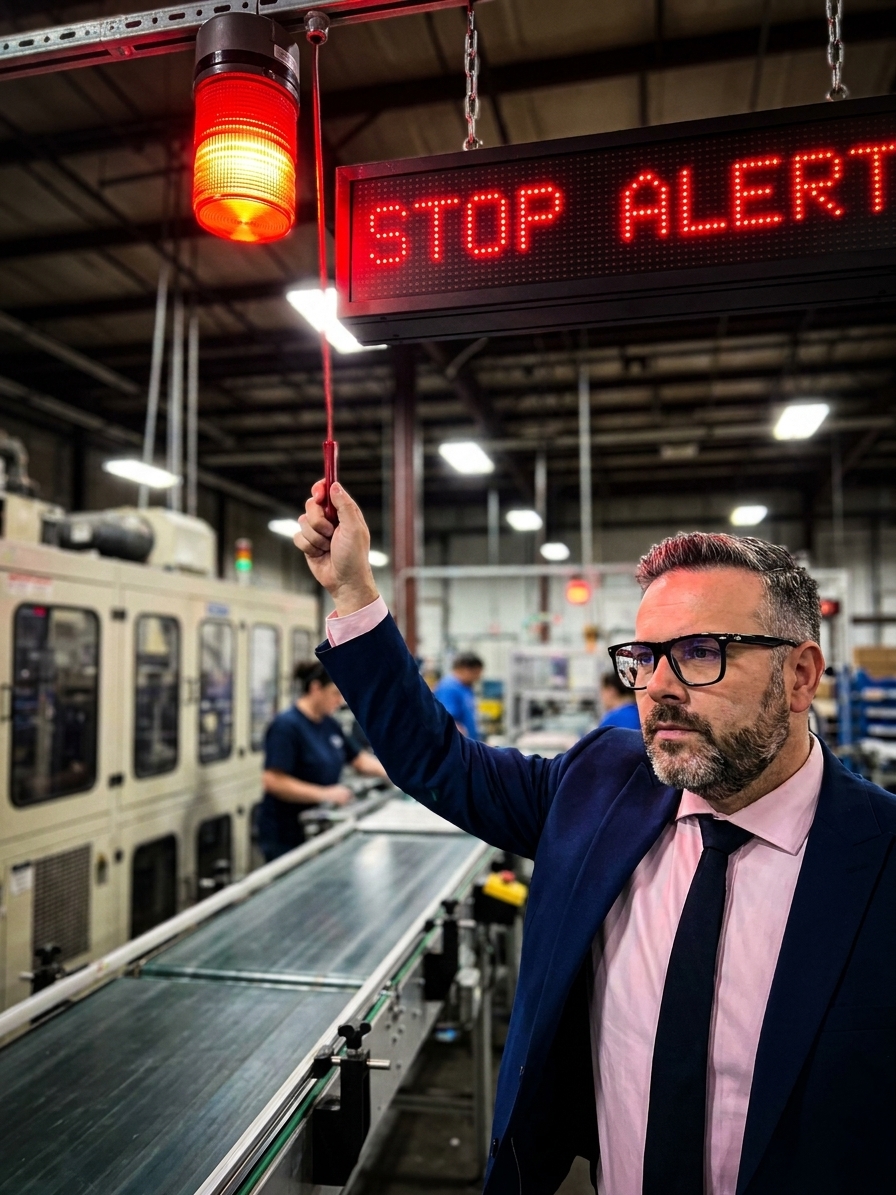
Yet walk into most factories today and you will find that the andon
cord exists, the andon light exists, the andon procedure exists in a
beautifully documented SOP that lives in a binder nobody opens — and
when the light turns red, everyone ignores it. The line keeps running.
The defect keeps flowing. The supervisor waves it off because the
schedule can’t afford a stoppage. And the principle that was supposed to
protect quality becomes the most expensive decoration in the plant.
What Jidoka Actually Means
The word “jidoka” is a Japanese term that doesn’t translate cleanly
into English. It’s often rendered as “autonomation” — a portmanteau of
“autonomous” and “automation” — meaning automation with a human touch.
The idea is that a machine operates autonomously but has the built-in
intelligence to detect abnormalities and stop itself when something is
wrong.
But jidoka extends beyond machines. In a broader sense, it means
any process, human or machine, that has both the authority and
the mechanism to stop when a defect is detected. The assembly
worker who spots a misaligned part and pulls the cord. The welder who
notices inconsistent penetration and flags it. The paint booth operator
who sees orange peel and shuts down rather than running defective parts
through the cure oven.
Jidoka has four essential components, and every single one must
function for the system to work:
1. Detect the abnormality. The machine sensor
triggers. The operator sees something wrong. The gauge reads outside
spec. Something physical and measurable identifies that the process has
deviated from standard.
2. Stop production. The machine halts. The line
stops. The operator pulls the andon cord. Production ceases — not slows,
not continues at reduced speed — stops.
3. Fix the immediate problem. The supervisor
responds. The root cause is investigated on the spot. The broken tool is
replaced. The misloaded part is corrected. The jammed mechanism is
cleared. The process returns to normal.
4. Investigate and prevent recurrence. The team asks
why it happened. The countermeasure is implemented. The standard work is
updated. The problem is added to the lessons-learned database. The fix
becomes permanent.
When all four steps happen reliably, jidoka creates a self-correcting
system where defects are caught at the source, root causes are addressed
immediately, and quality improves continuously. When any step fails —
particularly step 2 — the entire system collapses into the thing it was
designed to prevent: a factory that produces defects and deals with them
later.
The Five Ways
Organizations Kill Jidoka
After 25 years in quality management, I have watched organizations
implement jidoka in every conceivable way. Most fail. Not because the
principle is flawed, but because organizations systematically undermine
the conditions jidoka needs to function. Here are the five most common
failure modes:
Failure 1: The Andon That
Cries Wolf
An automotive supplier I consulted with had a beautifully designed
andon system — cord at every station, overhead lights, digital display
board, the works. In their first month of implementation, operators
pulled the cord 847 times. Supervisors responded to 847 calls. Of those,
approximately 830 were for minor issues that could have been resolved
without stopping the line: a bin needing refill, a question about a work
instruction, a tool that needed adjustment.
By month two, supervisors stopped responding quickly. By month three,
they stopped responding at all. By month four, operators stopped pulling
the cord. And in month five, a real defect — a critical torque
specification missed on 200 brake caliper housings — flowed straight
through the line because nobody pulled the andon. The system had trained
everyone to ignore it.
The lesson: an andon system that signals everything signals
nothing. Jidoka requires clear, specific, well-defined triggers
for stopping. Not every deviation warrants a line stop. The organization
must classify what constitutes a stop-worthy event and what constitutes
a call-for-help event, and they must be different signals with different
responses.
Failure 2: The
Schedule That Punishes Stopping
A tier-one supplier to a major OEM implemented jidoka as part of
their lean transformation. Operators were trained. Cords were installed.
The first week, production stopped 23 times for genuine quality issues.
The plant manager looked at the production numbers, saw they had missed
their daily target by 12%, and announced at the next morning meeting
that “we need to be more selective about when we stop the line.”
That single sentence killed jidoka more effectively than removing the
cords entirely. Every operator heard the message: stopping the line is
bad. Missing quality targets is acceptable. Hitting production numbers
is what matters. Within two weeks, the andon pulls dropped to near zero.
The quality problems didn’t drop — they just stopped being caught at the
source and started being found at final inspection, where rework cost
ten times more.
The lesson: if your production schedule doesn’t account for
jidoka stops, your jidoka system is fiction. Toyota builds
expected andon response time into its takt time calculations. They
expect stops. They plan for them. They staff for them. When you treat
every stop as an unexpected disruption rather than a designed-in feature
of the system, you create a culture where the path of least resistance
is to let defects pass.
Failure 3: The Response
That Never Comes
Jidoka depends on a rapid, reliable response. When the machine stops
or the cord is pulled, someone must arrive — fast. Toyota’s standard is
that a team leader responds within seconds, not minutes. The operator is
never left standing alone, waiting for help, watching the production
clock tick.
I visited a plant where the andon system routed alerts to a single
shift supervisor who was responsible for 40 stations across two
buildings. When I asked what happened when two alerts came
simultaneously, the supervisor laughed and said, “I go to whichever one
is loudest.” The system had been designed without considering response
capacity. The andon light would burn red for 15, 20, sometimes 30
minutes while the supervisor was occupied elsewhere. Operators learned
that pulling the cord meant standing idle for half a shift, so they
stopped pulling it.
The lesson: jidoka is not just a detection system — it’s a
response system. If you cannot guarantee a rapid, competent
response to every stop, you don’t have jidoka. You have an expensive
alarm that nobody listens to. Response capacity must be designed into
your organizational structure. Team leaders must be positioned,
available, and trained to respond immediately. This is not a cost — it
is the mechanism that makes the entire system work.
Failure 4: The Fix
That Addresses Symptoms
When the line stops and the supervisor arrives, what happens next
determines whether jidoka delivers value or just wastes time. If the
response is “clear the jam and restart,” then you have the world’s most
expensive fire alarm — it detects the fire, summons the firefighters,
and then the firefighters pour water on the smoke while the fire keeps
burning underneath.
A medical device manufacturer had a molding line where a particular
cavity repeatedly produced short shots. The andon would trigger, the
technician would arrive, clear the blocked nozzle, restart the line, and
document the event. This happened 14 times over three shifts before
someone finally asked why the nozzle kept blocking. The investigation
revealed a worn feed screw that was causing inconsistent melt
temperature. The real fix cost $4,200 and two hours of downtime. The
symptom fixes had cost 14 stoppages, approximately 9 hours of lost
production, and an unknown number of defective parts that had been
reworked or scrapped.
The lesson: every jidoka stop is a root cause investigation
opportunity. If your response protocol is “fix and restart”
without asking why it happened, you will fix the same problem repeatedly
until the underlying cause finally destroys something expensive enough
to force a real investigation. The fourth step of jidoka — investigate
and prevent recurrence — is the step most organizations skip, and it is
the step that generates the actual return on investment.
Failure 5: The
Culture That Blames the Messenger
The most insidious failure mode is cultural. When an operator pulls
the andon cord and the supervisor’s first response is frustration — a
sigh, an eye roll, a comment about how “we’re behind schedule now” — the
operator learns that stopping the line is socially punished. No
procedure, no SOP, no training program can overcome that learning. The
operator will think twice before pulling the cord next time. And the
time after that, they won’t think about it at all.
Toyota celebrates andon pulls. They publicly recognize operators who
catch defects. They understand that every andon pull is a defect that
didn’t reach the customer, and that information is gold. Most
organizations treat andon pulls as disruptions to be minimized. The
difference in mindset is the difference between a quality culture and a
production culture wearing a quality costume.
The lesson: your response to jidoka stops sends a louder
message than any training program. If you want people to stop
the line when they see a problem, you must make it psychologically safe
— even rewarding — to do so. The moment stopping the line becomes
something people are reluctant to do, your quality system has lost its
primary defense.
The Mathematics of
Stopping vs. Not Stopping
Let me make this concrete with numbers, because numbers are the
language that changes minds in manufacturing.
Consider a line running at 60 parts per hour with a first-pass yield
of 95%. That means 3 defective parts per hour are being produced. If
those defects are caught at the source through jidoka, the cost is the
stoppage time — let’s say 5 minutes per stop, so 15 minutes of lost
production per hour, or roughly $450 in lost production time at a
typical burdened rate.
If those same 3 defects are NOT caught at the source and instead flow
downstream, here’s what happens:
- They may be caught at final inspection: rework cost averages $15-50
per part depending on complexity. - They may escape to the customer: warranty, return, and reputation
costs average $500-5,000 per escaped defect in automotive, and far more
in aerospace or medical devices. - The root cause remains unaddressed, so the defect rate stays at 5%
or worsens.
The math is brutal and obvious: stopping the line at the
source is always cheaper than dealing with defects downstream.
Always. Yet organizations routinely make the false economy calculation
of “we can’t afford to stop” when the reality is they can’t afford not
to.
Implementing Jidoka
That Actually Works
If you want jidoka that functions — not as theater but as a genuine
quality system — here is what it requires:
Define stop conditions clearly. Not every anomaly is
a stop event. Create a specific, unambiguous list of conditions that
warrant a line stop: critical dimensions out of spec, safety concerns,
repeated minor defects indicating a systemic issue, missing or incorrect
components. Separate these from call-for-help conditions that need
assistance but don’t require stopping.
Design response capacity into your structure. Every
zone should have a designated first responder who is available — not
“will try to get there” but is physically positioned and assigned to
respond within a defined time. Calculate the expected stop frequency and
ensure you have enough responders to handle simultaneous events.
Build stop time into your schedule. If your
production plan assumes zero stops, your production plan is wrong.
History tells you your stop rate. Build it into takt time. Staff for it.
When the schedule accounts for stops, stops don’t feel like emergencies
— they feel like the designed-in feature they are.
Mandate root cause investigation for every stop. Not
a 30-minute ritual. A 5-minute conversation: What happened? Why? What
will prevent it? Document it. Track recurring issues. When the same root
cause appears three times, escalate to a formal problem-solving
process.
Reward stops, don’t punish them. Track andon pulls
as a positive metric — “defects caught at source” — not a negative one.
Recognize operators who pull the cord. Make it clear through both words
and actions that you would rather stop 100 times and ship perfect
product than run continuously and ship defects.
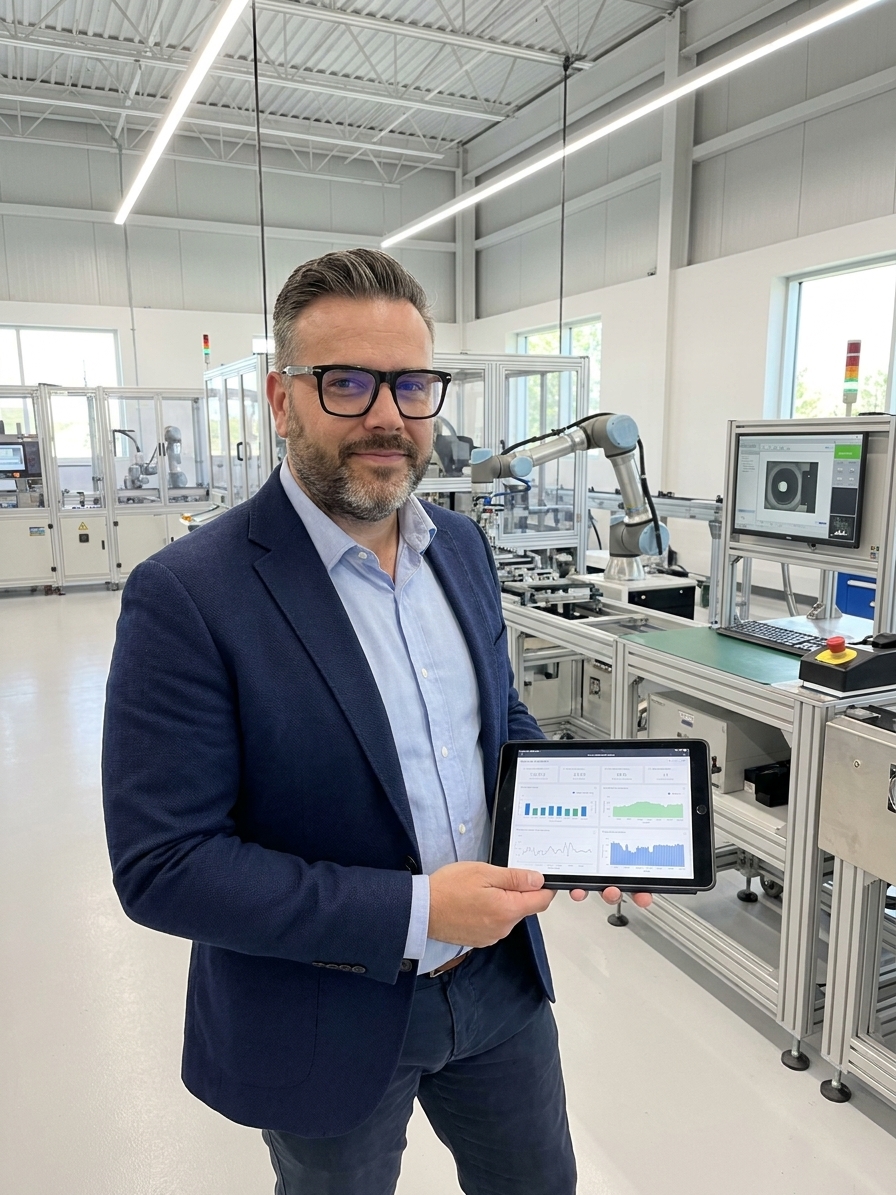
Use technology to support, not replace, human
judgment. Machine vision, IoT sensors, and automated defect
detection are powerful tools. But jidoka’s strength is not just
mechanical detection — it’s the human judgment that decides what to do
when something goes wrong. Don’t use technology to bypass the human; use
it to give the human better information to act on.
The Deeper Philosophy
Jidoka embodies a principle that extends far beyond manufacturing:
the idea that quality is built in at the source, not inspected
in at the end. This principle applies to software development
(fail fast, catch bugs at commit time not at production), to healthcare
(address complications immediately, not in the recovery room), to
construction (fix a framing error when it’s discovered, not after the
drywall goes up), to any process where defects compound the further they
travel from their origin.
The cost of a defect increases by an order of magnitude at each stage
it passes undetected. A defect caught at the source costs minutes. The
same defect caught at assembly costs hours. Caught at test, it costs
days. Caught by the customer, it costs relationships.
Jidoka is the mechanism that catches defects at the cheapest possible
point: the moment they occur. But it only works when the organization
has the discipline to stop, the courage to investigate, and the wisdom
to understand that a line that never stops is not a high-quality line —
it’s a line that has stopped noticing its own defects.
Sakichi Toyoda’s loom was invented over a century ago. The principle
it embodied — stop when something is wrong, fix it, prevent it from
recurring — remains the most powerful quality tool ever conceived. It is
also, a century later, the one most organizations still cannot bring
themselves to follow.
The question is not whether your machines can detect defects. Modern
technology makes detection trivial. The question is whether your
organization can tolerate the disruption of stopping — and whether you
have built a system where that disruption is expected, planned for, and
valued as the primary mechanism for continuous improvement.
If your andon light is red right now and nobody is moving, you
already know the answer.
About the Author: Peter Stasko is a Quality
Architect with over 25 years of experience in manufacturing quality
management, process optimization, and continuous improvement across
automotive, aerospace, and industrial sectors. He has implemented
jidoka, lean manufacturing, and Toyota Production System principles in
facilities across Europe and North America.