Stop the line. That is the promise of jidoka — the lean manufacturing
principle that gives every machine and every operator the authority to
halt production the moment something goes wrong. It sounds noble in a
conference room. It sounds expensive on a shop floor running at full
capacity with a customer waiting.
Jidoka, often translated as “autonomation with a human touch,”
represents one of the two pillars of the Toyota Production System
alongside just-in-time production. Sakichi Toyoda built the concept into
his automatic looms in the early 1900s: when a thread broke, the machine
stopped itself. No defective fabric wove itself into existence. No
operator needed to watch every machine constantly. The machine possessed
enough intelligence to detect an abnormality and cease operation.
A century later, the principle remains powerful — yet most
organizations that claim to practice jidoka have hollowed it out into
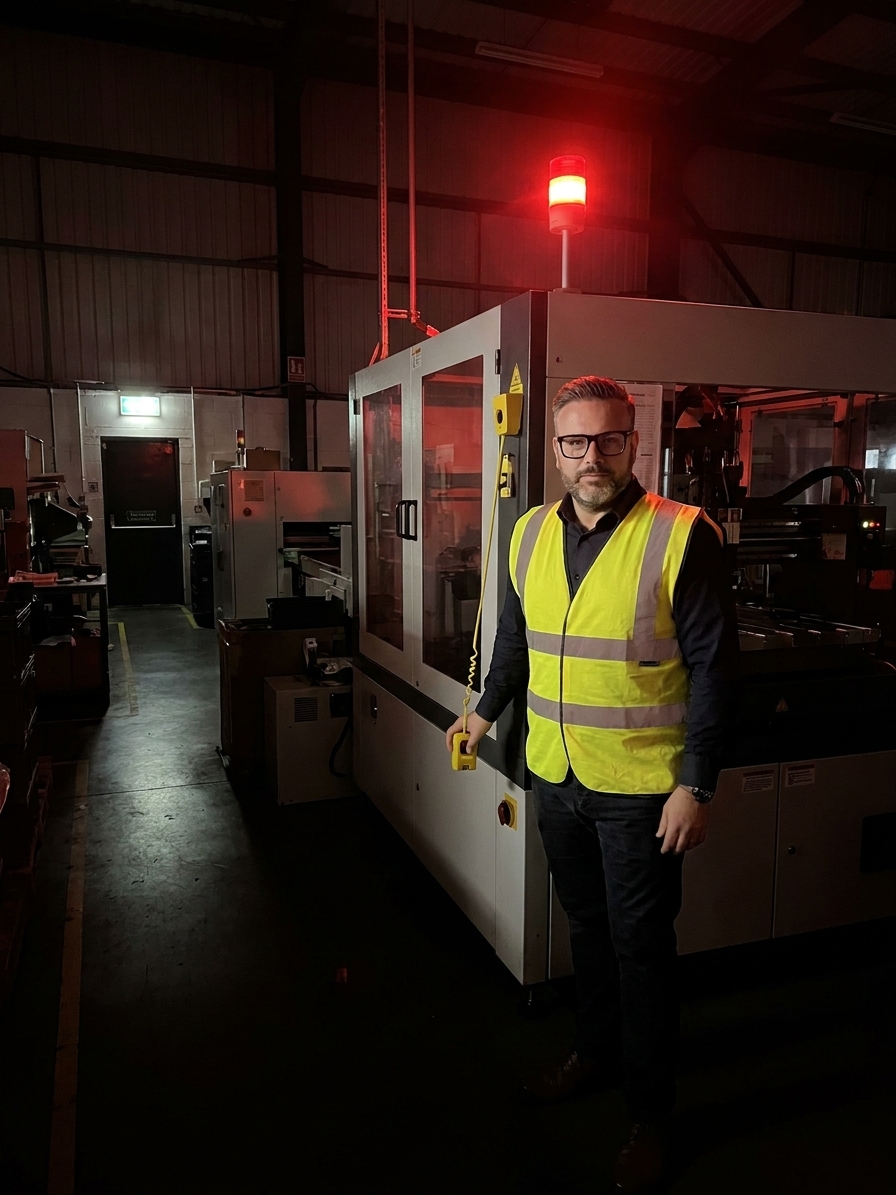
something unrecognizable. The andon cord exists, but nobody pulls it.
The alarm sounds, but somebody resets it. The line stops, and a
supervisor rushes over to restart it as quickly as possible without
investigating why it stopped.
This article examines what happens when jidoka degrades from a
quality philosophy into a performance metric — and how to rebuild it
into something that actually works.
The Original Genius of
Jidoka
Sakichi Toyoda’s autocop mechanism for looms was deceptively simple.
A thin metal blade sat across each warp thread. When a thread broke, the
blade dropped, triggering a mechanical stop. The loom halted instantly.
No supervisor needed to patrol the aisles. No quality inspector needed
to hunt for defects in finished cloth. The process itself prevented
defects from forming.
Four principles defined this early jidoka:
- Detect the abnormality — the machine or operator
senses that something is wrong - Stop production — work halts immediately, not after
the current batch finishes - Fix or flag the problem — someone responds to
address the root cause - Prevent recurrence — a countermeasure ensures the
same abnormality cannot pass through again
Notice the sequence. Detection comes first. Stopping comes second.
Investigation comes third. Prevention comes fourth. Most companies that
implement jidoka get the detection part right — they install sensors,
error-proofing devices, and visual signals. Then they stumble on step
two because stopping production feels like failure rather than
success.
How Jidoka Unravels in
Practice
The Andon Cord That Nobody
Pulls
Walk through a factory that installed an andon system five years ago.
Ask operators when they last pulled the cord. Watch the shift in body
language. Some will laugh. Others will look at their supervisor before
answering. A few will admit honestly: pulling the cord brings more
trouble than it solves.
Here is what typically happens. An operator notices a problem — a
misaligned part, a machine running hot, a tool that has drifted out of
specification. They pull the andon cord. The line stops. A team leader
arrives within sixty seconds, as the standard work demands. So far, so
good.
Then the pressure begins. Production targets loom. The shift is
already behind schedule. The team leader asks: “Can we fix this while
the line runs?” The operator says the problem is intermittent and
probably won’t recur. The team leader overrides the stop. The line
restarts. The defect continues producing itself at intervals nobody
tracks because the line is moving again and everybody feels
relieved.
After three or four cycles of this, the operator learns the real
lesson: pulling the cord makes you the person who slowed production. So
they stop pulling it. Small problems accumulate. Eventually a major
defect reaches the customer, and everyone wonders why the andon system
failed to catch it.
The Alarm Fatigue Problem
Modern manufacturing equipment generates hundreds of alerts per
shift. Vision systems flag cosmetic deviations. Temperature sensors
trigger warnings. Cycle-time monitors beep when an operation takes 0.3
seconds longer than standard. Operators sit behind dashboards that look
like cockpit displays, bathed in amber and red indicators.
The human brain cannot triage that volume of signals effectively.
Research on alarm fatigue in healthcare — where nurses hear 700+ alerts
per shift — shows that people desensitize rapidly. They develop mental
filters. They mute alerts. They learn which warnings actually matter and
which ones are background noise.
Manufacturing suffers the same desensitization. When every deviation
triggers an alarm, no deviation feels urgent. Operators categorize
alerts into “real problems” and “the system being overly sensitive.”
They are usually right — but the one time they silence a genuine
critical alert, a defect escapes.
Jidoka requires that every stop signal means something. When the
signal-to-noise ratio drops, the entire system breaks.
The Reset Culture
A machine stops. The display shows fault code 7741. The operator
knows what to do: press the yellow reset button, wait three seconds,
press the green start button. The machine hums back to life. Production
resumes. The fault code gets logged in the maintenance system, where it
joins thousands of other entries that nobody analyzes.
This is reset culture — the practice of clearing faults without
investigation. It is the antithesis of jidoka, yet it thrives in
organizations that measure uptime as a primary KPI. Maintenance teams
get bonused on machine availability. Operators get evaluated on parts
produced per shift. Neither group gets rewarded for stopping to ask why
a fault occurred.
Reset culture creates a dangerous illusion: the machines are running,
therefore everything is fine. In reality, the machines are running
because nobody is willing to stop them. Defects are being produced and
passed downstream, where they become someone else’s problem — usually
the customer’s.
What Real Jidoka Looks Like
Organizations that practice jidoka effectively share several
characteristics that distinguish them from those going through the
motions.
Authority Lives at the
Source
In a functional jidoka system, the operator’s authority to stop the
line is absolute and unquestioned. No supervisor can override it. No
production target can trump it. When an operator pulls the andon cord,
the response from leadership is “thank you” — not “was that really
necessary?”
Toyota’s plants operate this way. Every team member can stop the
line. In fact, Toyota tracks andon pulls as a positive metric — a sign
that people are engaged and catching problems early. Plants that report
zero andon pulls over long periods trigger audits, because a complete
absence of reported problems indicates either complacency or fear, not
perfection.
Contrast this with organizations where pulling the andon cord
requires permission. If an operator must call a supervisor, explain the
situation, and get approval before stopping production, the threshold
for stopping becomes impossibly high. Minor problems get ignored. By the
time a problem is severe enough to justify the bureaucratic overhead of
stopping, the damage is already extensive.
Stops Lead to
Structured Problem Solving
When a line stops under jidoka, the response follows a defined
protocol — not a frantic scramble. A typical sequence:
- Immediate triage (60 seconds): The team leader
arrives, assesses whether this is a known issue with an existing
countermeasure or a new problem. - Quick fix or quarantine (5 minutes): If a standard
fix exists, apply it. If not, mark the affected parts for inspection and
isolate them. - Root cause investigation (same shift): Before the
shift ends, conduct a preliminary 5 Whys or similar analysis. Document
what happened. - Countermeasure (within 24 hours): Implement a
temporary countermeasure to prevent recurrence. Schedule the permanent
fix.
The critical element is speed of investigation. When problem solving
happens immediately, while the evidence is fresh, root causes emerge
naturally. When investigation is deferred to a weekly quality meeting,
memories fade, details blur, and the analysis devolves into
guesswork.
Machines Are Designed
to Stop Themselves
True jidoka builds detection and response into the equipment itself.
Sensors detect anomalies. Limit switches confirm part presence. Torque
monitors verify fastener tightness. When a process parameter drifts
outside specification, the machine halts automatically — no operator
judgment required.
This requires investment in machine design that many companies
resist. Adding error-detection sensors to a stamping press costs money.
Engineering a packaging line to stop when a carton is missing its insert
adds complexity. The financial justification is straightforward —
preventing one defect saves the cost of rework, scrap, warranty claims,
and customer dissatisfaction — but capital expenditure committees often
defer these investments in favor of capacity upgrades that show clearer
ROI.
The result is a jidoka system that depends entirely on human
vigilance. People are poor substitutes for engineered error detection.
They get distracted, fatigued, and complacent. Machines, when properly
designed, do not.
Rebuilding Jidoka
After It Has Degenerated
If your organization has an andon system that nobody uses, an alarm
network that everyone ignores, or a reset culture that masks underlying
problems, you can rebuild — but the process requires patience and
visible leadership commitment.
Start With Trust
Operators will not stop the line if they believe stopping carries
personal risk. Rebuilding trust takes time and consistent behavior from
management. Start by publicly celebrating every line stop. When an
operator catches a problem, recognize them in the shift handover
meeting. Share the cost avoidance — “your stop prevented an estimated
200 defective units from reaching final assembly.” Make it clear that
catching problems is a valued contribution, not an inconvenience.
Expect skepticism at first. Operators who have been penalized for
stopping production will test whether the new behavior is genuine or
temporary. Consistency over three to six months begins to shift culture.
Full transformation takes longer — plan for a multi-year journey.
Reduce Alarm Noise
Audit every alert and alarm in your facility. Classify each one as
critical, informational, or obsolete. Critical alarms should stop the
line and require human intervention. Informational alerts should log to
a database for trend analysis without interrupting production. Obsolete
alarms — alerts for conditions that no longer exist or have been fully
error-proofed — should be removed entirely.
A useful target: operators should hear no more than a handful of
critical alarms per shift. If your facility generates hundreds of
alerts, the system is screaming, not communicating.
Track Stops as Success
Metrics
Reframe your metrics. Instead of measuring only uptime and output,
track:
- Number of andon pulls per shift (target: nonzero —
zero means people aren’t reporting) - Problems caught at the source versus found
downstream (target: trending upward) - Time from stop to root cause identification
(target: same shift) - Recurrence rate of the same fault (target: trending
downward — one-time stops that lead to permanent countermeasures)
These metrics tell a different story than traditional production
dashboards. They reward detection, investigation, and prevention rather
than speed at all costs.
Engineer the Stops
For your highest-risk processes — those where defects are most costly
or most difficult to detect downstream — invest in automated error
detection that stops the machine without human intervention. Sensor
technology has become increasingly affordable. Machine vision systems
that once cost six figures now run on industrial cameras and open-source
software. The investment calculation should include not just defect
prevention but also the freed-up human attention — operators who no
longer need to watch for problems they cannot reliably catch can focus
on improvement work instead.
The Philosophical Core
Jidoka rests on a simple but counterintuitive idea: stopping
production to fix a problem is more efficient than continuing to produce
with a defect. This seems wrong to managers trained to maximize output.
It feels like you are losing money every second the line sits idle.
But the math is clear. A defect caught at the source costs a fraction
of one caught at final inspection, which costs a fraction of one caught
by the customer. The cost cascade is exponential — a bad weld fixed at
the welding station costs minutes. The same bad weld found during
pressure testing costs hours. Found during a warranty claim, it costs
thousands and damages your reputation.
Jidoka makes the economic case visible by making the invisible
visible. When a machine stops, the problem becomes impossible to ignore.
When a defect passes downstream, it becomes invisible — absorbed into
rework budgets, scrap allowances, and warranty reserves that nobody
questions because they have always been there.
The organizations that practice jidoka successfully understand this.
They see line stops not as interruptions but as information — real-time
signals from the process about where to focus improvement energy. Every
stop is a gift. Every defect caught at the source is a customer who
never knows your process struggled.
The organizations that practice jidoka in name only have it
backwards. They see stops as interruptions. They push to restart
quickly. They silence alarms. They override operator judgment. And
slowly, inevitably, the defects accumulate — in the rework area, in the
scrap bin, in the returned-goods warehouse, and in the customers who
quietly start looking for alternative suppliers.
Jidoka is not a system you install. It is a culture you build — one
stop at a time, one problem solved at the source, one operator trusted
to say “something is wrong” and be heard.
Peter Stasko is a Quality Architect with over 25
years of experience in manufacturing quality management, process
improvement, and lean implementation. He has helped organizations across
automotive, electronics, and industrial sectors build quality systems
that work in practice — not just on paper. His focus is bridging the gap
between theory and execution, ensuring that tools like jidoka deliver
measurable value rather than becoming another initiative that fades into
the background.